
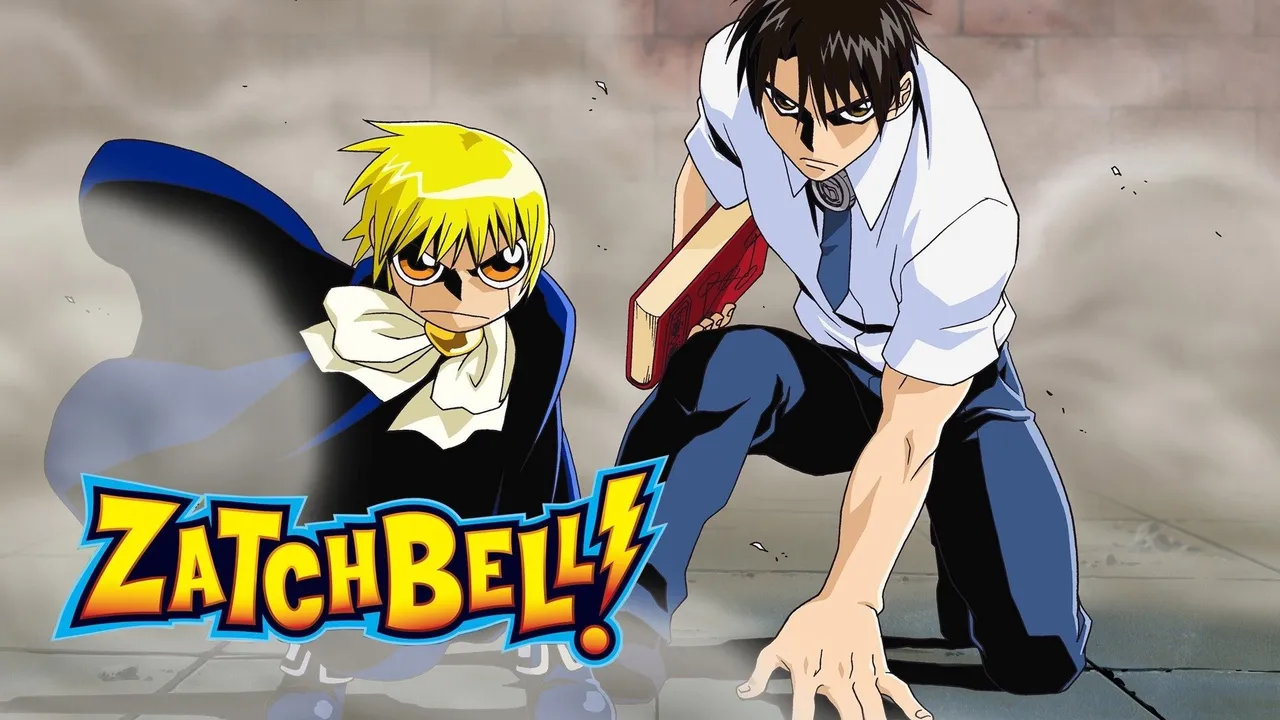



 TV · 2003
Zatch Bell!
A lonely middle-school genius bonds with a mysterious mamodo boy and enters a thousand-year contest of spellbook battles to decide the next king of another world.
Zatch Bell! follows Kiyo Takamine, a brilliant but isolated Japanese middle-schooler whose life changes when he discovers a small blond child named Zatch living near his home. Zatch is a mamodo from another dimension who has lost his memories and carries a red spellbook that only Kiyo can read. Together they learn that mamodo children and their human partners must fight in a tournament held once every thousand years; the last pair standing will make their mamodo the king. Early episodes establish Kiyo’s social struggles, Zatch’s cheerful but impulsive nature, and the first lightning-based spells they unleash against rival mamodo. The pair travel, train, and gradually form a genuine partnership while facing opponents who seek the same crown.
As the mamodo battles intensify, Kiyo and Zatch encounter other human-mamodo teams with unique powers, some friendly and others ruthless. Zatch’s missing past and the true stakes of the kingship contest become clearer through successive confrontations and alliances. Kiyo grows from a withdrawn prodigy into a more confident partner who protects Zatch and the people around them, while Zatch’s kindness influences even hardened rivals. Later arcs expand the cast of mamodo, deepen the rules of the spellbooks, and push the duo toward larger confrontations that test their loyalty and strength. The series keeps its focus on action, comedy, and the evolving bond between the boy and his otherworldly friend as they chase the throne.
Creator: Takahiro Sakurai, Ikue Otani
Click any of the following icons below to rent or stream it!
Oops! Is this show WOKE?
Only an account holder or member can file. Cite a scene, a line, or a pattern. Other account holders +1 or −1 that argument, once each. The show is not WOKE until enough of them have given a +1. Enough −1s remove the write-up, and it is no longer shown.
Sign in to file a woke label. One of each criterion per member.
Comments and reviews
Report a mistake
Same rule as woke labels: one report, a written reason, and the community +1 or −1 it — once per member. A net +5 applies the change. Editors can hold it for review, or apply it immediately.
No mistake reports yet.
Sign in to report a mistake. One report per field, per member.
Member review
Wes Calder Member
Oct 22, 2026
★★★★★★★★★★Zatch Bell settles into a groove pretty quickly and mostly stays there. A lonely kid named Kiyo ends up stuck with a short mamodo who looks like he wandered out of a candy commercial, complete with a red spell book and a tendency to shout. Their deal is simple enough: win the mamoto games that roll around every thousand years, or the little guy goes home empty-handed. I watched it the way I watch most long-running shonen from that stretch of the early 2000s—half for the fights, half because the after-school slot demanded something that kept moving without asking too much of me.
The core hook works better than it has any right to. Kiyo starts out as the kind of know-it-all who would rather read than talk to anyone, and Zatch is pure chaos with lightning bolts. Watching the bookworm get dragged into outdoor brawls and gradually care about winning for someone else is the part that lands. The spell system is straightforward: partner reads the book, mamodo fires off the named attack. Early on that feels fresh. Later it turns into a checklist of who has the stronger lightning or the bigger explosion. I never hated the formula, but I also never pretended it reinvented anything.
What keeps it from tipping fully into background noise is the pair chemistry. Zatch’s default yell is annoying in the first handful of episodes and then somehow becomes the joke that still works three arcs later. Kiyo’s gradual shift from reluctant babysitter to actual partner feels earned instead of scheduled. Side characters cycle in and out with their own books and their own grudges; some stick, some evaporate the minute their episode ends. The ones that stick usually share the same dry problem—loyalty versus power, or the simple fact that a thousand-year contest does not leave much room for ordinary childhood. The show never lectures about any of that. It just lets the kids take hits and keep standing up.
Pacing is the usual long-show tax. Filler battles arrive on schedule. Power-ups arrive slightly before they are needed. Tournament brackets stretch longer than the actual tension can support. I kept watching because the quieter stretches between fights still had something small to offer: a shared meal, a dumb argument about whose turn it was to carry the book, the occasional reminder that these two would be completely lost without each other. Those beats are understated enough that they do not feel manufactured. When the series tries to go bigger—world-ending stakes, ancient rivalries—it sometimes loses the thread that made the early partnership interesting. Still, it rarely collapses completely. It just coasts on goodwill built earlier.
Animation holds up for its time without pretending to be premium. Lightning effects get the job done. Character designs stay consistent enough that you always know who is who even when the screen fills with spells. The English dub I caught most of is serviceable; the voices match the energy without overselling every line. Music does the expected heroic swell when someone finally lands the big spell. Nothing here is trying to win awards for craft. It is trying to fill a weekly slot with kids throwing magic at each other and somehow forming a team in the process. On that modest goal it mostly succeeds.
I rated it 3.5 because the highs never quite make up for the stretches where the formula shows its seams, yet the central duo remains worth the time. There is no grand statement about friendship or destiny—just two mismatched partners learning the hard way that the games do not care how lonely you were before they started. If you have already burned through the bigger titles from the same era and still want something that keeps the lights on without demanding you take notes, this one fills the gap cleanly. It never became appointment television for me, but it also never felt like a chore once the early awkwardness settled. That is enough for a solid middle score and the occasional rewatch of a favorite bout when nothing else is on.
The mamodo contest setup itself is pure tournament logic dressed in demon folklore. Every hundred or so years the rules reset and a new crop of short tyrants arrives with human partners who have to shout the right words at the right time. It is absurd on paper and somehow less absurd once you accept that the real story is the partnership, not the crown. I never needed the lore explained past the first couple of episodes. The show hands you the bare minimum and then gets back to the next fight. That restraint is rarer than it should be. Later seasons lean harder on larger threats and the tone shifts a notch darker, but the basic engine—book, partner, spell, consequence—stays intact. I appreciated that consistency even when the individual matches started to blur together.
One small thing that still amuses me is how casually the series treats the idea that these creatures are here to conquer or be banished. There is no heavy moralizing about power or destiny. Kids get hurt, they recover, they try again. Adults mostly stay on the sidelines looking worried. It is kids’ entertainment that trusts its audience to follow the emotional through-line without needing a lecture every third episode. That trust is why I stuck with it past the point where pure novelty wore off. Not every long-running show earns that kind of patience. This one did, just barely, and that is why the 3.5 feels honest rather than generous.