




 MOVIE · 2026
Wicker IS WOKE
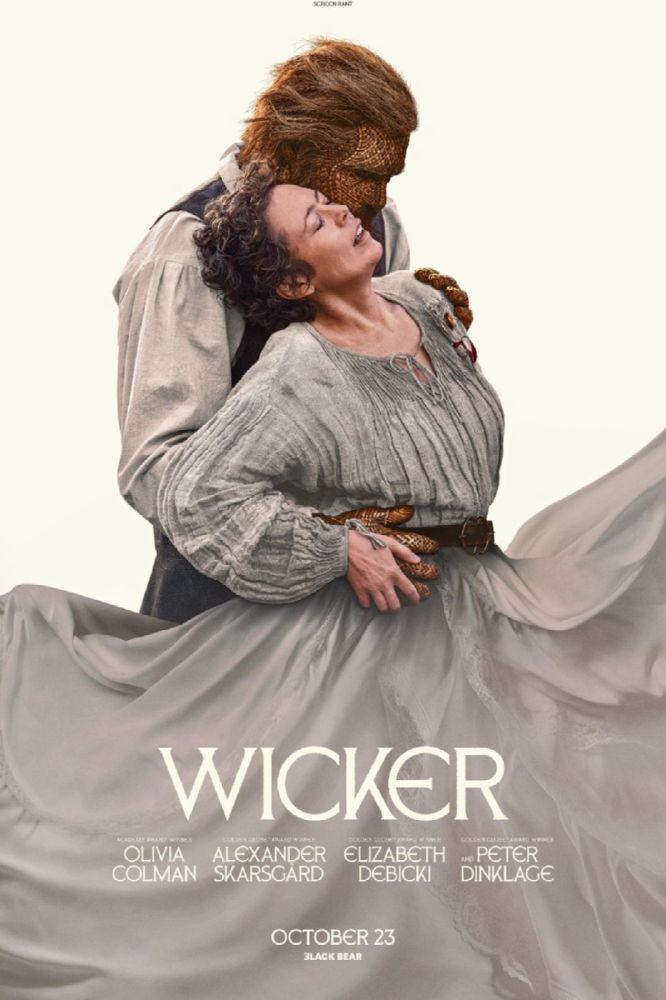
A smelly, mocked fisherwoman finally has enough of her nosy seaside village and pays the local basketmaker to weave her a husband. He turns out to be perfect, and the whole town loses its mind.
Creator: Alexander Skarsgård, Olivia Colman · IMDb
Click any of the following icons below to rent or stream it!
WHAT CRITERIA MAKES IT WOKE?




Oops! Is this show WOKE?
Only an account holder or member can file. Cite a scene, a line, or a pattern. Other account holders +1 or −1 that argument, once each. The show is not IS WOKE until enough of them have given a +1. Enough −1s remove the write-up, and it is no longer shown.
Sign in to file a woke label. One of each criterion per member.
Comments and reviews
Report a mistake
Same rule as woke labels: one report, a written reason, and the community +1 or −1 it — once per member. A net +5 applies the change. Editors can hold it for review, or apply it immediately.
No mistake reports yet.
Sign in to report a mistake. One report per field, per member.
Member review
Peg Harlan Member
Oct 29, 2026
★★★★★★★★★★I bought a ticket for Wicker on a damp Thursday and sat through the trailers with a half-full house that kept shifting in the seats like they weren’t sure what they’d walked into. By the time the fisherwoman showed up on that wide screen, salt-stiff and already tired of the jokes, the room had settled. She’s the kind of woman the seaside village has decided is fair game: smells like the boats, talks too little, gets mocked in the square. One day she has enough and pays the local basketmaker to weave her a husband. He turns out better than any of them, and the whole place loses its mind. I walked out giving it 7 out of 10.
They used to make odd little fables like this without quite so much pointing, but the movie still works as a story even while it’s doing the pointing. What I noticed right away is how hard it leans on the idea of a woman stuck inside a patriarchal setup. The satire keeps circling the rules the men made and the ways those rules pinch. Marriage itself gets treated as something with a built-in cruelty to it under those old arrangements; you feel the film wanting you to clock that. It isn’t subtle. A couple near me chuckled at the first few jabs and then went quiet when the tone stayed locked on that track.
The village men are the clearest part of it. Once the wicker husband is walking around looking steady and useful, you can practically smell their panic. They’re terrified they can’t compete with him in bed, and the movie doesn’t let that joke land soft. It keeps returning to their faces, the sideways looks, the sudden need to prove something. There’s a tailor who faints at the sight of blood; his wife, who actually knows the work, steps in and finishes the job while he gets the credit and she gets none. That beat played long on the big screen. You sit there watching her hands move and realizing the film wants the unfairness to sit with you. I didn’t need it underlined twice, but it was underlined twice.
The husband himself is written as a stay-at-home spouse living off her fishing money. Roles swapped clean. He keeps the place, she brings in the catch, and the town can’t decide whether to envy her or punish her for it. That flip is the engine of half the plot, and it lands differently in a dark theater than it probably would on a smaller screen; you feel the whole crowd clocking the reversal at the same moment. Some people behind me muttered when he stayed home again while she went out on the water. Fair enough. The movie is not shy about what it’s rearranging.
There’s another thread I caught that the picture doesn’t shout but also doesn’t hide: pangs of homosexual longing worked into the edges of the story. It shows up in how certain men watch the wicker husband, or each other, in the quieter cuts between the louder village nonsense. It isn’t a subplot with a speech; it’s just present, woven through the looks and the silences. In a packed row it reads as one more way the film is stacking its deck toward modern score-settling. I noticed it, filed it, and kept watching.
For all that, the movie still has a pulse. The fisherwoman’s stubbornness carries long stretches. The basketmaker’s craft is filmed with real patience; you see the weave take shape and it feels like actual work instead of a magic shrug. When the town finally turns, the chaos has a messy energy that filled the theater without needing extra music cues. I laughed at a couple of the physical gags, winced at a few of the lectures, and never checked the time. That counts for something. A pure fairy tale without the finger-wagging might have sat easier, but this version still holds together as a night out. The crowd left talking more about the husband than the sermons, which is probably the best sign the picture has.
I don’t need every old story flipped inside out to prove a point, and Wicker does a fair amount of that proving. Still, the central idea—a woman who stops taking the mockery and builds herself a partner—has enough strange charm and mean little laughs to keep it from collapsing under its own messaging. Seven out of ten feels right: worth the ticket, worth the dark room, and clear-eyed about what it’s selling. If they dialed back the patriarchal checklist by a third and trusted the weirdness more, I’d have sat happier. As it stands, I got a solid evening and a clear sense of the argument it came to make.