



 MOVIE · 2025
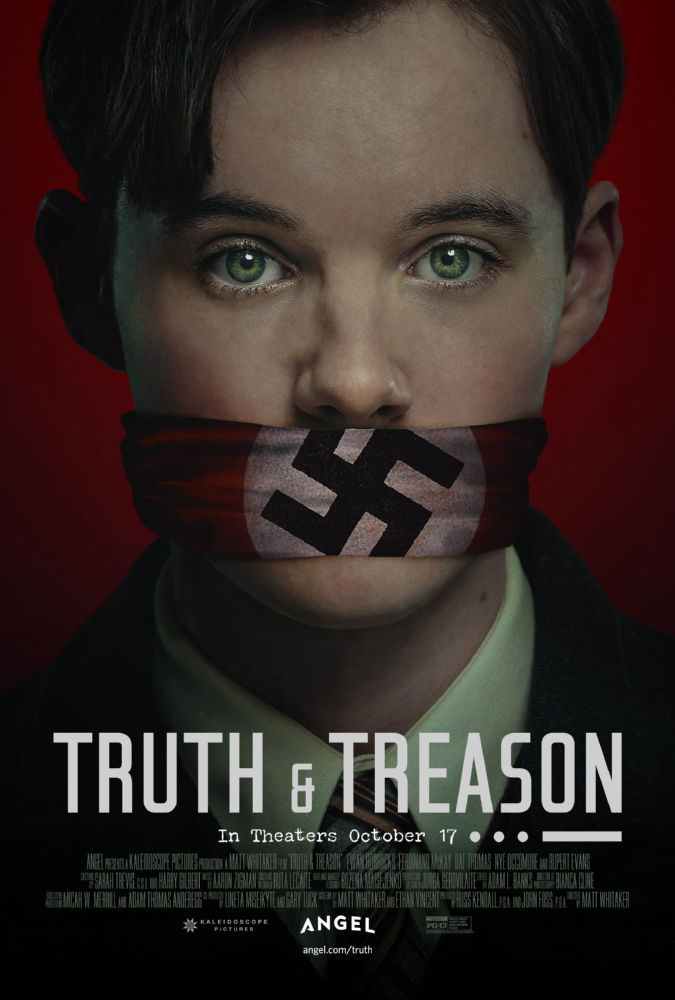
Truth and Treason
As WWII rages, a teenage boy in Germany is forced to confront a terrible truth—loyalty to his country now means loyalty to a lie.
When his trusted bishop urges obedience to the Nazi regime, he begins to question everything.
And after his Jewish friend is taken away, he secretly listens to banned radio broadcasts and launches a resistance, exposing the truth. In a nation ruled by fear, defiance comes at a cost—and as the regime closes in, he must decide what it truly means to be a good German.
Creator: Angel Studios
Click any of the following icons below to rent or stream it!
Oops! Is this show WOKE?
Only an account holder or member can file. Cite a scene, a line, or a pattern. Other account holders +1 or −1 that argument, once each. The show is not WOKE until enough of them have given a +1. Enough −1s remove the write-up, and it is no longer shown.
Sign in to file a woke label. One of each criterion per member.
Comments and reviews
Report a mistake
Same rule as woke labels: one report, a written reason, and the community +1 or −1 it — once per member. A net +5 applies the change. Editors can hold it for review, or apply it immediately.
No mistake reports yet.
Sign in to report a mistake. One report per field, per member.
Member review
Peg Harlan Member
Oct 7, 2026
★★★★★★★★★★Truth and Treason sits with you in a quiet way. It tells the story of Helmuth Hübener, a teenage boy in wartime Hamburg who starts catching foreign radio broadcasts and realizes the newsreels and school lessons are full of lies. He doesn’t turn into some larger-than-life rebel overnight. He just can’t ignore what he’s hearing anymore, so he pulls in a couple of friends he trusts and they start typing leaflets at night, copying them, and leaving them where people might actually pick them up and read them. The whole thing is small-scale and tense because one wrong word to the wrong neighbor and it’s over. I liked that the movie doesn’t dress the danger up with big speeches. The risk feels ordinary and constant, which is how it probably was.
What stays with me is the choice itself. Helmuth knows the regime will come down hard, and he still decides silence is worse. That’s the spine of the film. You watch him weigh loyalty to the people around him against what he now understands is true, and he keeps choosing the harder road. The friends who help him aren’t saints either. They’re scared kids who still show up. That part felt honest. The movie lets you sit with how thin the line is between going along and speaking up when the cost is real. I kept thinking about how easy it is to tell yourself the next person will do something, or that it’s not your place. He doesn’t give himself that out.
The ending hits hard and leaves you quiet. It doesn’t soft-pedal what happened to him, and I appreciated that. On a less serious note, it’s odd how none of these characters who are meant to be German sound German. The accents never settle into anything that feels lived-in, and once you notice it you keep noticing it. In a few scenes after his head is shaved, Helmuth even looks a bit like Nicholas Hoult, which pulled me out for a second in a way I didn’t expect. Small things, but they stack up. The production design is solid enough—the cramped rooms, the careful hiding of paper and typewriter ribbons, the way people glance over their shoulders—but the voices keep reminding you you’re watching a movie instead of listening to people who grew up there.
I gave it 3.5 because the core story earns its keep and the tension around the leaflet drops works more often than not. You feel the circle tightening. At the same time the film never quite finds a rhythm that matches the subject. Some stretches lean on the same beats of near-misses and whispered arguments without deepening them. The friendships are sketched clearly enough, yet I wanted a little more of the ordinary days between the risks so the pressure would land harder when it rose. Helmuth’s conscience drives everything, and the movie trusts that, which is good, but it sometimes leaves the supporting characters standing around waiting for the next plot turn rather than living full lives of their own.
Still, I respect what it sets out to do. It doesn’t turn the Nazi machinery into cartoon evil or the teenagers into polished heroes. They make mistakes, they argue about how far to go, they get tired. The leaflets name the deceptions plainly and call ordinary people to stop swallowing the official story. That directness feels right for the material. You come away thinking about how information gets controlled and how fast “loyalty” can become a demand to stop asking questions. The movie doesn’t lecture on any of that; it just lets the boy’s decisions show the cost. I left wishing the accents had been handled with more care and that a few middle stretches had been tightened, but the central thread held. They used to make films that trusted a simple moral conflict to carry the weight without dressing it up. This one gets close enough that I’m glad I watched it, even if it doesn’t quite stick the landing every minute. The sadness at the end isn’t cheap, and the courage isn’t inflated. That combination is rarer than it should be, and it’s why the film stays with me a few days later more than some flashier titles do. A solid three and a half felt fair—enough craft and honesty to recommend, enough rough edges to keep it from higher marks.