



 TV · 2026
Tomb of the Ancients
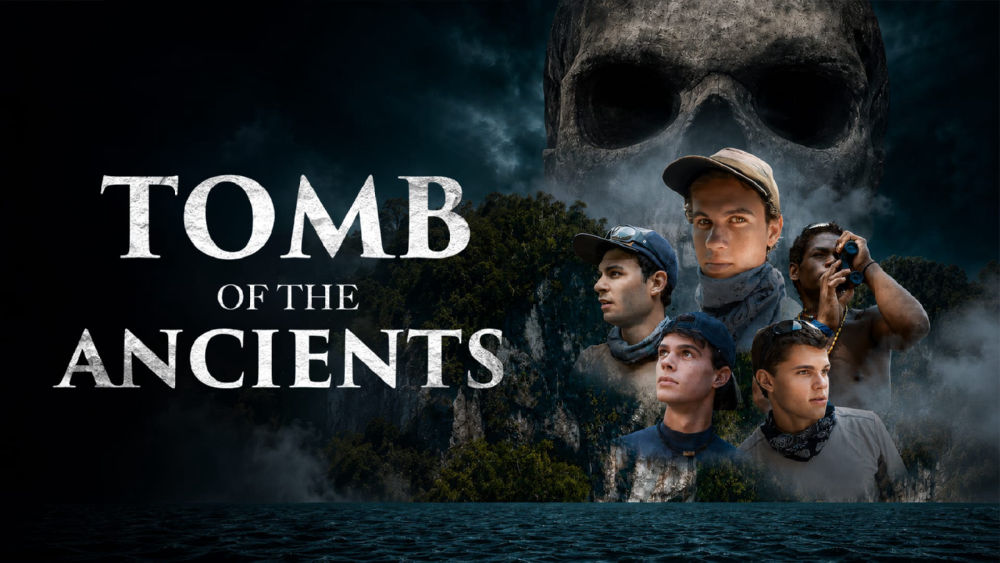
The Wild brothers head to remote Raja Ampat on a service trip and are drawn into an unsolved mystery when pottery turns up on a forgotten beach. Their search for the islands’ ancient people leads through sacred rock art, guarded caves, and a concealed tomb.
Tomb of the Ancients follows the Wild brothers as they arrive in the remote waters of Raja Ampat intending to help local communities rather than chase relics. On a quiet stretch of shoreline they uncover a pottery shard that immediately reframes the entire trip. Local knowledge and the fragment itself point toward people who once lived among these islands yet left almost no clear written record. The brothers begin tracing clues from coastal finds inland, treating each site as one piece of a larger unanswered question. Early stops include exposed rock faces marked with sacred art that still carries meaning for communities nearby. What started as practical service work becomes a careful chase after whoever shaped this forgotten culture.
Pushing farther from easy anchorages, the brothers work through guarded caves and narrow channels where access is limited and stories remain scarce. Guides and islanders share fragments of oral history while the pair documents carvings, chamber layouts, and the routes that once linked scattered sites. The trail ultimately centers on a tomb concealed inside a labyrinth of islands, a place earlier visitors never fully mapped. Along the way the brothers weigh each new clue against the need to respect living traditions and restricted ground. Their service-minded approach keeps the focus on listening and careful observation rather than trophy hunting. The short episodes close on the quiet discovery of that hidden resting place and the questions it still leaves open about the people who built it.
Oops! Is this show WOKE?
Only an account holder or member can file. Cite a scene, a line, or a pattern. Other account holders +1 or −1 that argument, once each. The show is not WOKE until enough of them have given a +1. Enough −1s remove the write-up, and it is no longer shown.
Sign in to file a woke label. One of each criterion per member.
Comments and reviews
Report a mistake
Same rule as woke labels: one report, a written reason, and the community +1 or −1 it — once per member. A net +5 applies the change. Editors can hold it for review, or apply it immediately.
No mistake reports yet.
Sign in to report a mistake. One report per field, per member.
Member review
Ray Okonkwo Member
Oct 17, 2026
★★★★★★★★★★The Wild brothers land in Raja Ampat with a service trip on the docket, which is the part that first hooked me. They are not out there waving metal detectors or talking about “lost civilizations” like they already own the story. They are there to help with practical work, and then a pottery shard turns up on a quiet stretch of beach that apparently nobody has been paying much attention to. That single object is what flips the whole trip. I liked how little fanfare the show gives the moment. No swelling music telling you this is the big discovery. Just the brothers turning the piece over, checking the edges, and realizing the local knowledge they have been hearing does not quite line up with the usual maps and timelines.
What follows is less a hunt and more a slow tracing. Coastal finds lead them inland, and each stop feels like another question instead of another checkbox. The sacred rock art is the stretch that stayed with me longest. Those exposed faces are not treated as pretty background for a drone shot. The communities nearby still carry meaning for the markings, and the brothers keep their distance while still trying to understand what they are looking at. You can feel the restraint. They ask, they listen, they do not climb up and start pointing like experts. That choice keeps the sequence from turning into the usual “we decoded the ancients” routine. It also makes the art feel heavier than if someone had just slapped a dramatic title card over it.
The guarded caves slow the pace even more, and I mean that as a compliment. Access is not automatic. People who watch over those places have their own reasons, and the show lets those reasons sit in the air instead of steamrolling them for the next reveal. There is a stretch inside one of the caves where the light drops and the brothers have to work with what little they can see, talking through the pottery connection in real time. No flashy reconstruction graphics, just the two of them trying to match shapes and patterns they already found on the beach to whatever is carved or left deeper in. It is quiet, almost plain, and that plainness works. You start caring about whether the thread holds instead of waiting for a jump scare or a sudden collapse.
By the time the hidden tomb enters the picture, the show has earned the right to open it. I will not walk through every step that gets them there, because the pleasure is in watching the pieces accumulate rather than in a checklist. What I will say is that the tomb does not arrive as a treasure chest. It arrives as another layer of the same unanswered question about the people who once lived among these islands and left almost nothing clear behind. The brothers treat it that way. Their service-trip mindset never fully leaves; even when they are deep into the mystery, you still catch them thinking about the communities they came to help and how this older story sits beside the present one.
The brother dynamic itself stays workable. They need each other for the practical side—boats, ropes, reading weather on open water—and the banter never tips into that forced “we finish each other’s sentences” act that kills so many travel-adventure pairings. One of them is quicker to push forward; the other is quicker to double-check the local guidance. That friction is useful. It keeps the search honest. Raja Ampat itself does a lot of the heavy lifting visually without the camera needing to over-sell it. Remote water, forgotten shoreline, inland rock that feels older than the boats they arrived on. The show trusts the place enough to let long takes breathe instead of cutting every three seconds for energy it has not earned.
Pacing will be the make-or-break for some people. This is not a race to the tomb. Whole sections sit with the pottery, the art, the careful asking of permission. If you want constant forward motion and big declarative answers, you will feel the drag. I did not. The unanswered quality is the point. The islands’ ancient people remain mostly out of reach, and the show is smart enough not to invent a tidy origin story just to close the loop. That restraint is rarer than it should be.
A few mechanics could be tighter. There are moments where the brothers circle the same observation twice, and a couple of transitions from beach to inland feel slightly padded. Nothing fatal, just the kind of soft spots you notice when the rest of the hour is otherwise locked in. The service-trip framing also fades a little once the mystery takes over; I would have liked one or two clearer reminders of the original reason they were out there, just to keep both threads alive at once. Still, those are small complaints against a show that mostly knows what it is doing.
I came away thinking this is solid, thoughtful adventure television that respects both the place and the limits of what outsiders can claim to know. It does not pretend the pottery solves everything. It does not turn the rock art into a puzzle box for Western eyes only. It lets the guarded caves stay guarded until trust is earned. And when the tomb finally opens, it feels like the natural end of a question rather than the start of a franchise. Three and a half stars feels right—good enough that I will watch whatever they do next in these waters, cautious enough that I will not pretend every beat landed perfectly. If slow island mysteries with real texture are your thing, this one sits well.