



 MOVIE · 2022
They/Them IS WOKE
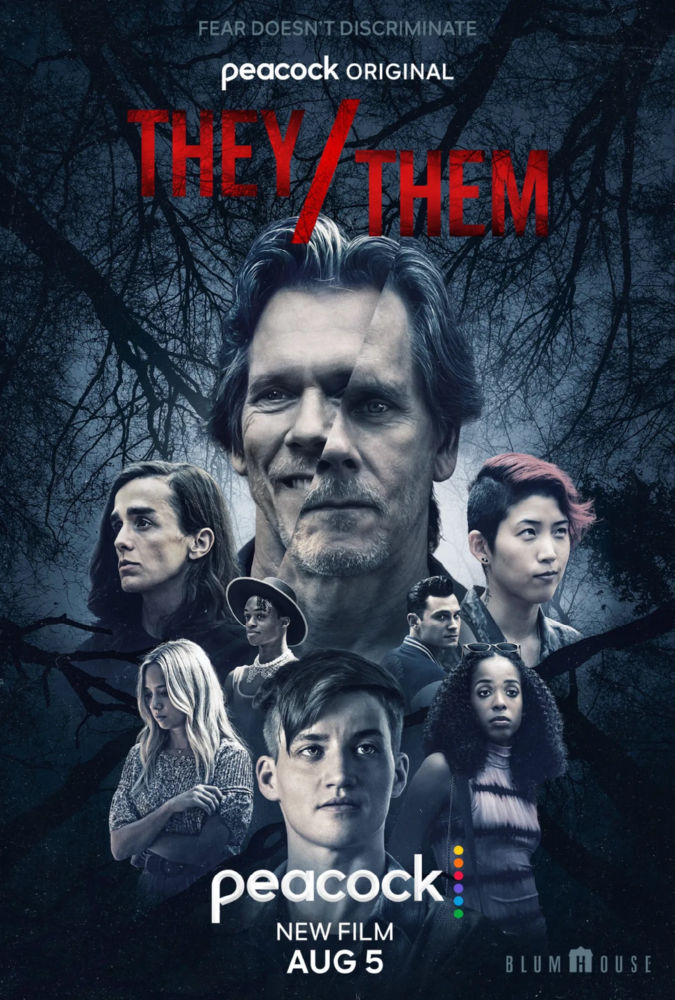
They/Them is a 2022 American slasher film written and directed by John Logan, in his feature directorial debut, and produced by Jason Blum through his Blumhouse Productions banner.
It stars Theo Germaine, Carrie Preston, Anna Chlumsky, Austin Crute, Quei Tann, Anna Lore, Cooper Koch, Monique Kim, Darwin del Fabro, Hayley Griffith, Boone Platt, Mark Ashworth, and Kevin Bacon, and follows a group of LGBTQ teens and a masked killer at a conversion camp.
WHAT CRITERIA MAKES IT WOKE?




Oops! Is this show WOKE?
Only an account holder or member can file. Cite a scene, a line, or a pattern. Other account holders +1 or −1 that argument, once each. The show is not WOKE until enough of them have given a +1. Enough −1s remove the write-up, and it is no longer shown.
Sign in to file a woke label. One of each criterion per member.
Comments and reviews
Report a mistake
Same rule as woke labels: one report, a written reason, and the community +1 or −1 it — once per member. A net +5 applies the change. Editors can hold it for review, or apply it immediately.
No mistake reports yet.
Sign in to report a mistake. One report per field, per member.
Member review
Wes Calder Member
Oct 10, 2026
★★★★★★★★★★They/Them sat on my list for a while before I finally put it on last weekend. A group of teenagers ends up at a remote conversion camp and a masked killer starts working through them while the staff keep the daily program running. I landed on two stars and that still feels accurate.
The first thing you notice is that the entire camper ensemble is explicitly LGBTQ—gay, lesbian, bi, trans, non-binary. The plot exists only because they have been sent to Whistler Camp to change those identities. Every major teen character’s arc is defined by orientation or gender identity. There is no one present for any other reason. That is the engine, not a backdrop.
Jordan, played by Theo Germaine, is non-binary and uses they/them pronouns. The film’s title itself is the singular-they pronoun pair. It foregrounds that identity as the marketing and narrative hook from the first frame. You are not allowed to miss it.
The camp’s conversion program is depicted as the source of the psychological abuse and the horror setting. Counselors force identity-suppressing exercises, enforced discussions of personal pronouns, supervised interactions meant to reshape self-perception. The religiously coded ‘cure’ framework is the institutional villain the killer operates inside. That part is never subtle.
I do not need a movie to hide its point of view. Most have one. Here the point of view occupies so much space that the slasher mechanics feel secondary. People get isolated, chased through the trees, dispatched in the usual order. A couple of the kills generate mild tension if you have not seen this pattern often. The night photography is serviceable. Fog and shadows do what they are supposed to do. Yet every time the story starts to lean into pure genre rhythm, another session or pronoun conversation pulls it back to the same ground.
After a while the double threat—evading the masked figure while still showing up for the next forced discussion—stops feeling like pressure and starts feeling like illustration. The characters remain largely their labels. You can list their identities faster than you can describe how any of them would behave outside this specific pressure cooker. Jordan gets the most screen time and Germaine handles the material cleanly, but the script still keeps the arc locked to the identity struggle against the camp’s rules. The others fill out the roster in similar fashion.
The counselors stay one-note enforcers, which fits the framing of the religiously coded program as pure villainy, yet it also makes them flat obstacles rather than anything that complicates the moral picture. I found myself paying more attention to the layout of the grounds and the practical logistics of who could reach which cabin than to most of the dialogue in the group circles. Those circles repeat the same beats. By the third or fourth I was ahead of them and waiting for the next body.
There is a leaner version of this idea that might have worked better: fewer campers, more time on one or two people under that dual stress, less need to check every identity box. What arrives instead is a broad ensemble where the gay ratio is total, the lead’s pronouns are the title, and the cure framework supplies both the abuse and the setting. It executes that plan thoroughly. The thoroughness is also why it stays at two stars for me. Competence without surprise or deeper texture.
Some of the later reveals try to tie the killer into the camp’s atmosphere with moderate success. I was never bored enough to shut it off, which counts for something on a weeknight. I also never leaned forward. The wry thought that kept returning was how neatly the whole construction fits its own template. Assemble the full set of queer teens, drop them into the religiously coded hellscape, name the movie after the pronouns, and let the stalker loose. It does exactly those things and little else that lingers.
If you are hunting for a title and the page throws leftover template language about media types or a prompt to login and create the entry yourself, you might land here the same accidental way I did. Or you might seek it out on purpose. Either way I watched it, clocked the complete identity-defined ensemble, the title-level focus on they/them, and the conversion program as institutional villain, and came away with a flat two-star impression. Competent packaging around a message that never once takes the passenger seat. That is the whole review.