



 TV · 1998
The Wild Thornberrys
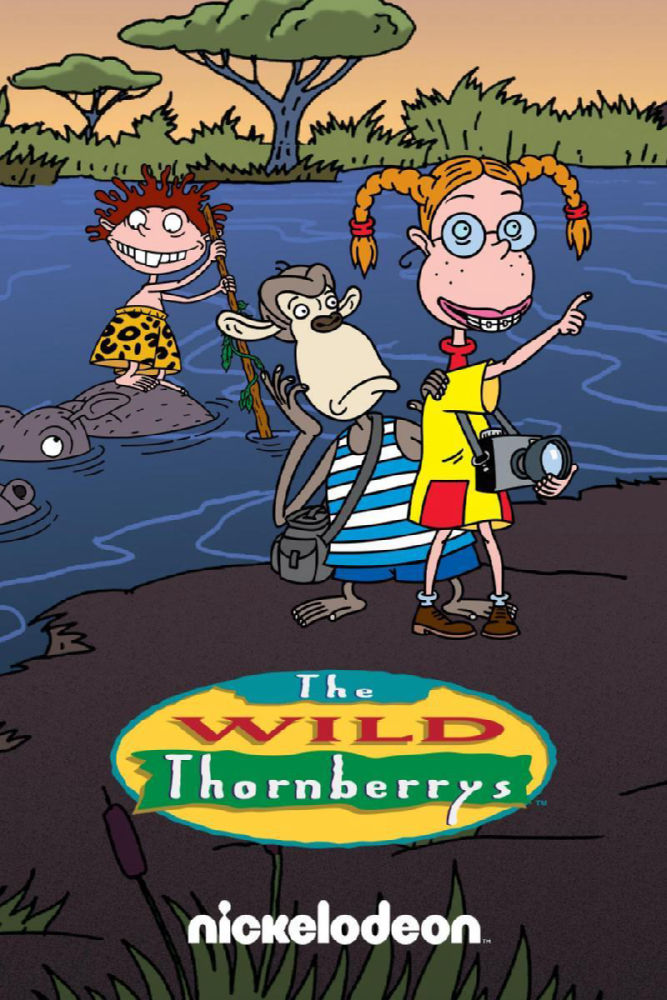
A wildlife-filming family crisscrosses the planet while their daughter Eliza secretly talks to animals and dives into every scrape. With chimpanzee Darwin at her side, she turns documentaries into rescue missions and mischief.
The Wild Thornberrys follows Eliza Thornberry, a bright and impulsive girl who can converse with animals and travels the world inside her family's mobile film unit. Her father Nigel is a boisterous British naturalist who narrates every creature they meet, while her mother Marianne steadies the camera and keeps the expedition on track. Older sister Debbie rolls her eyes at the chaos, wild little brother Donnie causes extra mayhem, and chimpanzee Darwin sticks close to Eliza as her confidant. Eliza slips away from the Commvee to aid blue sheep in Nepal, emus in Australia, or marmots in rugged high country, often risking discovery of her secret gift. Flash floods, rock slides on mountain highways, and runaway balloons pull the whole family into the same scrapes she starts with the animals. Each stop mixes real habitats with the comic fallout of a kid who understands every creature's side of the story.
As the Thornberrys push farther afield, Eliza's bond with Darwin deepens into a running partnership of whispered plans and last-second rescues that the adults never fully explain. Nigel's enthusiasm and Marianne's practical grit keep the documentary work moving even when Donnie vanishes into the brush or Debbie demands a normal teenage life far from tigers and tombs. Eliza learns that helping one animal can unsettle an entire valley, yet she still chooses to intervene when a creature is trapped or a habitat is threatened by accident. Sibling friction softens into reluctant teamwork whenever the Commvee is stranded or a storm closes in. The series keeps returning to the same core rhythm: a new landscape, a new animal voice, and Eliza racing to fix the trouble before her family packs up for the next shoot. Friendships with the creatures and the messy loyalty inside the Thornberry clan remain the engine of every journey.
Creator: Lacey Chabert, Jodi Carlisle
Click any of the following icons below to rent or stream it!
Oops! Is this show WOKE?
Only an account holder or member can file. Cite a scene, a line, or a pattern. Other account holders +1 or −1 that argument, once each. The show is not IS WOKE until enough of them have given a +1. Enough −1s remove the write-up, and it is no longer shown.
Sign in to file a woke label. One of each criterion per member.
Comments and reviews
Report a mistake
Same rule as woke labels: one report, a written reason, and the community +1 or −1 it — once per member. A net +5 applies the change. Editors can hold it for review, or apply it immediately.
No mistake reports yet.
Sign in to report a mistake. One report per field, per member.
Member review
June Pell Member
Oct 21, 2026
★★★★★★★★★★The Wild Thornberrys earned a 3.5 from me because it still works as a sturdy little engine even after the formula becomes obvious. Eliza talks to animals, Darwin the chimp is the only one who knows, and the rest of the family barrels from habitat to habitat in the Commvee while she quietly mends whatever local crisis has cropped up. That setup is simple and it holds. Nigel charges in with pure enthusiasm, Marianne keeps the camera rolling and the logistics from collapsing, Debbie supplies the eye-rolls that keep the whole traveling circus from floating off into pure whimsy, and Donnie just ricochets around like he never quite left the orangutan life. The mix of sibling friction and wildlife scrapes is what makes the show feel lived-in rather than pure educational packaging.
I keep coming back to how specific the animal problems usually are. Blue sheep in Nepal, emus, floods, runaway balloons—the show actually names places and creatures instead of reducing everything to generic “nature.” You pick up small facts without a lecture attached. That used to matter more than I realized at the time. A lot of children’s animation now stays locked inside the same three city blocks or a single suburban school; here the planet itself was the set, and the scrapes felt bigger than the living room. I remember watching it in the late afternoon and feeling like the Commvee had more range than anything I could reach on a bike. That sense of scale is half the charm.
Eliza’s gift is handled with a light touch that still works. She doesn’t monologue about destiny or chosen-one status. She just talks to the animals, Darwin groans and tags along, and the two of them try to fix the mess before the parents notice. Darwin’s reluctance is the quiet joke that never gets old—he knows the plan will go sideways and he still ends up waist-deep in it. The secret creates a private lane inside the public family adventure, and that private lane is where most of the better episodes live. When the show trusts that dual track, it feels sharp. When it leans too hard on the weekly crisis resolving itself in tidy twenty-two minutes, the edges soften and you can see the scaffolding.
Debbie remains the most reliable human pressure valve. Her sarcasm is never mean enough to sour the room, but it’s constant enough that Nigel’s boundless energy doesn’t tip into pure cartoon. Marianne’s practical competence is easy to underrate; someone has to keep the schedule and the film stock intact while the rest of them invent new ways to nearly drown or get lost. Donnie is pure chaos, which is fine in small doses and occasionally overstays. The animation itself is very much of its late-nineties moment—bright, a little stiff in the joints, expressive faces that still read clearly. The voices do more lifting than the drawings sometimes, and that is not a complaint.
I take a short detour here into the difference between curiosity and curriculum. The Thornberrys are filmmakers first. They are out there to capture footage, not to deliver a morality play about the planet. The animals have their own agendas—territory, food, weather, human interference—and Eliza just happens to be able to hear them. That keeps the show from turning into a walking pamphlet. Modern kids’ media often feels obligated to announce its virtue in the first act; this one simply dropped you into a new biome and let the scrapes do the talking. I don’t need every cartoon to teach me latitude and longitude, but I miss the ones that treated the wider world as ordinary rather than exotic set dressing.
Not every episode earns the runtime. Some animal dilemmas resolve with a soft thud, and the sibling banter can loop the same beats when the writers are tired. The series never pretends to be prestige, and that honesty is part of why the 3.5 feels right. It is comfortable without being empty, informative without being pious, and funny in the dry places where Darwin mutters under his breath. I still put it on when I want something that moves across continents without demanding I take notes or feel scolded. The family is messy in ordinary ways—Debbie wants a normal teenage life, Nigel wants the next impossible shot, Eliza wants to help every creature that talks back—and those ordinary wants keep the globe-trotting from turning into pure fantasy. That balance is harder to strike than it looks, and The Wild Thornberrys usually manages it. Three-and-a-half stars is the honest middle: worth keeping, not worth canonizing, and still better company than most of what filled the same after-school slot.