



 MOVIE · 2026
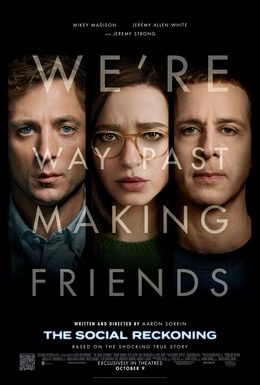
The Social Reckoning
Frances Haugen, a Facebook engineer, teams with Wall Street Journal reporter Jeff Horwitz on a risky path to expose the social network's hidden algorithms and corporate secrets.
The Social Reckoning follows Frances Haugen, a young Facebook engineer on the civic integrity team, as she grows alarmed by internal data on how the platform's algorithms amplify harm, extremism, and damage to young users. She enlists the help of Jeff Horwitz, a Wall Street Journal reporter new to the tech beat, despite the dangers of violating her nondisclosure agreement. Their secret collaboration uncovers guarded documents showing leadership prioritized engagement and profits. Haugen initially believes in the company's mission to connect people but faces dismissal when raising concerns. The pair navigates meetings, leaks, and risks as the investigation builds toward public exposure. Zuckerberg and company executives appear in parallel as they prepare responses and face mounting scrutiny.
Haugen provides Horwitz with key internal studies and files that form the basis of damaging reports on algorithmic radicalization, Instagram's effects, and other issues. She relocates temporarily amid the pandemic before being ordered back, cutting contact at times out of fear of discovery. The story builds to her decision to go on the record, seek whistleblower protections, and testify. Parallel scenes show company preparations interrupted by major events including the Capitol riot, with debates over content moderation and free speech. Horwitz publishes the series while Haugen delivers her statement. Closing notes cover the aftermath of the revelations and the company's later changes.
Creator: Aaron Sorkin
Oops! Is this show WOKE?
Only an account holder or member can file. Cite a scene, a line, or a pattern. Other account holders +1 or −1 that argument, once each. The show is not WOKE until enough of them have given a +1. Enough −1s remove the write-up, and it is no longer shown.
Sign in to file a woke label. One of each criterion per member.
Comments and reviews
Report a mistake
Same rule as woke labels: one report, a written reason, and the community +1 or −1 it — once per member. A net +5 applies the change. Editors can hold it for review, or apply it immediately.
No mistake reports yet.
Sign in to report a mistake. One report per field, per member.
Member review
Peg Harlan Member
Oct 21, 2026
★★★★★★★★★★I caught The Social Reckoning on a weeknight when the big auditorium still had empty rows, which turned out to be useful. You could hear people shift and mutter when the internal slides hit the screen. Not a gasp-fest, more the low sound of folks recognizing the shape of something they’d already half-suspected. Ticket stub still in my jacket pocket when I walked out. That kind of night.
Aaron Sorkin is doing what he does. People talk in clean paragraphs, walk and argue at the same time, and every hallway conversation feels like it was blocked for maximum velocity. Mikey Madison plays Frances Haugen as someone who keeps a running list of questions her bosses keep batting away. She’s in the integrity unit, which sounds noble until you watch how fast “integrity” gets redefined as loyalty to the growth chart. Jeremy Allen White’s Jeff Horwitz isn’t the shy tech beat guy; he’s a reporter who smells blood and knows how to time a story so it doesn’t disappear into the weekend news cycle. Their scenes together have a practical tension. She’s got the documents. He’s got the outlet. Neither one trusts the other completely at first, and that felt right.
The movie stays close to the Facebook Files material without turning into a slideshow. You get the teen mental-health research, the polarization findings, the internal memos that treat user harm like a cost of doing business. Leadership, Zuckerberg included, circles the wagons with lawyers and talking points the second the first piece lands. None of that surprised me. What landed harder in a dark theater was watching ordinary product decisions get framed as moral choices the company simply refused to make. The free-speech argument sits in the middle of it and doesn’t resolve cleanly. Sorkin lets both sides talk long enough that you feel the friction instead of getting a neat sermon. I appreciated that. Easy answers would have cheapened the whole thing.
Some of the dialogue still carries that Sorkin gloss where everyone is a little too quick and a little too quotable. Real offices are messier and duller. But the big-screen version of the document dumps and the late-night calls worked for me. You feel the weight of thousands of pages when they’re spread across a table under harsh light. Madison keeps Haugen human instead of turning her into a pure crusader. She’s scared, methodical, and occasionally stubborn in ways that don’t always help her cause. White plays Horwitz as a guy who’s been burned before and isn’t interested in becoming anyone’s mascot. Their collaboration has the awkwardness of two people who need each other more than they like each other.
I kept thinking about how companies this size develop their own weather systems. Growth is the climate. Everything else is a temporary storm they wait out. The film doesn’t pretend Haugen invented the critique; it shows her deciding the internal research had to leave the building or it would keep getting filed under “interesting but not actionable.” That choice is the spine. Once the stories start dropping, the movie becomes a study in institutional panic dressed up as process. Lawyers, PR, closed-door meetings. We’ve seen versions of this dance before, only usually without the paper trail projected twenty feet high.
Is it as sharp as The Social Network? Not quite. That one had a meaner comic engine and a clearer villain energy. This one is angrier in a quieter way, more procedural, and it asks you to sit with the idea that the people inside knew. They had the studies. They ran the numbers on harm versus engagement and kept the engagement. If you already follow this beat, some stretches will feel like confirmation rather than revelation. If you don’t, the accumulation of detail can still get under your skin. A couple near me kept whispering “are you kidding me” at the screen, which is its own kind of review.
I didn’t walk out wanting to burn my accounts or join a march. I walked out tired in the specific way you get when a system you use every day is shown, again, to have optimized itself past basic care. They used to make corporate exposure pictures with more pulp and less paperwork. This one is almost all paperwork, arguments, and the slow dread of realizing the incentives never pointed anywhere else. Sorkin’s analogies land hard in places and overreach in others. The free-speech knot at the center stays knotted, which is honest even when it’s frustrating.
Would I sit through it again? Probably once more with someone who still thinks these platforms are neutral pipes. The theater made the scale feel bigger than a headline. You leave with the same phone in your pocket you walked in with, only it feels a little heavier. That’s about as much as a movie like this can do without turning into a lecture. It mostly avoids the lecture. Mostly. Three and a half stars feels fair for a film that got me mad in the right spots and talky in the predictable ones, and that still had the crowd leaning forward when the first story hit the presses on screen.