




 MOVIE · 2023
The Hunger Games: The Ballad of Songbirds & Snakes IS WOKE
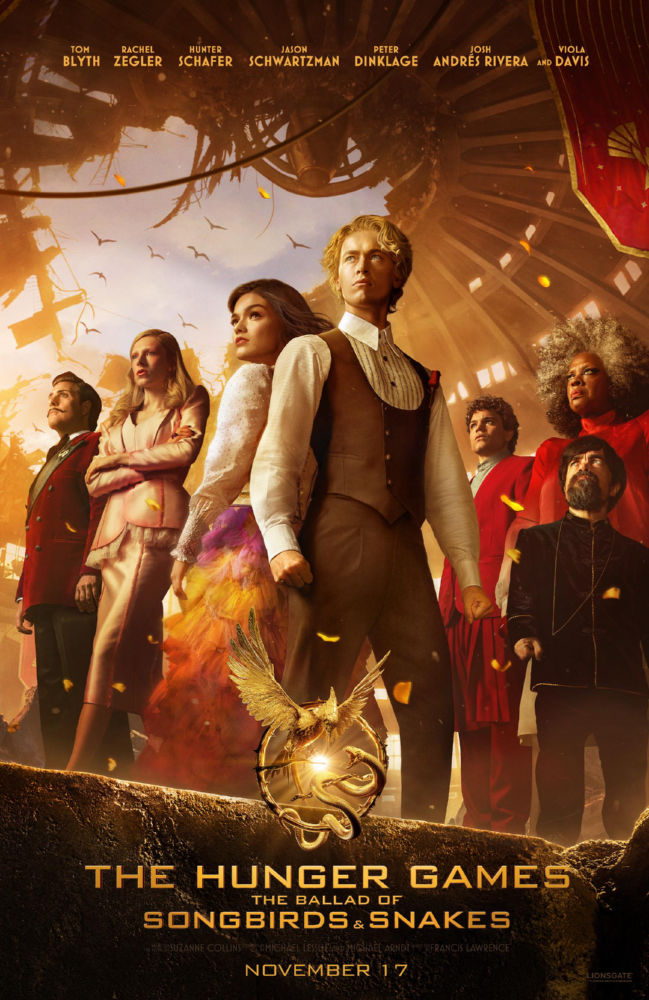
Coriolanus Snow mentors and develops feelings for the female District 12 tribute during the 10th Hunger Games.
Click any of the following icons below to rent or stream it!
WHAT CRITERIA MAKES IT WOKE?






Oops! Is this show WOKE?
Only an account holder or member can file. Cite a scene, a line, or a pattern. Other account holders +1 or −1 that argument, once each. The show is not WOKE until enough of them have given a +1. Enough −1s remove the write-up, and it is no longer shown.
Sign in to file a woke label. One of each criterion per member.
Comments and reviews
Report a mistake
Same rule as woke labels: one report, a written reason, and the community +1 or −1 it — once per member. A net +5 applies the change. Editors can hold it for review, or apply it immediately.
No mistake reports yet.
Sign in to report a mistake. One report per field, per member.
Member review
Lila Marsh Member
Sep 19, 2026
★★★★★★★★★★I finally put on The Ballad of Songbirds and Snakes after it had sat in my queue for a while. I went in mostly curious about young Coriolanus Snow and whether the movie could make his early years feel like more than a simple origin checklist. It does that part pretty well. The film cares more about the slow hardening of one ambitious kid than about restaging big arena set pieces, and that choice is what kept me watching even when the runtime started to feel long.
Snow is a Capitol student whose family name still carries weight but whose actual money is gone. He needs a strong showing as a mentor in the tenth Hunger Games or his future starts looking thin. They hand him Lucy Gray Baird from District 12, who shows up singing and refuses to play the broken-tribute role the crowd expects. That mismatch is the engine of the whole movie. He teaches her how to work the cameras and stay alive inside the rules the Gamemakers are still inventing, and she keeps surprising him with a kind of stubborn life that doesn’t fit the Capitol’s neat categories. Their partnership turns personal in a way that feels earned rather than forced, and you can watch him weigh every kindness against the image he thinks he has to project.
I liked that the movie lets the attachment breathe. It isn’t pure romance and it isn’t pure strategy. There are stretches where you can see him genuinely invested and other stretches where the same investment starts looking like a liability he might have to cut loose. That tension sits under almost every scene once the Games get underway. The arena itself is uglier and less polished than the later versions we already know. Resources are scarce, the oversight is openly sadistic, and the mentors are scrambling as much as the tributes. It gives the survival pieces a rawer edge without needing constant spectacle.
Where it lands at 3.5 for me is the middle. The political maneuvering among the students and the adults who run the Games sometimes drags. A few of the rival mentors and Capitol figures blur together, and certain conversations about image and loyalty circle the same points longer than they need to. Lucy Gray’s songs and colorful presence work early on; later they start to feel like the movie is tapping the same button to remind you she is different. I never got bored enough to check out, but I did notice the clock more than once. The final stretch tightens up again and sticks the landing on Snow’s choices without a big monologue or a sudden heel-turn speech. The quiet decisions do the work, which felt right for the character.
Performances help a lot. The young man playing Snow has the mix of pride, charm, and cold calculation the part needs. You believe both the moments when he still has something soft left and the moments when that softness starts looking expensive. Lucy Gray comes across as her own person rather than a walking symbol or a love interest checklist. Their scenes together carry the film when the surrounding Capitol intrigue gets repetitive. I also appreciated how the early Games feel like an experiment still finding its shape. The cruelty is already there, but the pageantry and the control mechanisms are still being tested, and that makes Snow’s education in ruthlessness feel specific to this moment instead of generic villain training.
I walked away thinking the movie understands the cost of the bond it builds. Every alliance has a price, and the film doesn’t flinch from showing how personal loyalty and self-preservation start pulling in opposite directions. That is more interesting to me than another round of tributes running through booby-trapped woods. At the same time, the length and the occasional soft middle keep it from feeling essential. It’s a solid prequel that fills in texture without rewriting everything that came later. If you already like the world, this gives you a clearer look at how someone like Snow becomes the man we meet in the later stories. If you don’t, the slower character focus might test your patience.
My clear take is that it is worth the watch when you want something darker and more about the making of a person than about pure action. It held my attention, earned its quieter moments, and didn’t insult my time. It just didn’t stay sharp for the entire stretch. 3.5 feels honest for a movie that does several things right and a couple of things longer than necessary. I don’t regret sitting with it, and I might even revisit the Snow sections later, but I’m not rushing to call it one of the stronger entries in the series.