



 MOVIE · 1995
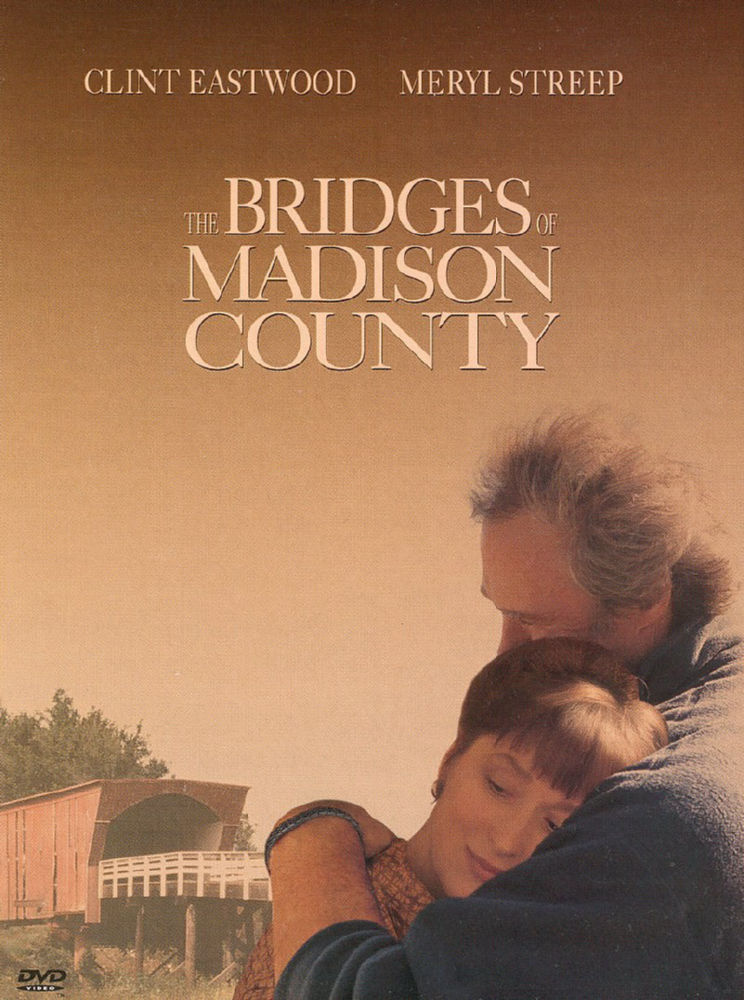
The Bridges of Madison County
A traveling photographer and an Iowa farm wife share four intense days of romance that permanently alter how each understands love, duty, and the life left behind.
The Bridges of Madison County follows Francesca Johnson, an Italian-born housewife living on a quiet farm in 1960s Madison County, Iowa, with her husband Richard and their two teenage children. While the family is away at the state fair, National Geographic photographer Robert Kincaid stops at her door asking directions to the local covered bridges he has been assigned to shoot. Francesca gives him water, then dinner, and the two strangers begin talking through the evening about travel, art, and the paths that brought them to this place. Over the next days Robert returns, they drive the back roads together, and a restrained attraction deepens into a full love affair. Francesca, long settled into routine and silence, finds herself seen and desired in a way her marriage has never offered. Robert, a solitary wanderer, discovers a home he never expected to want.
As the four days end, Francesca must decide whether to leave with Robert or stay for her children and the life she built. She chooses the farm, watching his truck disappear down the road while she remains behind the screen door. Years later, after Francesca’s death, her grown son and daughter discover a packet of letters, photographs, and a journal that finally explain the secret she carried. Reading her account, they confront the depth of the love she sacrificed and the quiet strength it took to keep her vows. The children honor her wishes about the bridges and the ashes, recognizing that the brief romance was neither casual nor forgotten. The story closes on the lasting mark those four days left on everyone who learned the truth.
Creator: Clint Eastwood
Click any of the following icons below to rent or stream it!
Oops! Is this show WOKE?
Only an account holder or member can file. Cite a scene, a line, or a pattern. Other account holders +1 or −1 that argument, once each. The show is not WOKE until enough of them have given a +1. Enough −1s remove the write-up, and it is no longer shown.
Sign in to file a woke label. One of each criterion per member.
Comments and reviews
Report a mistake
Same rule as woke labels: one report, a written reason, and the community +1 or −1 it — once per member. A net +5 applies the change. Editors can hold it for review, or apply it immediately.
No mistake reports yet.
Sign in to report a mistake. One report per field, per member.
Member review
June Pell Member
Oct 22, 2026
★★★★★★★★★★I came to The Bridges of Madison County late, the way you sometimes find an older movie when you’re already past the age the characters are living through. That timing helped. What might have felt like pure swoon material at twenty-two lands differently when you’ve had a few decades of ordinary choices behind you. Clint Eastwood directed it and stars as Robert Kincaid, the National Geographic photographer who pulls up to Francesca Johnson’s farm looking for the covered bridges. Meryl Streep is Francesca, the Italian-born wife and mother whose family has gone off to the state fair for a few days. Four days is all they get, and the movie never pretends those days rewrite the whole world. They just rearrange the furniture inside two people.
Streep does that thing she does where the accent sits a little heavy at first—I’m still not fully convinced by every vowel—but then the performance settles and you stop noticing the machinery. She carries the restraint so well that the few moments she lets go feel earned rather than staged. Eastwood plays Kincaid with a quiet that never tips into the gruff loner caricature. He’s a man who has spent his life moving through places without staying, and you believe both the restlessness and the sudden wish to stop. Their scenes together are mostly talk, cooking, driving the back roads, standing in doorways. The attraction builds through attention more than fireworks. I like that the film trusts the audience to feel the pull without constant underscoring.
There is a mild cheese factor, the kind that comes with rain on windshields and certain lines about roads not taken. I can see why someone would bounce off it. For me it stayed on the sweet side of sentimental rather than tipping into syrup. Part of that is the 1960s Iowa setting—ordinary rooms, ordinary chores—which keeps the grand emotions tethered to something solid. Francesca’s life isn’t painted as a prison. Her husband is decent, the kids are theirs, the farm is real work. The ache comes from realizing that decency and real work can still leave a person half-asleep to herself. When Kincaid shows up, he doesn’t rescue her so much as wake the part that had gone quiet. That distinction matters. The movie is interested in what people owe the lives they already chose, not just in the thrill of the alternative.
The frame with the adult children going through Francesca’s papers after her death is the weaker stretch. Annie Corley and Victor Slezak do what they can, but those scenes feel like scaffolding the story didn’t fully need. Still, the eventual payoff—how the children understand their mother differently—lands with enough weight that I didn’t mind the setup. It underlines the central question without lecturing: what do we keep private, and what do we risk by keeping it. Mature viewers will recognize the territory. This isn’t a story that treats infidelity as either pure liberation or pure sin. It’s messier. Eros arrives, it matters, and then the calendar and the other people in the house reassert themselves. The decisions that follow determine the rest of two lives, and the film lets the cost sit there without rushing to absolve or condemn.
I kept thinking about the small gestures—the way Francesca hesitates before answering the door again, the way Kincaid looks at the bridges he came to photograph and then looks past them. Eastwood the director gives the landscape room to breathe without turning it into postcard poetry. The bridges themselves become a quiet metaphor that never gets underlined too hard. You can walk across them, you can photograph them, you can leave. Francesca’s choice at the end is the one that stayed with me longest. It isn’t triumphant and it isn’t tragic in the operatic sense. It’s simply the shape a life takes when someone decides the people already depending on her outweigh the version of herself she glimpsed for four days. That kind of ending feels honest in a way a lot of romance movies avoid.
Watching it now, I also noticed how little the film needs to invent conflict. No villain, no cartoon spouse, no last-minute chase that undoes the moral math. Just two adults who know the clock is running and still choose to open the door. The restraint is what makes the intensity work. If it had pushed harder for tears or speeches it would have tipped into the cheesy zone I usually sidestep. Instead it stays thoughtful, a little sad, and surprisingly clear-eyed about duty. I rated it four stars because the performances hold, the central relationship feels lived-in rather than written, and the questions it raises about love and the life left behind don’t evaporate when the credits roll. It’s the kind of movie you finish and then sit with for a while, turning over what you would have done in the same kitchen, with the same fair going on down the road and the same stranger waiting by the truck. Not everyone needs that kind of quiet reckoning, but I did, and I’m glad it exists.