
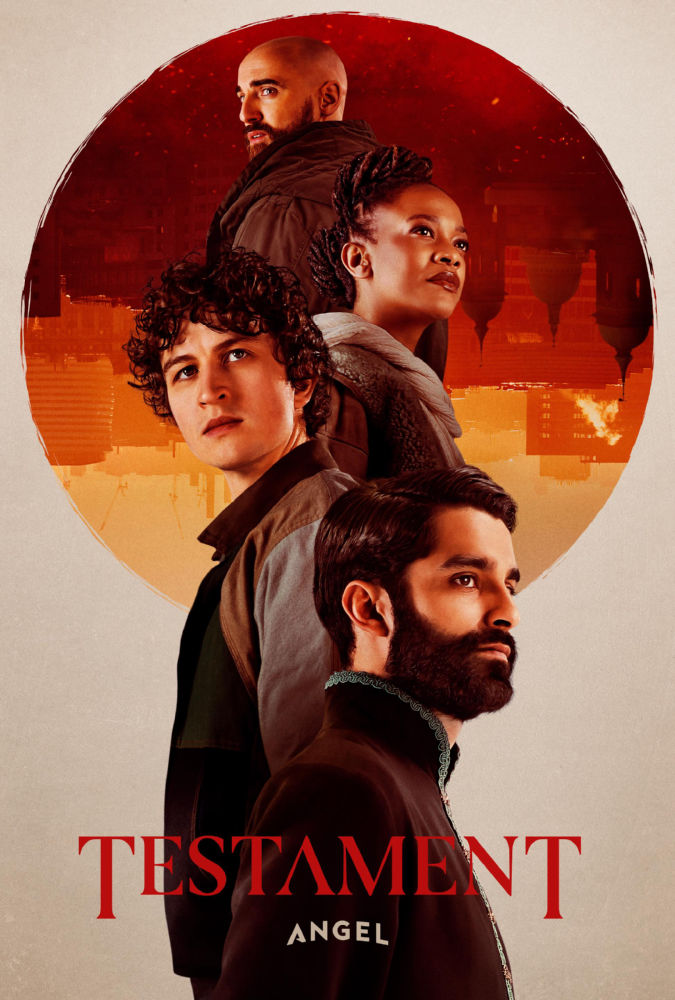



 TV · 2025
Testament
A modern reimagining of the Book of Acts follows Jesus’ early followers as a resurrection sparks a hopeful movement that collides with the Temple and an oppressive Imperium. Public miracles and fractured loyalties force everyone to face the cost of their choices.
Testament follows Peter and the other early followers of Jesus after a stunning resurrection upends their world in an alternate modern era. They begin preaching the good news in public, drawing crowds with signs and wonders while ordinary people find sudden hope amid surrounding chaos. The Temple authorities move quickly to contain the new movement, fearing it will provoke the Imperium regime into harsh retaliation. Peter and his companions risk arrest and worse as they refuse to stay silent, sharing what they have witnessed. Secrets long buried start to surface, testing loyalties inside both the growing fellowship and the religious establishment. Every choice carries weight as the message spreads farther than anyone expected.
As the followers press on, more public miracles force the Temple into open confrontation while the Imperium watches for any excuse to crush dissent. Fractured relationships inside the movement and among its opponents reveal personal stakes that go beyond politics or power. Some who once opposed the message begin to question everything they believed; others double down on silence and control. Peter and those closest to him keep preaching even when the danger escalates, holding to the promise they were told to wait for. Unburied truths and shifting alliances push both sides toward decisions that cannot be undone. The cost of speaking, or of trying to stop the speaking, becomes impossible to ignore.
Click any of the following icons below to rent or stream it!
Oops! Is this show WOKE?
Only an account holder or member can file. Cite a scene, a line, or a pattern. Other account holders +1 or −1 that argument, once each. The show is not WOKE until enough of them have given a +1. Enough −1s remove the write-up, and it is no longer shown.
Sign in to file a woke label. One of each criterion per member.
Comments and reviews
Report a mistake
Same rule as woke labels: one report, a written reason, and the community +1 or −1 it — once per member. A net +5 applies the change. Editors can hold it for review, or apply it immediately.
No mistake reports yet.
Sign in to report a mistake. One report per field, per member.
Member review
Stu Kline Member
Oct 7, 2026
★★★★★★★★★★Testament puts the Book of Acts into an alternate-modern setting and mostly gets away with it. A resurrection kicks off a movement that spreads hope while everything around it tries to crush the message. The followers keep preaching and the Temple works overtime to shut them up before the Imperium comes down hard. Public miracles, buried secrets, and people switching sides keep the pressure on both camps. That setup is solid enough that I stuck with it.
The early stretch works best. You feel the risk when ordinary people decide the good news matters more than their safety. Scenes of small gatherings turning into something larger have a real pulse. The show does not treat faith like a costume or a punchline. It lets the characters believe hard and pay for it. That alone kept me watching when the pacing slowed.
Where it loses steam is in the middle. The fractured loyalties pile up and start repeating the same beats. Someone doubts, someone betrays, someone gets pulled back. Fine once or twice. After the fourth or fifth cycle it feels like the writers are spinning plates instead of moving the story forward. The Imperium stays mostly off-screen as a looming threat, which works for atmosphere but leaves the actual day-to-day tension thinner than it should be. I wanted more concrete choices with clear costs instead of another late-night argument about who can still be trusted.
The miracles are a mixed bag. A couple land with genuine weight and change how people in the room look at each other. Others feel staged for the camera, like the production knew it needed a big moment and forced one. When a miracle actually costs someone something, the show is strong. When it just resets the board so the next chase can start, it undercuts itself. The alternate-modern world has cars, phones, and city streets that feel lived-in, but the rules of what power can and cannot do stay fuzzy. I never quite knew the limits, and that made some of the higher-stakes sequences harder to buy.
Performances are uneven in a way that matches the material. A few of the core followers carry quiet conviction that sells the danger. You believe they would keep talking even when the Temple has eyes everywhere. Supporting players sometimes slide into stock types—the zealot, the cynic, the one who just wants quiet. Not bad, just familiar. The Temple side gets some sharp moments of institutional panic, which I appreciated. Power protecting itself is always more interesting than cartoon villains, and the show mostly understands that.
I rated it 3.5 because the core idea has real force and the faith elements are handled with more honesty than I expected from something this scale. It does not sneer at the message or turn the believers into easy targets. At the same time it never fully trusts the simple power of people speaking openly and living with the fallout. Too many side plots about secrets and shifting allegiances dilute the central drive. When it stays close to the cost of preaching in a hostile system, it clicks. When it wanders into conspiracy loops, it feels longer than it needs to be.
Production values are decent without calling attention to themselves. The cities look used, not polished. Night scenes have enough grit that you feel the risk of being overheard. Music stays out of the way most of the time, which is a relief. I never felt lectured by the score telling me how sacred or how dangerous a moment was supposed to be. The show lets the faces and the words do that work, and when the writing is tight those faces are enough.
One thing that nagged at me was how quickly some characters flip from conviction to compromise and back. Real people do change, but the turns here sometimes happen because the plot needs a new obstacle rather than because the person has been cornered by their own beliefs. A tighter focus on fewer faces would have helped. I cared most about the ones who kept showing up even after they had every reason to disappear. Those arcs felt earned. The rest floated in and out.
Still, I finished the season and did not feel robbed of the time. In a year full of safer choices, Testament at least swings at something big. It takes source material that still matters to a lot of people and asks what it would look like if the same explosion happened under modern surveillance and modern power structures. That question is worth asking. The answers it gives are only partially satisfying, which is why it sits at 3.5 for me instead of higher. There is a sharper, leaner version of this story inside what they made. What reached the screen has heart and some genuine tension, but it also has stretch marks from trying to cover too much ground.
If you come in expecting a pure thrill ride you will bounce off the slower loyalty scenes. If you come in curious about how an ancient movement might look when phones and regimes can track every gathering, you will find stretches that stick with you. I am glad it exists. I just wish it had trusted its strongest material more and cut the repeated doubt cycles. The good news parts still cut through the noise. That is rare enough that I will remember those scenes longer than the ones that spun their wheels.