
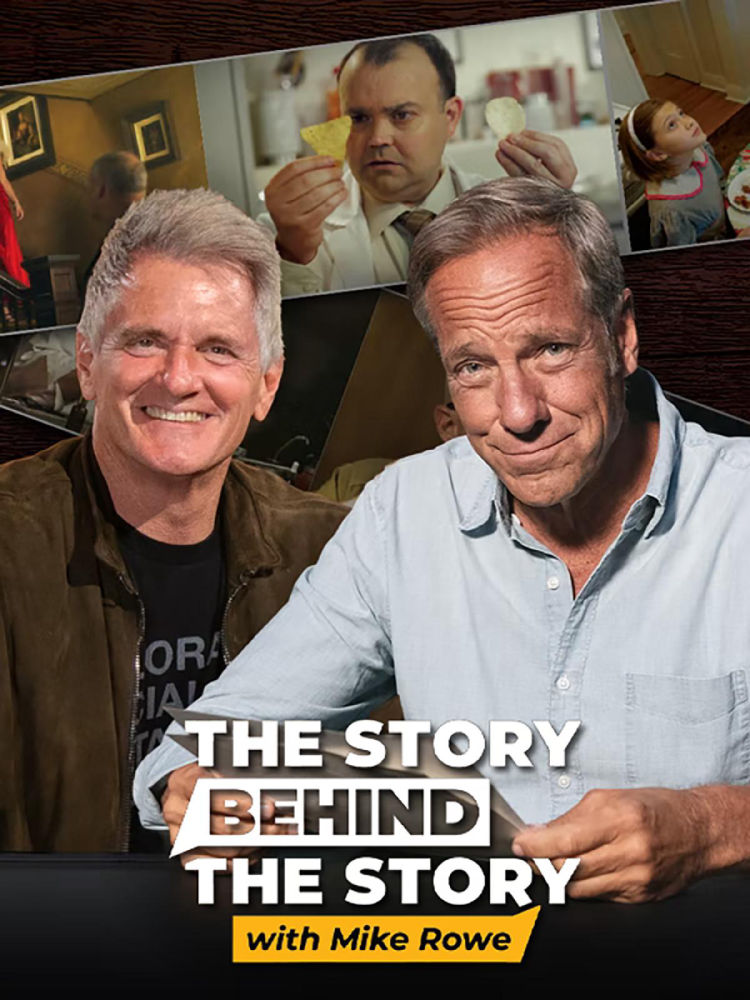



 TV · 2022
Story Behind the Story
Mike Rowe hosts compact true stories about inventors, celebrities, code breakers, and oddball criminals, each built around a hidden detail that flips the familiar version of the tale.
Story Behind the Story follows Mike Rowe as he digs into the overlooked back-stories of real people and events, drawing directly from the style of his podcast The Way I Heard It. Rowe opens each segment with a seemingly ordinary figure or moment—an inventor, a Hollywood name, a wartime code breaker, or even a naked bank robber—then layers in obscure facts that reframe everything. The narration stays conversational and linear, guiding viewers through the setup without digressions into modern politics. Concrete turns include the accidental discoveries, unlikely careers, and strange crimes that actually happened, always aimed at the final twist. Episodes remain self-contained, letting the historical record itself supply the surprise rather than invented drama or messaging.
Later installments keep the same rhythm: Rowe introduces another real-life subject, builds the conventional understanding of their fame or failure, then reveals the detail that changes the meaning. Relationships and rivalries appear only when they drive that reveal, never as extended soap-opera arcs. Viewers encounter inventors whose mistakes became industries, performers whose private choices rewrote public legends, and ordinary people whose single bold or foolish act entered the record. The half-hour family-friendly format ends each tale cleanly once the twist lands, leaving the next episode free to start fresh with a new name and a new hidden angle. No overarching plot binds the seasons beyond Rowe’s steady voice and the promise of another unexpected true story.
Click any of the following icons below to rent or stream it!
Oops! Is this show WOKE?
Only an account holder or member can file. Cite a scene, a line, or a pattern. Other account holders +1 or −1 that argument, once each. The show is not WOKE until enough of them have given a +1. Enough −1s remove the write-up, and it is no longer shown.
Sign in to file a woke label. One of each criterion per member.
Comments and reviews
Report a mistake
Same rule as woke labels: one report, a written reason, and the community +1 or −1 it — once per member. A net +5 applies the change. Editors can hold it for review, or apply it immediately.
No mistake reports yet.
Sign in to report a mistake. One report per field, per member.
Member review
Dan Reilly Member
Oct 19, 2026
★★★★★★★★★★Story Behind the Story starts with a problem that never quite goes away. Mike Rowe takes the clean, linear style of his podcast and tries to make it work as television, but the compact format keeps bumping into its own limits. Each piece opens on a familiar name or event, then spends most of its time setting up the hidden detail that is supposed to flip everything. Too often that setup feels like it is marking time. You sit through the ordinary version you already half-know, waiting for the turn, and when the turn arrives it is neat rather than startling. The running time of these segments does not leave much room for texture or second thoughts, so the flip can land like a punchline instead of a genuine reframe. I kept wanting one more layer or one more loose end left hanging, and the show almost never gives it.
The production itself stays modest in a way that sometimes undercuts the ambition. Talking-head framing, archival stills, the occasional reenactment snippet—it all looks serviceable, but it rarely feels like it has to be television. A lot of the time you could close your eyes and get nearly the same experience you would from the audio version. Rowe’s voice carries the load, conversational and steady, guiding you without digressions into the usual cultural score-settling. That restraint is welcome. Still, the visual side never quite earns its keep. When the story involves an inventor’s workshop or a wartime code room, the pictures stay decorative rather than illuminating. You leave knowing the twist, but you do not feel like you have lived inside the moment that produced it.
Where the series does better is in the simple pleasure of the material itself. Rowe has a good ear for the accidental discovery, the unlikely career path, the oddball criminal whose motive turns out stranger than the crime. Those concrete turns—the overlooked patent filing, the Hollywood name who got famous for the wrong reason, the code breaker whose personal quirk actually mattered—are the parts that stick. He does not dress them up with moral lectures or modern analogies. He just lays out the sequence and lets the final detail do the work. When that detail is strong enough, the episode feels like a short, sharp history lesson you did not know you needed. The self-contained structure helps here; you can drop in for one story without homework from the previous week. That accessibility is honest and useful.
I also appreciate that the show trusts the audience to sit still for facts. There is no frantic editing or forced comedy undercutting the narration. Rowe sounds like a guy who has done the reading and wants to tell you what he found, not like a host auditioning for a bigger platform. The absence of current-politics detours keeps the focus on the people and events themselves. Inventors stay inventors, criminals stay criminals, and the hidden detail is allowed to be interesting on its own terms. That approach feels rarer than it should. A few of the celebrity stories lean a little too hard on the “you thought you knew them” tease, but even those usually recover once the obscure fact arrives.
The ceiling, though, remains lower than it could be. Because every episode is built to the same shape—ordinary setup, layering of obscure facts, final flip—the pattern becomes predictable after a handful of installments. You start spotting the moment the turn is coming. The show never risks a story that refuses to resolve cleanly or that leaves you arguing with the interpretation. It prefers tidy packages. That choice keeps things light and watchable, yet it also keeps the series from feeling essential. I finished most episodes mildly pleased and immediately ready for the next distraction. The best ones made me look something up afterward; the rest simply filled half an hour.
Credit where it is due: Rowe is doing something straightforward that a lot of history programming no longer bothers with. He is not trying to make the past a mirror for today’s grievances. He is not padding runtime with talking-head experts restating the obvious. He is telling small true stories with a clear beginning, middle, and twist, and he is doing it without apology for being interested in the past on its own terms. That basic competence is why the show earns its keep even when the format frustrates. It is the kind of program you put on when you want a clean narrative and a single memorable fact to carry away. It rarely exceeds that modest goal, and it rarely falls short of it either.
I landed at 3.5 because the skepticism never fully left. The gimmick of the hidden detail works often enough to keep you watching, yet the thinness of the presentation and the sameness of the structure keep it from rising higher. If you already like Rowe’s podcast voice, you will find the same strengths and the same limits here, only with pictures that do not add as much as they could. It is decent, occasionally sharp, and almost never more ambitious than it needs to be. That is both its charm and its ceiling.