
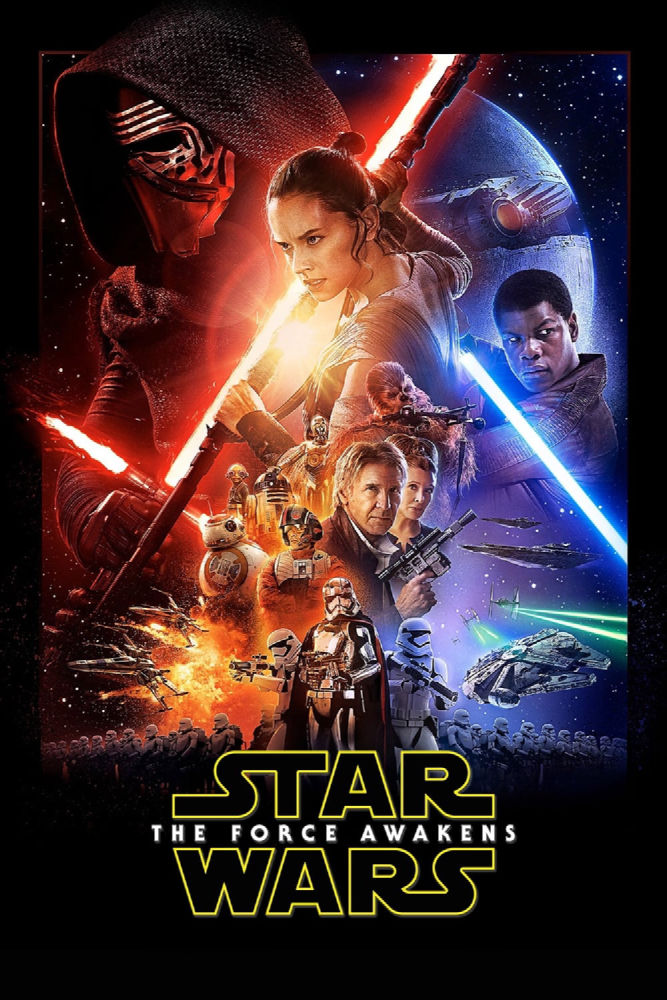



 MOVIE · 2015
Star Wars: The Force Awakens IS WOKE
Thirty years after defeating the Galactic Empire, Han Solo and his allies face a new threat from the evil Kylo Ren and his army of Stormtroopers.
WHAT CRITERIA MAKES IT WOKE?



Oops! Is this show WOKE?
Only an account holder or member can file. Cite a scene, a line, or a pattern. Other account holders +1 or −1 that argument, once each. The show is not WOKE until enough of them have given a +1. Enough −1s remove the write-up, and it is no longer shown.
Sign in to file a woke label. One of each criterion per member.
Comments and reviews
Report a mistake
Same rule as woke labels: one report, a written reason, and the community +1 or −1 it — once per member. A net +5 applies the change. Editors can hold it for review, or apply it immediately.
No mistake reports yet.
Sign in to report a mistake. One report per field, per member.
Member review
Dan Reilly Member
Sep 20, 2026
★★★★★★★★★★The first thing that bugs me about The Force Awakens is how little it trusts itself to stand on new ground. I sat down ready for a proper return after the prequels left me cold, and instead I kept clocking the same beats I already knew by heart. Desert planet, lonely scavenger, cute droid carrying crucial data, a bigger, badder planet-killer, the old hero showing up to mentor the kids—it plays like someone traced the original outline and filled in the lines with fresher paint. That safety net works for a while because the original was so strong, but by the third time a familiar piece of architecture shows up I started wondering whether anyone in the room pushed back and said we could try something that wasn’t already tested. The Starkiller Base sequence in particular feels like homework. Same trench, same countdown, same sense that the day will be saved by the same kind of shot we already saw work once. I get the comfort play after years of waiting, yet comfort without risk starts to feel thin once the novelty of seeing those ships again wears off.
Rey’s learning curve is the other spot that never sat right. She goes from never having held a lightsaber to holding her own against a trained dark-side user in what feels like an afternoon. I like her isolation and the way she scrapes by on Jakku; that part has grit. What doesn’t land is how quickly the Force just decides she is the main character and hands her the toolkit. It undercuts the sense that this stuff costs something. Finn has the opposite problem. His defection is the most interesting idea in the early reels—a stormtrooper who simply cannot pull the trigger—but the movie keeps yanking him sideways into comic relief or sidekick duty before that idea can settle. You can feel the film wanting both the dramatic weight of his choice and the easy laughs of him tripping over Resistance protocol, and it never quite picks a lane long enough to make either stick.
Still, I gave it four stars because when it stops shadowboxing the past it actually works. The moment the Falcon lifts off that junkyard with Han and Chewie already mid-argument is pure oxygen. Harrison Ford looks older and a little tired in the best way; he carries the weight of someone who has lived with these legends too long and is half-embarrassed they still matter. That scene where he and Leia just stand there looking at each other does more honest work than most of the bigger set pieces. You feel the years without anyone having to monologue about them. Adam Driver’s Kylo Ren is the real new blood. He is not a polished villain. He throws tantrums, he hesitates, he is clearly still figuring out how to wear the mask he chose. That insecurity makes him more dangerous than another invincible emperor type would have been. When he finally commits to the darkest choice available, it lands because the movie has already shown you he is capable of doubt.
The craft around all of this helps paper over the structural laziness. Practical creatures, real dirt on the costumes, the sound of the Falcon’s engines hitting the same register they always did—those details matter more than I expected. After the polished digital sheen of the prequels, just watching people sweat and stumble in real environments felt like a correction. Daisy Ridley and John Boyega have a lived-in chemistry even when the script keeps shoving them toward the next plot marker. BB-8 is the rare new droid that feels like it belongs instead of being designed by committee to sell toys. And John Williams still knows exactly when to let the brass come in and when to hold back. I caught myself grinning during the first jump to lightspeed even while my brain was busy cataloguing how many of the surrounding beats I had already seen.
What keeps it at four instead of climbing higher is the sense that the movie is constantly looking over its shoulder. It wants the goodwill of the original trilogy so badly that it forgets to earn its own. The map-to-Luke plot is a MacGuffin that never quite justifies how much running around it generates. General Hux and the First Order brass feel like they were written to fill chairs rather than to scare anyone. Yet every time I start listing the shortfalls I remember the quieter stretches—the campfire conversation, the way the lightsaber feels heavy when it finally gets passed, the simple pleasure of watching Chewbacca reclaim his seat. Those moments are why I still rate it solidly. It is not the bold reinvention some people pretended it was on opening weekend, and it is not the hollow cash-in others later decided it must be. It is a careful, occasionally inspired piece of franchise maintenance that knows exactly which buttons still work and presses them with more sincerity than cynicism. I walked out glad the series felt alive again, even if I also walked out wishing someone had been brave enough to leave a few of the old blueprints in the drawer.