


 MOVIE · 2023
Spider-Man: Across the Spider-Verse
IN REVIEW · the community verdict is still open
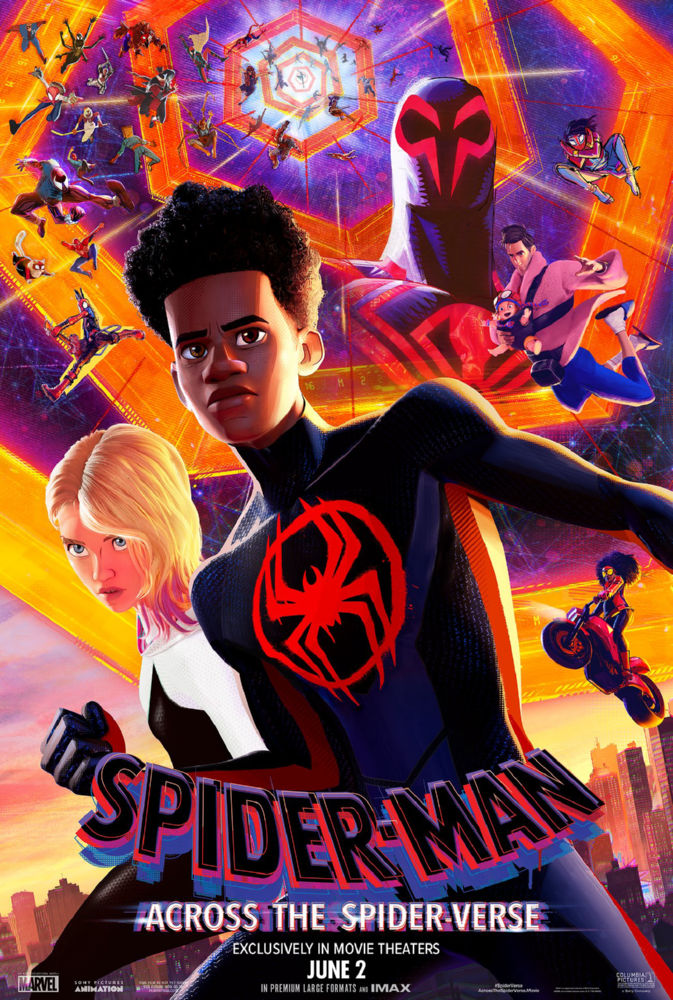
After reuniting with Gwen Stacy, Brooklyn’s full-time, friendly neighborhood Spider-Man is catapulted across the Multiverse, where he encounters the Spider Society, a team of Spider-People charged with protecting the Multiverse's very existence.
But when the heroes clash on how to handle a new threat, Miles finds himself pitted against the other Spiders and must set out on his own to save those he loves most.
Oops! Is this show WOKE?
Only an account holder or member can file. Cite a scene, a line, or a pattern. Other account holders +1 or −1 that argument, once each. The show is not WOKE until enough of them have given a +1. Enough −1s remove the write-up, and it is no longer shown.
Sign in to file a woke label. One of each criterion per member.
Comments and reviews
Report a mistake
Same rule as woke labels: one report, a written reason, and the community +1 or −1 it — once per member. A net +5 applies the change. Editors can hold it for review, or apply it immediately.
No mistake reports yet.
Sign in to report a mistake. One report per field, per member.
Member review
Wes Calder Member
Oct 10, 2026
★★★★★★★★★★I went in already knowing the first film, so the sequel didn’t have to reintroduce the whole idea of a kid from Brooklyn who got bit and then found out the universe is basically a crowded apartment building of spider people. That helped. Across the Spider-Verse moves faster once it decides what it’s doing, and the craft is still the main event. Different dimensions look like they were drawn by different hands on purpose—comic panels, rough ink, watercolor washes—and it doesn’t feel like a gimmick for most of the runtime. It feels like someone actually cared how each world should move.
Miles is still trying to keep school, parents, and the mask from colliding. That’s the spine. Gwen shows up again and the story opens outward into a formal Spider-Society that treats multiverse anomalies like a job with rules and a hierarchy. I noticed pretty quickly how Gwen is written here. She doesn’t wait for anyone to clear a path. She leaves her own dimension on her terms, slots into the Society’s leadership circle, and runs a lot of the sharpest action without a male character steering her choices or talking her through the next move. She’s operating as her own Spider-Woman the whole way—independent, decisive, already past the point of needing permission. You can see the film lean on that. It’s not subtle, and if you’re allergic to that particular modern template it will register. It registered for me. I still followed her scenes because the animation around her is kinetic and the voice work lands, but the independence is dialed all the way up as a feature, not a side effect.
The Society itself is the new machinery. Lots of variants, lots of protocol, a sense that someone out there is trying to keep every reality from tearing. Miguel and the rest of the bureaucracy give the story a colder edge than the first film had. That works when the movie wants friction between Miles’s instincts and the official line about “canon.” It works less when the screen fills with so many spider people that a few of them feel like cameos with attitude rather than people you could pick out of a lineup later. Spider-Punk is a blast in short bursts—the collage look, the noise—but I kept waiting for a sharper joke aimed at the actual punk record-shelf crowd and it never quite arrived. Close enough visually; not quite the in-joke it could have been.
Villain-wise, the Spot is the right kind of weird. Simple concept that gets worse the longer you look at it, which is what you want. The bigger conflict is less about punching a guy with holes in him and more about whether Miles will accept a role that costs him the people at home. Family scenes still carry weight. His parents aren’t comic relief; they’re the reason the multiverse stuff hurts. That balance is what keeps the movie from floating off into pure spectacle, even when the spectacle is the best thing in the room.
Length is real. You’re past two and a half hours and you can feel the movie saving pieces for the next chapter. Some threads stop at the interesting part instead of resolving. I’m not mad about a cliffhanger in principle, but it does mean this one plays like a middle chapter that also wants to be a event. The animation never phones it in during those stretches—every new style still gets full attention—but the story sometimes does the “we’ll finish this later” shrug a little early. Same strengths and same soft spots as the first film, just scaled up: the visuals can overwhelm the quieter beats, and the quieter beats are what make Miles worth caring about.
I didn’t need a comic-book education to track this one the way I half-needed it before. Familiarity with the first movie is enough. The emotional through-line is clearer, the set pieces are more ambitious, and the jokes mostly know when to get out of the way. I docked it a notch for the unfinished shape and for how hard it pushes the Gwen-as-self-contained-leader model past character into statement. Still left the theater knowing I’d watch the next one without being dragged. The craft alone is hard to argue with if you care about what animation can do when a studio stops playing safe. Four and a half. The half-point off is for the pause button at the end and for the parts that felt more like a checklist of independence than a person making hard choices. The rest holds.