



 MOVIE · 2005
Saints and Soldiers
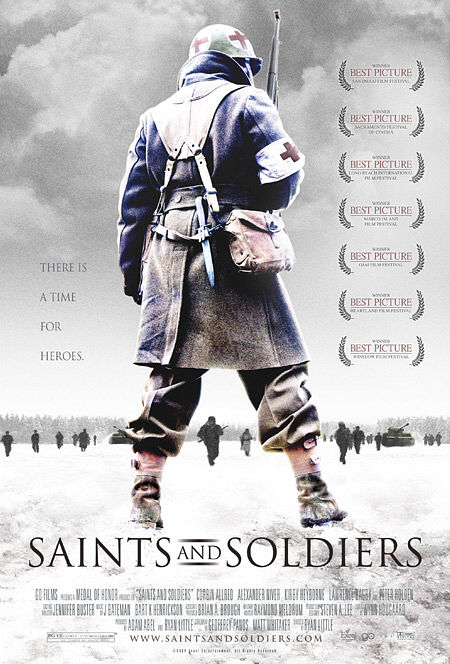
Saints and Soldiers is an action-packed story based on the horrifying historical event known as the “Malmedy Massacre.”
In December 1944, Hitler’s army blitzkriegs through the Ardennes Forest into Belgium, creating the terrifying wintertime offensive known as the Battle of the Bulge.
Corporal Nathan Greer and close-friend Sergeant Gordon Gunderson find themselves held captive with over one hundred other American soldiers in a snow-covered field.
Creator: Ryan Little
Click any of the following icons below to rent or stream it!
Oops! Is this show WOKE?
Only an account holder or member can file. Cite a scene, a line, or a pattern. Other account holders +1 or −1 that argument, once each. The show is not WOKE until enough of them have given a +1. Enough −1s remove the write-up, and it is no longer shown.
Sign in to file a woke label. One of each criterion per member.
Comments and reviews
Report a mistake
Same rule as woke labels: one report, a written reason, and the community +1 or −1 it — once per member. A net +5 applies the change. Editors can hold it for review, or apply it immediately.
No mistake reports yet.
Sign in to report a mistake. One report per field, per member.
Member review
Becky Soto Member
Oct 7, 2026
★★★★★★★★★★Saints and Soldiers sat with me longer than a lot of bigger war pictures do. I put it on mostly because the Malmedy opening still hits hard even when you know it’s coming, and then the rest of the film settles into something quieter and more personal than I expected. Four Americans and one British flight sergeant trying to cover twenty miles of frozen Ardennes with almost no ammunition and a piece of intelligence that actually matters—that bare setup is enough to keep you watching.
What stayed with me most was Deacon. Corporal Nathan Greer doesn’t speechify every five minutes, but his faith is just there, steady, the way some men carry a lucky coin or a letter from home. In that cold and that fear it felt natural rather than forced. The medic, Gould, pushes back hard, and their conversations are long. Some nights I might have wanted more action sooner, yet those stretches of walking and low talk built a real weight. You feel how tired they are, how every snap of a twig could be the end. The British airman, Winley, has the maps and the urgency, and watching the group decide who to trust and how far to push became the real story for me.
I liked that the film doesn’t rush the small decisions. Running low on food, choosing when to risk a fire, arguing over whether to take a shot that might give away their position—these moments land because the actors keep them ordinary. Nobody turns into a superhero. When the shooting finally comes it feels sudden and messy, the way it probably would for men who have been trying to stay invisible for days. One sequence in the snow near a farmhouse still sits in my head: the way the light falls, the short burst of violence, then the quiet afterward where nobody quite knows what to say. That quiet is what the movie does best.
The ending takes a turn I know some people roll their eyes at. Gould, who has spent most of the film refusing any talk of God, ends up doing something that looks a lot like grace toward a wounded German. I can see why that bothers a purely pragmatic viewer. Part of me wondered if it was too neat. But sitting there in the dark I also felt the exhaustion of the whole journey pushing him somewhere he didn’t expect to go. It didn’t feel like a sermon so much as a man who has seen too much finally letting go of the hardness he needed to survive. Whether that lands as inspirational or unrealistic probably depends on what you bring into the room. For me it was moving enough that I didn’t mind the earnestness.
The production is modest. You can tell the budget wasn’t huge, and a few of the larger action beats stretch credibility. Still, the winter looks real, the breath in the air, the way the men huddle and stamp their feet. That physical cold helps sell the moral cold of the opening massacre and the small mercies that follow. I kept thinking about how little these five men have left except each other and whatever scrap of belief or duty keeps them moving. Deacon’s calm doesn’t fix everything, but it gives the group a center when tempers fray.
I wouldn’t call it a perfect film. The dialogue about faith occupies a big share of the running time, and if you’re allergic to that it will drag. Some of the German patrols feel a little convenient in their timing. Yet the core held me: ordinary soldiers carrying something bigger than themselves through country that wants them dead. The British sergeant’s urgency about the reconnaissance photos never feels abstract; you understand lives further down the line depend on them getting through. That simple mission, stripped of speeches about grand strategy, kept me rooting for them even when the pace slowed.
When the credits rolled I sat for a minute. Not because it reinvented the war movie, but because it left me with the image of those men in the snow, one of them quietly praying, another still arguing, all of them just trying to take the next step. That stuck. I gave it three and a half stars because the heart is genuine and the tension of being hunted works, even if the craft is uneven and the spiritual thread will not be for everyone. It’s the kind of picture I end up recommending to friends who want something smaller and more human than the usual big-battle spectacle. A few days later I still remember Deacon’s voice more clearly than any explosion, and that feels like the right reason to have watched it.