



 MOVIE · 2025
RFK Legacy
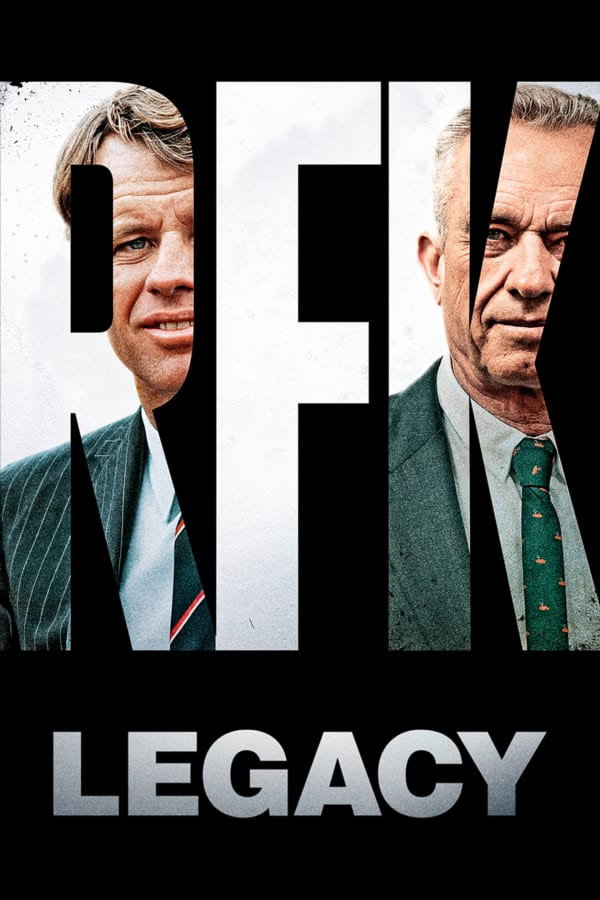
RFK Legacy charts Robert F. Kennedy and Robert F.
RFK Legacy follows Robert F. Kennedy and his son Robert F. Kennedy Jr. through decades of public battles that began in the upheaval of the 1960s and stretch into the present. The film recounts how the elder Kennedy confronted entrenched interests while serving as attorney general and later as a presidential candidate whose campaign ended in assassination. It then turns to the younger Kennedy’s own path as an environmental lawyer and later political figure who likewise refused conventional party discipline. Archival material and contemporary interviews trace the personal price each man paid for challenging official narratives. Family continuity becomes the through-line: shared stubbornness, shared targets, and shared isolation from the centers of power they opposed.
The documentary moves forward by pairing the father’s unfinished fights with the son’s later campaigns on health, corporate influence, and government secrecy. Viewers see Robert F. Kennedy Jr. pick up themes of institutional distrust that his father voiced, while the film underscores the human cost paid by spouses, children, and allies around them. Key episodes show both men choosing confrontation over accommodation, whether in Senate hearings, courtroom work, or public rallies. Later passages weigh how those choices reverberate in today’s polarized climate without resolving every controversy. The closing movement treats the family story as a warning that patterns of power and resistance keep returning rather than simply repeating.
Creator: Sean Stone
Click any of the following icons below to rent or stream it!
Oops! Is this show WOKE?
Only an account holder or member can file. Cite a scene, a line, or a pattern. Other account holders +1 or −1 that argument, once each. The show is not WOKE until enough of them have given a +1. Enough −1s remove the write-up, and it is no longer shown.
Sign in to file a woke label. One of each criterion per member.
Comments and reviews
Report a mistake
Same rule as woke labels: one report, a written reason, and the community +1 or −1 it — once per member. A net +5 applies the change. Editors can hold it for review, or apply it immediately.
No mistake reports yet.
Sign in to report a mistake. One report per field, per member.
Member review
June Pell Member
Oct 7, 2026
★★★★★★★★★★RFK Legacy sits with you longer than a lot of political documentaries do, mostly because it refuses to treat the father and the son as separate museum exhibits. It keeps setting Robert F. Kennedy’s years in the Justice Department and the Senate next to Robert F. Kennedy Jr.’s later stretch as an environmental lawyer, and the resemblance is not just blood. Both men keep stepping outside the comfort of their own side. That parallel is the whole reason the film exists, and for long stretches it works without needing to shout about it.
I went in half-expecting the usual tribute reel with soft lighting and swelling music. What I got was more patient than that. The older Kennedy’s fights against corruption and for people who had almost no institutional voice still land with real weight. You watch him push inside a Democratic establishment that already had its own habits and protections, and you feel the cost of that posture. Then the film cuts over to the son’s work founding and leading groups like Riverkeeper and Waterkeeper Alliance, taking on concentrated interests that prefer quiet deals to public reckoning. The through-line is not “heroism” as a brand. It is the repeated choice to break with orthodoxy when the easier path would have been to stay useful to the room you already occupy.
Family expectation hangs over both of them in ways the movie does not try to tidy up. The Kennedy name opens doors and then immediately charges rent. You sense how that pressure can harden a person’s sense of mission or, just as easily, distort it. I found myself thinking about other families where public service becomes a kind of inherited weather system—everyone breathes it whether they asked to or not. The film does not linger on gossip or palace intrigue. It stays with the public crusades and the institutional resistance those crusades produce. That choice keeps the temperature honest.
Where it settles at a 3.5 for me is the unevenness in how the two lives are weighted. The father’s decade gets the fuller dramatic arc; the son’s later chapters sometimes feel more like evidence boards than lived sequences. I wanted a little more texture around the day-to-day grind of the environmental cases—the slow accumulation of filings, the local alliances, the moments when a victory still left the water only half-cleaned. Those scenes exist, but they do not always carry the same voltage as the earlier Justice Department and Senate material. Documentaries that braid two eras often lean harder on the first because the archival footage is richer and the cultural memory is thicker. Here that tilt is noticeable without wrecking the project.
Still, the central idea holds. Both men appear as outsiders who keep testing the walls around power rather than decorating them. The film links the father’s willingness to challenge his own party’s settled interests to the son’s independent streak and his critiques of concentrated authority. You do not have to sign on to every position either man took to recognize the pattern. In a media climate that prefers simple team jerseys, that pattern is worth sitting with. I caught myself pausing the film once just to let a stretch of Senate footage settle—no narration, just the atmosphere of a man working against the grain of the building he was standing in. Those quiet patches are stronger than the occasional explanatory voice-over that tries to do too much summarizing.
There is also a useful restraint about motive. The movie does not pretend pure altruism or pure ambition. It lets the mixture stay mixed. Legacy can be a fuel and a trap at the same time. Watching the son navigate the same surname while building his own record in environmental law makes that double edge plain. I appreciated that the film did not flatten either figure into a mascot for a current faction. It stays interested in the repeated act of stepping outside the approved lane.
I have a soft spot for documentaries that trust the audience to hold two timelines at once without constant hand-holding. RFK Legacy mostly earns that trust. When it slips, it is usually by under-serving the later material or by letting a few transitions feel more schematic than organic. Even so, the core comparison stays sharp: two public lives spent testing entrenched power, shaped by family expectation, and marked by a stubborn refusal to treat institutional pressure as destiny. That is enough to make the film worth the time, even if it never quite becomes the definitive statement it sometimes reaches for. I walked away thinking about how rare it still is to see outsider posture treated as a continuous family habit rather than a single heroic season. That thought alone justified the sitting.
If you come looking for pure celebration or pure demolition, you will leave disappointed. If you come looking for a clear-eyed look at mirrored crusades across generations, you will find enough substance to keep turning over after the credits. My rating sits right in the middle-high range because the idea is strong, the execution is solid more often than not, and the gaps never fully erase the value of the parallel. It is the kind of movie that improves a little in memory once the structural seams fade and the two figures remain standing next to each other in your head, still arguing with the rooms that wanted them quieter.