
Find a mistake?
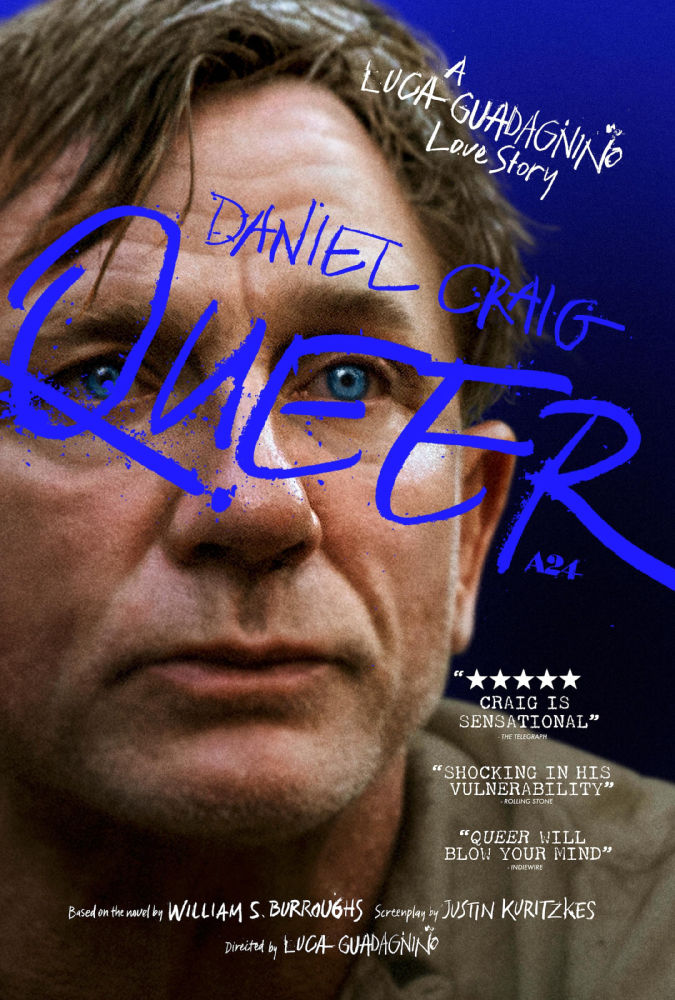


 MOVIE · 2024
Queer IS WOKE
–
Not ratedCommunity rating
Label it
IS WOKE
No summary on file yet. Know this one? Tell us.
WHAT CRITERIA MAKES IT WOKE?

Oops! Is this show WOKE?
Only an account holder or member can file. Cite a scene, a line, or a pattern. Other account holders +1 or −1 that argument, once each. The show is not WOKE until enough of them have given a +1. Enough −1s remove the write-up, and it is no longer shown.
Sign in to file a woke label. One of each criterion per member.
Comments and reviews
Report a mistake
Same rule as woke labels: one report, a written reason, and the community +1 or −1 it — once per member. A net +5 applies the change. Editors can hold it for review, or apply it immediately.
No mistake reports yet.
Sign in to report a mistake. One report per field, per member.
Member review
Becky Soto Member
Oct 10, 2026
★★★★★★★★★★I settled in with Queer the other evening mostly because Daniel Craig was attached and I was curious how he would handle this kind of material. What I ended up noticing almost immediately is that the entire story hangs on William Lee’s romantic and sexual pursuit of the younger Eugene Allerton. Every major stretch of the film is powered by that non-heterosexual desire; it is the central engine, not a side thread. Lee is an American expat killing time in 1950s Mexico City with drink and heroin and restless nights in bars, and once he locks onto Allerton the movie never really looks elsewhere. The longing is one-sided and awkward and sometimes painful to watch, and that imbalance is what the picture keeps returning to.
There is a stretch early on that stuck with me more than I expected. Lee keeps arranging these dinners and bar meetings, trying to draw Allerton out while the younger man stays cool and mostly closed off. The silences between them feel loaded, and Craig plays the neediness without making it cartoonish. You can see Lee hoping each shared meal or walk will tip into something closer, and Allerton just accepts the company and the free drinks without giving much back. That pattern repeats, and it creates this lopsided courtship that the film studies at length. I found myself leaning in during those moments because the discomfort felt honest, even if the overall pace never picks up.
Later they head south looking for yagé, the plant brew that is supposed to open some kind of mind-to-mind connection. Lee is clearly desperate for any shortcut that might fuse them together, and the trip itself becomes another expression of that same hunger. The landscapes open up and the addiction deepens, but the emotional center stays locked on whether Allerton will ever match Lee’s intensity. I kept thinking about how completely the plot refuses to branch away from that pursuit. There is loneliness and self-destruction layered in, yet those elements serve the central chase rather than standing on their own. It is not subtle, and after a while the single focus started to feel narrow to me.
I have to admit the movie asks a fair amount of patience. It moves at a glacial speed and seems to assume you already know something about the source material or the life behind it. Without that background a few stretches land as meandering or even pretentious. Scenes linger on faces and half-finished conversations longer than they need to, and I caught myself wondering whether the picture could have stood more clearly on its own. Still, Craig is committed. He lets Lee look both predatory and fragile at the same time, which keeps the character from turning into a simple caricature. The younger actor playing Allerton does a good job of staying just out of reach, which is exactly what the story requires.
What surprised me is how the film treats the addiction and the expat drift as almost secondary to the romantic obsession. Lee’s days fill with substances and empty cruising, yet the camera and the script keep pulling everything back to Allerton. That choice makes the whole experience feel like a study of one man’s fixation rather than a broader portrait of the period or the place. I can see why some people might bounce off it entirely; if the central relationship does not hold your attention, there is not much else to grab onto. For me it held just enough. The awkward dinners, the loaded chess games in the bar, the quiet dread on the road south—those beats stayed with me after the credits.
I landed at three stars because the craft is solid and Craig is doing interesting work, but the single-minded focus on that pursuit eventually wears thin. The movie never pretends the desire at its center is anything other than the main event, and that honesty is both its strength and its limitation. It is not a film that tries to sneak anything past you; it puts the longing right up front and lets it drive every decision. I walked away thinking about how rarely stories commit that completely to one unbalanced attachment, and how exhausting it must have been for Lee to live inside it. That exhaustion comes through clearly, and it is probably the most lasting impression I took. If you go in knowing the pace will be slow and the emotional range deliberately limited, you might find the same quiet moments I did. I would not rush back for a second viewing, yet I am not sorry I spent the time with it once.