
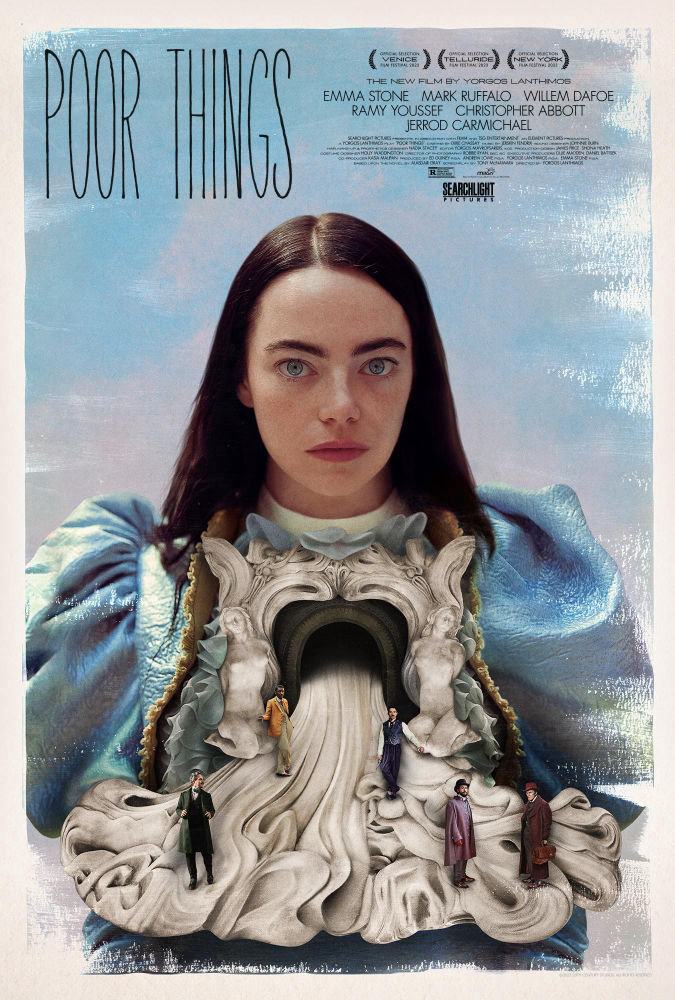



 MOVIE · 2024
Poor Things IS WOKE
Brought back to life by an unorthodox scientist, a young woman runs off with a lawyer on a whirlwind adventure across the continents.
Free from the prejudices of her times, she grows steadfast in her purpose to stand for equality and liberation.






Oops! Is this show WOKE?
Only an account holder or member can file. Cite a scene, a line, or a pattern. Other account holders +1 or −1 that argument, once each. The show is not WOKE until enough of them have given a +1. Enough −1s remove the write-up, and it is no longer shown.
Sign in to file a woke label. One of each criterion per member.
Comments and reviews
Report a mistake
Same rule as woke labels: one report, a written reason, and the community +1 or −1 it — once per member. A net +5 applies the change. Editors can hold it for review, or apply it immediately.
No mistake reports yet.
Sign in to report a mistake. One report per field, per member.
Member review
June Pell Member
Oct 10, 2026
★★★★★★★★★★Poor Things sat with me longer than I expected. I went in knowing it would be strange—Yorgos Lanthimos doesn’t really do ordinary—and came out still turning over how Emma Stone carries the whole thing. Bella Baxter starts as this reanimated creation under the eye of a scarred scientist in Victorian Glasgow, and the movie just lets her loose on the world. What struck me most wasn’t the steampunk flourishes or the oddball humor, though those are sharp. It was watching her mind catch up to her body in real time. Stone makes every stage feel specific without tipping into parody. You see it in how she walks, how her hair lengthens, how color starts to flood the frame once she steps outside the house. That physical storytelling does a lot of quiet work.
I kept thinking about the way the film treats curiosity as a kind of engine. Bella doesn’t just discover sex or money or travel; she tests every boundary she bumps into. Mark Ruffalo’s Duncan is pure chaos energy—he’s funny and pathetic in equal measure—and Willem Dafoe’s Godwin has this damaged paternal warmth that never quite settles into simple villainy. Ramy Youssef’s Max feels like the rare decent man in the mix, someone who actually believes she can choose her own path. The performances never fight each other; they orbit Bella’s growth. The score punches in at exactly the right moments without drowning anything out. And the cinematography keeps finding new angles on rooms you’ve already seen, so the world expands with her.
Still, the movie doesn’t hide what it’s doing with that growth. I noticed how Bella becomes more and more fixed in her purpose once she gets free of the prejudices around her. She doesn’t just want experience; she starts standing explicitly for equality and liberation, and the story turns her arc into a running critique of the patriarchal institutions that try to box her in—marriage contracts, medical authority, class rules, the whole Victorian machinery that treats women as property or experiments. You feel it in the way men keep trying to claim her, and in how she keeps walking past them. It’s not subtle. The film presents that steadfastness as the natural endpoint of her education, almost like the only honest conclusion once she sees how the world is built. I can admire the craft and still side-eye how neatly it maps onto a particular kind of feminist fable. It borrows the Frankenstein frame and then loads it with contemporary grievances about power and desire. Some of the satire lands because it’s broad and mean; some of it feels like the movie congratulating itself for pointing out that men have historically been controlling.
That tension is part of why I rated it as high as I did. The weirdness works. The film is long and sensual and occasionally violent, and it never quite lets you get comfortable. There are stretches where the comedy of manners collides with pure body farce, and somehow Stone holds the center. I laughed out loud more than once, then felt the discomfort settle in. It’s the kind of movie that rewards staying with it past the first ten minutes of pure oddity. The production design alone—those curved glass roofs, the fish-eye lenses, the shifting color temperature—makes every location feel like a stage Bella is rewriting as she moves through it. I caught myself wondering how they kept the tone from collapsing under its own ambition. Mostly it doesn’t. The script trusts the audience to follow the leaps without over-explaining.
I do wish it had dialed back the sermonizing just a notch. Once Bella’s purpose hardens into that equality-and-liberation stance, certain scenes start playing like illustrations rather than discoveries. You can almost hear the thesis clicking into place. Yet the movie is still inventive enough, and Stone is still so precise, that I couldn’t bring myself to dock it harder. It’s a ride that stays interesting even when it’s preaching. The supporting cast commits fully—nobody phones it in—and the whole thing has a confidence that most prestige oddities lack. I walked away thinking about freedom as both a physical and intellectual problem, which is more than most films manage. For all its flaws in leaning so hard into the patriarchal-critique platform, Poor Things remains one of the more memorable things I’ve sat through this year. It earns the high mark on craft and nerve, even when the messaging feels grafted on.