



 VIDEO GAME · 2022
Pentiment IS WOKE
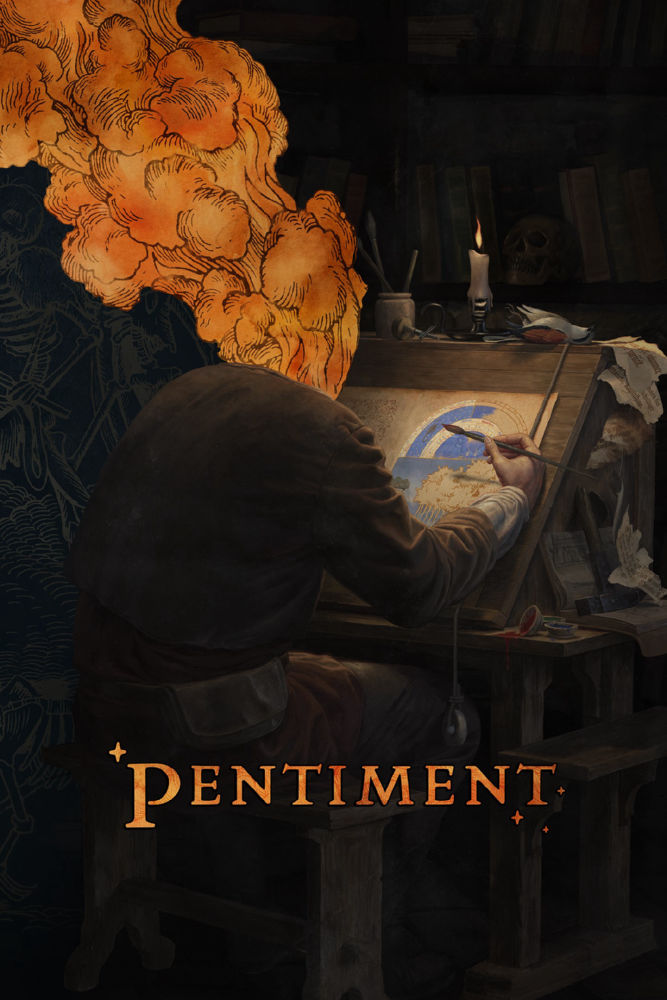
Step into a living illustrated world in a time when Europe is at a crossroads of great religious and political change.
Walk in the footsteps of Andreas Maler, a master artist who finds himself in the middle of murders, scandals, and intrigue in the Bavarian Alps. From Obsidian, this game is a historical narrative-driven game focusing on character development, heavily stylized art, and choice-driven storytelling in early 16th century Bavaria. Players will play as Andreas Maler, a clever illustrator caught up in a series of murders in Tassing and Kiersau Abbey over the course of twenty five years. Players will be responsible for conducting their own investigation to decide the fate of the community, but each decision will have lasting consequences and inexorably draws Andreas closer to the center of an underlying conspiracy.
Illustrated world Experience 16th century Europe as the master artists of the time saw them. Art inspired by great illuminated manuscripts and the earliest printed books becomes a living, breathing world in Pentiment. Uncover mysteries Choose different academic and social backgrounds and meet a colorful cast of characters as you discover the stories and secrets that lie within the small Bavarian town of Tassing and nearby Keirsau Abbey. Impact a changing world In an era of great religious and political change, each decision you make can have a profound impact on the community’s future. Find your own way through this turbulent time and see the consequences of your choices play out over generations.
Developer: Obsidian Entertainment
WHAT CRITERIA MAKES IT WOKE?


Oops! Is this show WOKE?
Only an account holder or member can file. Cite a scene, a line, or a pattern. Other account holders +1 or −1 that argument, once each. The show is not WOKE until enough of them have given a +1. Enough −1s remove the write-up, and it is no longer shown.
Sign in to file a woke label. One of each criterion per member.
Comments and reviews
Report a mistake
Same rule as woke labels: one report, a written reason, and the community +1 or −1 it — once per member. A net +5 applies the change. Editors can hold it for review, or apply it immediately.
No mistake reports yet.
Sign in to report a mistake. One report per field, per member.
Member review
Omar Quill Member
Oct 20, 2026
★★★★★★★★★★Pentiment ate more hours than I expected for a game with no combat and basically no inventory. I went in thinking it would be a chill point-and-click mystery I could half-watch while farming mats in something else, and instead I kept the headphones on and just walked Andreas around Tassing and the abbey like it was a second life. The art is the first thing that locks you. Everything looks like it was pulled straight out of a manuscript, ink blotches and all, and the way text appears with little flourishes depending on who is talking never got old. I kept pausing just to look at the margins.
You play as Andreas Maler, an artist who keeps getting dragged into murders and local messes over something like twenty-five years. The first two acts feel like proper detective work: you talk to people, dig through books, decide who to trust, and the clock actually matters so you cannot check every lead. That pressure made the choices feel real. By the third act a lot of it turns into long conversations you mostly click through, and a couple of those dialogue trees annoyed me hard. One spot with a doctor where he offers information and your only real reply is basically telling him to get lost felt dumb. Still, the overall story held me. Seeing the same families age, change jobs, hold grudges, or soften up across the decades is the part I keep thinking about. It is closer to a long novel you live inside than a regular game loop, and I do not mind that when the writing is this sharp.
I did notice how hard the game goes after the Church. The whole mystery frame keeps circling back to systemic rot inside the abbey and the higher clergy. The abbot and certain friars come off as greedy hypocrites who lean on the illiterate peasants with taxes and fear while preaching one thing and doing another. Deception and clerical crime sit right at the center, and the climax leans into that hard. It is not subtle. If you come in wanting a balanced look at faith in that era you will feel the thumb on the scale. At the same time the game is packed with real historical texture—actual books that existed, real theological arguments, the way ordinary people mixed saints’ days with older local stories—so the critique never feels like it came from nowhere. It just chooses a very particular angle and stays there.
The other thing that jumped out is the gay relationship between two monks inside Kiersau Abbey. For a tight cast in an isolated early-1500s Benedictine house and alpine village, that secret pairing takes up noticeable space. It is written with care and it affects how certain scenes land, but it is also a clear modern insertion into a setting that is otherwise obsessed with period detail. I do not think the game needed to pretend 16th-century Bavaria had the same ratios we talk about now. It is there, it is deliberate, and you will notice it.
Even with those choices I still came away loving most of the experience. The background traits you pick at the start of each act open different dialogue paths, and replaying to see how a different education or temperament changes a conversation is genuinely fun. There is no big skill tree or gear chase, just the slow accumulation of knowing every household in Tassing and watching your earlier decisions ripple forward. Some people call that glacial or pretentious. I call it the point. When a game makes me care whether a miller or a widow is still around twenty years later, it has done something right. The music stays spare, which fits the illuminated-page mood, and the little minigames (copying manuscripts, the occasional chase) are light enough that they never break the tone.
I have bounced off plenty of “important” narrative games that felt like homework. This one did not. It is introspective without demanding you already know Renaissance Central Europe, though if you do bring that knowledge you will catch a lot of extra layers. It is also refreshing that the whole thing stays planted in Bavaria instead of defaulting to the usual Italian city-state checklist. After I finished I sat there for a bit just scrolling back through the character list, remembering who had died, who had kids, who still held the same grudge. That does not happen with most titles I clear in a weekend.
Would I change the heavy anti-clerical framing and the outsized monastery romance? Yeah. They pull focus from the quieter historical texture that is the game’s real strength. But the illustration work, the way the town feels lived-in across generations, and the writing that makes imperfect people feel specific all outweighed those problems for me. I already started a second run with different background picks just to see which threads move. If you like slow, choice-heavy stories and can live with the ideological lean, this one is worth the time. I gave it 4.5 because the highs are that good and the frustrations never quite killed the spell.