



 MOVIE · 2026
Parable
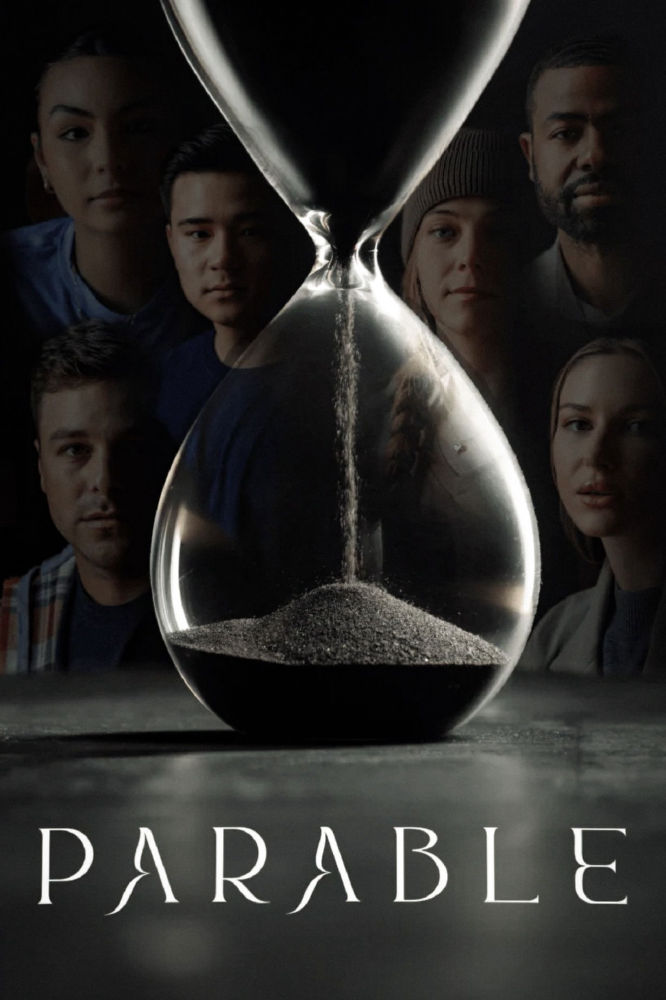
Six strangers awake trapped inside a loft with no memory of how they got there. Time counts down as the 6 confront secrets, suspicion, and themselves in a tense, character-driven mystery.
Parable follows an intense, character-driven plot centered around six strangers who abruptly wake up trapped inside an isolated loft with no memory of how they arrived. Adding to the psychological dread, a seventh individual lies completely lifeless on a bed within the room. With no apparent means of escape, the group discovers hourglasses ticking away, counting down the remaining minutes and forcing them into a desperate race against time to uncover the truth and find a way out.
As suspicion mounts and tensions escalate, the captor-free chamber piece transforms into a deep dive into human vulnerability, loss, and grief. Often described as a modern reimagining or "The Breakfast Club for a new generation," the film moves away from typical thrillers by using its high-concept premise to explore Christian themes of confession, hope, and redemption. Distributed through Angel Studios and starring an ensemble cast including Sabrina Broyles, Brian Duong, and Raquel Lebish, Parable ultimate demonstrates that the only true path forward is not physical escape, but confronting personal secrets and understanding one another.
Click any of the following icons below to rent or stream it!
Oops! Is this show WOKE?
Only an account holder or member can file. Cite a scene, a line, or a pattern. Other account holders +1 or −1 that argument, once each. The show is not WOKE until enough of them have given a +1. Enough −1s remove the write-up, and it is no longer shown.
Sign in to file a woke label. One of each criterion per member.
Comments and reviews
Report a mistake
Same rule as woke labels: one report, a written reason, and the community +1 or −1 it — once per member. A net +5 applies the change. Editors can hold it for review, or apply it immediately.
No mistake reports yet.
Sign in to report a mistake. One report per field, per member.
Member review
Dan Reilly Member
Oct 7, 2026
★★★★★★★★★★Parable starts with a setup that already feels worn out before the first hourglass even flips. Six strangers wake up in a sealed loft with blank memories and those little sand timers hanging over them like cheap stage props. The idea is that the ticking forces confessions and suspicion, which sounds workable on paper until you realize how many locked-room thrillers have already run this exact race. What didn’t work for me right away was how mechanical the whole pressure system felt. The hourglasses don’t create real dread so much as a countdown clock the script keeps pointing at, and once you notice the device is doing most of the heavy lifting the tension starts leaking out. Characters blurt secrets on cue, then circle each other with the kind of generic mistrust that never quite hardens into something personal or dangerous. I kept waiting for one of them to do something that felt like a genuine choice instead of another beat in the formula, and it rarely happened.
The loft itself is another problem. It’s meant to feel claustrophobic, but the camera treats it more like a bland multi-camera set than a pressure cooker. Lighting stays even, corners stay visible, and nobody ever seems truly cornered. When people start accusing each other the scenes play like table reads rather than people who might actually crack. A couple of the performers try to push past that—there’s a wiry intensity from the guy who keeps checking his own timer that almost lands—but the writing keeps yanking them back into speechifying about guilt and second chances. Secrets get revealed in tidy monologues instead of messy, overlapping fights, so the suspicion never really compounds. You can feel the script marking off boxes: trauma dump, false alliance, sudden betrayal. After a while I stopped caring who was lying because none of the lies felt expensive.
Pacing is uneven in the middle stretch. Long stretches of people sitting around debating trust give way to abrupt little set pieces that don’t escalate so much as reset the board. The hourglasses empty, new ones appear, the cycle repeats. That repetition undercuts the stakes. If the film had committed to one relentless timer instead of resetting the gimmick, the dread might have stuck. As it is, the structure keeps giving the audience (and the characters) little breathing rooms that the story can’t afford. I also got tired of the way every revelation is framed as a moral test rather than a practical one. Survival should force ugly trade-offs; here it mostly forces speeches.
Still, I won’t pretend the whole thing is a wash. Once the group dynamics settle, a few quieter moments actually land. There’s a stretch where two of them stop performing for the others and just sit with the fact that neither remembers enough to know if they’re the threat. Those scenes have a plain, uncomfortable honesty the louder confrontations lack. The sound design helps more than the visuals—low industrial hums and the faint rattle of sand do more atmospheric work than any of the dialogue about “who we really are.” And the final act, while not clever, at least stops pretending the loft is a therapy session and lets the remaining people act like cornered animals. That shift arrives late, but it keeps the movie from collapsing completely into self-important emptiness.
I rated it three stars because the craft is competent enough to watch once and the core idea still has a pulse, even if the execution keeps smothering it. The performances are serviceable rather than special; nobody is phoning it in, yet nobody finds a second gear either. Direction favors clarity over texture, which means you always know what’s happening and almost never feel it in your gut. If you’re looking for a tight little chamber piece that trusts silence and small gestures, this isn’t it. If you just want a rainy-night diversion with a locked door and some mild paranoia, it scrapes by. I walked away thinking the film knew it had a solid skeleton and then dressed it in the safest clothes possible. That safety is what keeps it from being better—and what keeps me from docking it further. It’s average in the exact way a lot of these mid-budget thrillers turn out average: nothing actively broken, nothing that sticks. I’ll remember the hourglass motif for a day or two and then move on, which is probably the fairest summary I can give.