
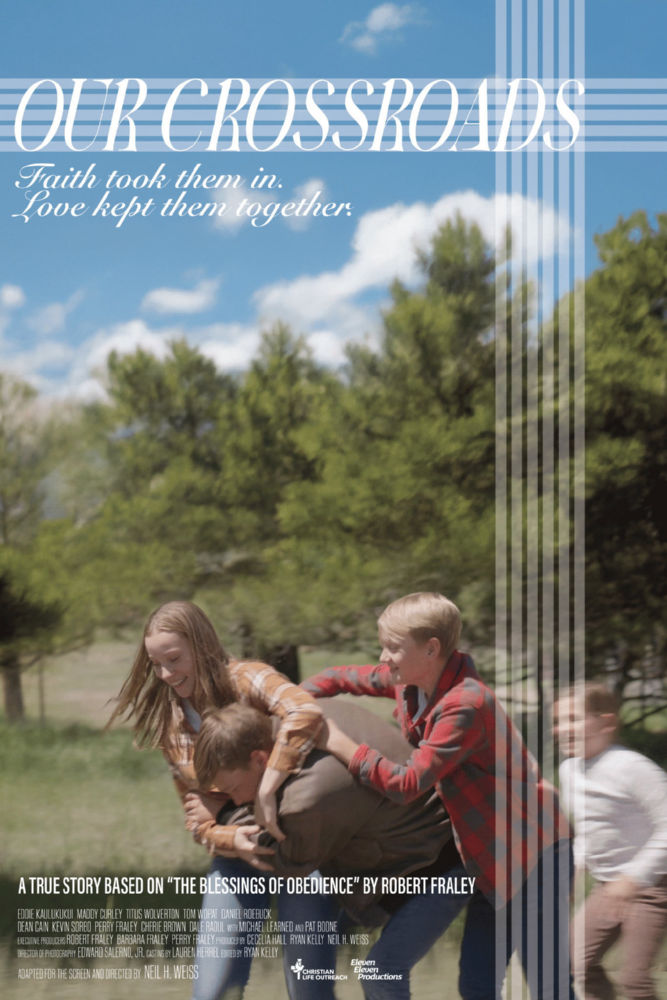



 MOVIE · 2024
Our Crossroads
An inspiring true story of a couple with two children in 1969 rural Ohio who are called by their faith to petition for guardianship of six recently orphaned siblings (4 - 18).
Our Crossroads chronicles the remarkable true-life story of Bob and Barbara Fraley. Set primarily in 1969 rural Ohio, the narrative follows the young couple—who already have two small children of their own—as they make the extraordinary decision to petition for guardianship of six local siblings, ages four to 18, who were suddenly orphaned after their parents died in a tragic car accident. Driven by their deep faith, the Fraleys face immense resistance from friends, family, and legal obstacles as they fight to keep the grieving children together under one roof, showcasing an enduring testament to selflessness and unconditional love amidst financial and emotional hardships.
The film frames this historical journey through a present-day lens in Arizona, where a spiritually troubled and cynical photographer named Ian is hired to shoot a portrait of the elderly Fraley family. As Ian learns about their incredible past through a series of emotional flashbacks, his initial skepticism and strained relationship with God are deeply challenged by the couple’s unwavering commitment.
Click any of the following icons below to rent or stream it!
Oops! Is this show WOKE?
Only an account holder or member can file. Cite a scene, a line, or a pattern. Other account holders +1 or −1 that argument, once each. The show is not WOKE until enough of them have given a +1. Enough −1s remove the write-up, and it is no longer shown.
Sign in to file a woke label. One of each criterion per member.
Comments and reviews
Report a mistake
Same rule as woke labels: one report, a written reason, and the community +1 or −1 it — once per member. A net +5 applies the change. Editors can hold it for review, or apply it immediately.
No mistake reports yet.
Sign in to report a mistake. One report per field, per member.
Member review
Stu Kline Member
Oct 2, 2026
★★★★★★★★★★Our Crossroads sits in that middle space for me where the core of the story is strong enough to hold attention, but the way it gets told keeps it from landing harder. I went in knowing it was based on a real couple in rural Ohio back in 1969 who already had two kids of their own and then stepped up for six orphaned brothers and sisters ranging from little kids to near adults. The goal was simple on paper and brutal in practice: keep those kids together under one roof instead of letting the system scatter them. That part still hits. Families like that do not get made often, and when they do the cost shows up in every corner of the house.
The movie splits time between that 1969 stretch and a present-day photographer in Arizona who is hired to take the family’s picture. He is spiritually off-balance, the kind of guy who still knows the language of faith but has not used it in years. Watching him learn the old story is the framing device, and it works better than I expected without turning into a sermon. He does not suddenly become a saint. He just starts seeing what selflessness actually costs when the numbers of mouths to feed jump overnight and the neighbors start talking. That felt honest.
What kept me at 3.5 instead of higher is the uneven stretch in the middle. The early Ohio scenes do the heavy lifting well enough. You get the petitions, the court skepticism, the practical chaos of fitting eight kids into a life that was already full. The parents are not painted as perfect. They argue about money and space and whether they bit off more than they can chew. Those beats feel lived-in. Then the film starts leaning on montage and soft music a little too often, and some of the orphaned kids blur together because there simply is not enough screen time to give each one a clear arc. I wanted more of the daily grind and less of the wide-eyed looks across the dinner table. Real life with that many kids would have been noisier and meaner in places, and the movie softens the edges more than it needs to.
The photographer thread is quieter and sometimes more interesting. His trouble with God is not some cartoon crisis. It is the ordinary kind where life has gone sideways and the old answers do not snap back into place. Seeing the old family’s choices through his eyes gives the whole thing a second layer without forcing a conversion speech at the end. I appreciated that restraint. Too many faith stories rush the payoff. This one lets the actions stand and trusts the audience to notice what they mean.
Acting is serviceable across the board. Nobody is phoning it in, but nobody is doing career-best work either. The couple at the center carry the load with a kind of steady decency that matches the material. The kids are hit or miss depending on the scene. Some of the younger ones feel natural; a couple of the older ones read more like they are performing the idea of trauma than living inside it. The Arizona photographer has the right unsettled energy, which helps sell the modern half.
I am not someone who needs every movie about faith to punch me in the chest. What I do want is a sense that the people on screen paid something real for the choices they made. This film gets there in stretches. The court scenes and the first weeks of the new household have weight. You feel the risk. Later it drifts toward neat resolution a little too cleanly, and that is where the rating settles. A tighter edit and a few more raw moments with the kids would have pushed it higher for me.
Still, the basic premise is worth sitting with. Most of us will never face a decision that large, but the smaller versions show up all the time: do you open the door when it is inconvenient, or do you protect the smaller circle you already have. The 1969 couple chose the harder road and made it stick. The movie does not pretend it was easy or that every day ended in harmony. It just shows the decision and the long follow-through. That is enough to make the two hours worthwhile even when the craft is only average.
I left thinking about how rare it is now to see a story like this told without apology or irony. No one is undercutting the family’s motives. No one is winking at the camera. It simply presents what they did and lets the photographer, and the viewer, sit with it. In a year full of louder movies that forget what ordinary courage looks like, this one stays quiet and sticks around. It is not perfect. It is solid. I would watch it again with family more than I would push it on strangers looking for fireworks. That is a fair place for a 3.5.