



 VIDEO GAME · 2026
Onimusha: Way of the Sword
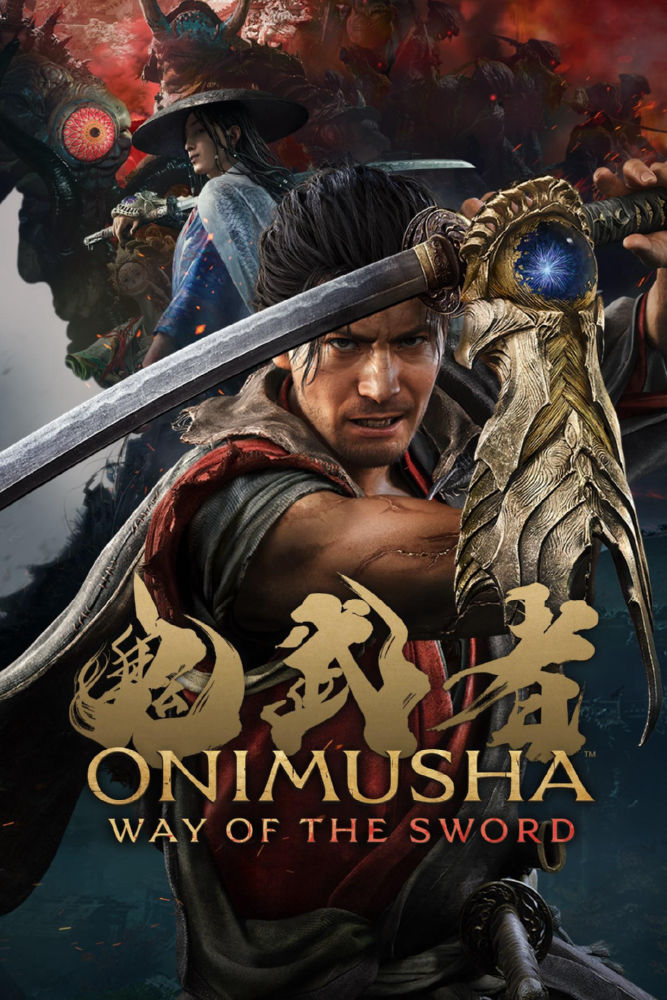
Revived by a supernatural force and bound to a magical Oni Gauntlet after a fatal encounter with demons, the legendary swordsman Miyamoto Musashi fights through an Edo-era Kyoto overrun by the Genma to stop a reality-altering conspiracy.
Set in feudal Japan, Onimusha: Way of the Sword follows the legendary wandering samurai Miyamoto Musashi as he seeks out master swordsmen to test his strength. After defeating the master of the prestigious Yoshioka School, Musashi faces a vengeful group of students before crossing paths with his great rival, Sasaki Ganryu. Before their duel can truly begin, supernatural demonic creatures known as the Genma ambush and kill both men. Musashi wakes up in the depths of Hell, where a mysterious Man in White forces a mystical Oni Gauntlet onto his arm and resurrects him in the mortal realm.
Bound to the gauntlet that sustains his life, Musashi travels to a corrupted Kyoto to purify sanctuaries and seal demonic rifts. He teams up with Ono Takamura, the guardian of the Oni Gate, and an assistant named Izumo no Okuni, while also encountering a transformed Ganryu who wields a similar gauntlet. As the journey unfolds, a companion named Shizuka emerges from the artifact to reveal a startling truth: the Man in White is actually Minamoto no Yoshitsune, a legendary and dangerous military strategist once imprisoned by the Oni. Musashi must master his unwanted power, confront his corrupted rival, and fight to stop the spreading malice threatening the mortal world.
Developer: CAPCOM Co., Ltd.
Oops! Is this show WOKE?
Only an account holder or member can file. Cite a scene, a line, or a pattern. Other account holders +1 or −1 that argument, once each. The show is not WOKE until enough of them have given a +1. Enough −1s remove the write-up, and it is no longer shown.
Sign in to file a woke label. One of each criterion per member.
Comments and reviews
Report a mistake
Same rule as woke labels: one report, a written reason, and the community +1 or −1 it — once per member. A net +5 applies the change. Editors can hold it for review, or apply it immediately.
No mistake reports yet.
Sign in to report a mistake. One report per field, per member.
Member review
Omar Quill Member
Oct 20, 2026
★★★★★★★★★★I’ve got around thirty-five hours in Onimusha: Way of the Sword and I keep catching myself wanting another boss run even though some of the open stretches started to wear thin. The combat is the whole reason I stuck with it. It starts simple—parries, basic strings, gauntlet abilities—but once the muscle memory locks in you just keep looking for things to fight because the button response feels that clean. Action difficulty lets you learn without constant death, and by the time I hopped into Carnage the last few bosses really gave me a run for my money. Timing windows get tight and you actually have to use everything you unlocked instead of mashing through.
Musashi bound to that Oni Gauntlet feels right once you stop treating every fight like a regular action game. The bosses are where the game lives. Designs stay distinct, the music swells at the right moments, and the arenas usually give you space to move without turning into pure chaos. There’s a duo fight somewhere in the middle third that might be the best pair fight I’ve done in years—two completely different patterns you have to track at once, and when you finally drop them both it feels earned. They reuse a handful of bosses later on. A couple of people would call that lazy, but the combat stayed satisfying enough that I wasn’t too bothered. Second time around you know the tells, so you can actually play cleaner and try different ability timings instead of just surviving.
The linear story chunks are the strong parts. You push through Kyoto districts with traps, short gauntlet rooms, light puzzles, then a proper boss. Those sections move. Then the map opens up and you get the side content that pads the clock—go here, clear that nest, fetch this. It’s largely uninteresting open-world busywork and it made me not want to replay the whole thing just to finish Carnage clean. I still knocked out most of the side stuff for completion because the combat loop is addictive, but the game would sit better if it was shorter and kept the focus on the main path and the big fights. Runtime feels stretched in places that don’t need stretching.
Story and cast surprised me more than I expected. Getting to know the people around Musashi actually lands, and the tone shifts from lighter early cutscenes into something more serious without losing the cinematic punch. The main antagonist has this weird grandpa-Joker energy that somehow works. There are moments where a perfect parry or a late-game ability lines up and it feels like pure aura—almost anime in the best way. Training room helped a lot. Having a clean space to practice strings and counters without loading a whole mission is the kind of small feature that keeps you improving instead of just grinding levels.
I ran it on PC at high settings and it held steady frames the whole way. Looked sharp, animations stayed smooth, sound design on the swords and Genma hits landed hard. Enemy variety in the open areas gets repetitive—same Genma types show up a lot—but a new story location or a fresh boss usually resets the boredom. Builds never got too deep, which matches the simple combat system; you aren’t drowning in menus, you’re just making the kit you already have work better. Sword feel sits next to something like Sekiro for me, only more forgiving on the recovery, so the learning curve never turned into pure frustration.
Final boss is one of the all-time greats in this style. Long, multi-phase, forces you to prove you actually learned the systems instead of carrying early habits. I finished the main story plus most sides and walked away wanting more of the boss-focused parts and less of the map filler. Capcom made the core loop feel excellent. Effects pop, counters have zero lag when you’re locked in, and you walk away from most fights feeling like a proper swordsman instead of a button masher. The padding and that tedious open-world layer are the only real reasons this isn’t higher for me. Still a clear 4.5. Combat carries everything, the best bosses stick with you, and once it clicks you can’t put it down for long. Hoping whatever comes next keeps the fights front and center and trims the busywork.