



 MOVIE · 2025
Off School Property
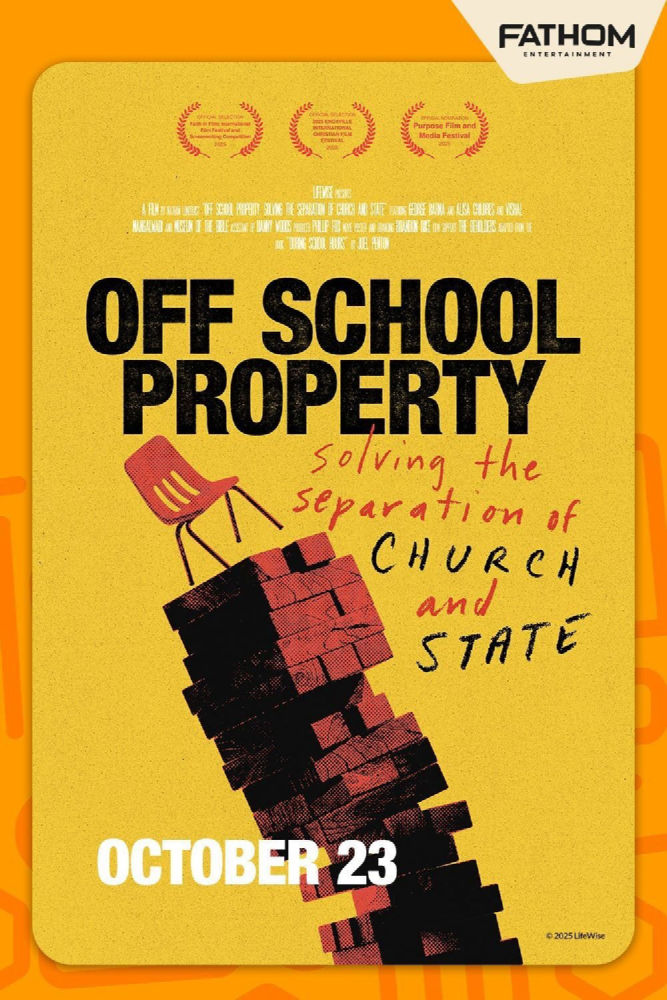
Off School Property: Solving the Separation of Church and State exposes the historic shift that removed the Bible from public education—and the lasting impact on students, schools and society.
Off School Property explores the historical removal of the Bible from the American public education system during the 1960s and details the subsequent cultural and moral impacts on students, families, and society. The documentary features prominent cultural researchers and evangelical voices, including George Barna, Alisa Childers, and John Stonestreet, to analyze how public schools transitioned away from scripture as a foundational academic and moral text.
Rather than focusing solely on what was lost, the second half of the documentary highlights a constitutionally sound path forward through Released Time Religious Instruction (RTRI). It showcases how LifeWise Academy legally brings Bible-based character education to public school students during regular school hours by transporting them to off-campus locations with parental permission.
Click any of the following icons below to rent or stream it!
Oops! Is this show WOKE?
Only an account holder or member can file. Cite a scene, a line, or a pattern. Other account holders +1 or −1 that argument, once each. The show is not WOKE until enough of them have given a +1. Enough −1s remove the write-up, and it is no longer shown.
Sign in to file a woke label. One of each criterion per member.
Comments and reviews
Report a mistake
Same rule as woke labels: one report, a written reason, and the community +1 or −1 it — once per member. A net +5 applies the change. Editors can hold it for review, or apply it immediately.
No mistake reports yet.
Sign in to report a mistake. One report per field, per member.
Member review
Lila Marsh Member
Oct 2, 2026
★★★★★★★★★★I sat down with Off School Property on a weeknight when I didn’t want anything flashy, just something that would actually talk about a subject most people treat like a third rail. The film looks at the long slide that took the Bible out of public schools and what that did to the culture inside those buildings and outside them. It doesn’t pretend this was a clean, neutral housekeeping move. It treats it as a real historical turning point with consequences that are still showing up in how kids learn, what they believe they’re allowed to say, and how thin the shared moral vocabulary has gotten.
George Barna’s presence helps. He’s not there to wave a flag; he brings the kind of research framing that makes you stop and check your own assumptions. The other voices in the film stay mostly in that lane too—serious, a little weary, not theatrical. I appreciated that. A lot of documentaries on faith and public life either preach to the choir until your eyes glaze or they sand everything down so nobody can take offense. This one mostly refuses both habits. It walks through how the separation idea got stretched past its original meaning, how court decisions and administrative caution piled up, and how that left schools treating religious expression like a hazard instead of a normal part of many families’ lives.
What landed for me was the section on what’s been lost in ordinary student life. Not the big culture-war soundbites—the quieter stuff. Kids who never encounter the foundational texts that shaped so much of Western literature and law. Teachers who self-censor even when a historical reference would be accurate and useful. Parents who feel like they have to choose between a public classroom and any serious moral formation. The film connects those dots without drowning you in footnotes. You can disagree with the weight it puts on certain court cases and still recognize the pattern it describes.
I also liked that it doesn’t stop at diagnosis. It spends real time on a constitutionally grounded approach some communities are already using, one that doesn’t require rewriting the First Amendment or turning public schools into churches. That part kept me from writing the whole thing off as nostalgia. Hope without a plan is just mood, and this film tries to show a plan that has already been tried in places. Whether every detail of that plan would scale is an open question, but at least they’re pointing at something concrete instead of just mourning.
Production-wise it’s straightforward. Clean interviews, decent pacing, no gimmicky reenactments. A couple of stretches lean a little long on talking heads, and I caught myself wanting one more on-the-ground classroom or family scene to break the rhythm. Still, the argument holds. I never felt manipulated into a conclusion I hadn’t already been walking toward with the evidence they laid out.
There’s a temptation with this topic to make every critic of secular school culture into a cartoon and every defender into a hero. Off School Property mostly sidesteps that. It assumes the audience can handle the idea that removing religious literacy and moral reference points had costs, and that some of those costs landed hardest on the kids who needed a stable framework the most. If you’ve spent any time around schools in the last decade, the “lasting impact” piece won’t sound abstract. You see the confusion, the thinness, the sense that everything is up for grabs and nothing is allowed to claim authority except the latest policy memo.
I rated it four stars because it does the hard part well: it names a real shift, backs it with people who have studied it, and then points toward a remedy that stays inside constitutional lines. It isn’t perfect. It could use tighter editing in the middle third, and a couple of claims would benefit from a sharper counter-voice so the debate feels fully joined. But I walked away clearer on the history and less cynical about whether anything constructive can still be done. That combination is rarer than it should be.
If you’re looking for pure outrage fuel, this isn’t it. If you want a sober look at how we got from a public square that could still talk about the Bible as part of our inheritance to one that treats that same text as contraband, it’s worth your evening. I keep thinking about the students who never get the chance to wrestle with the material on its own terms—not as indoctrination, just as part of the record. The film makes a solid case that the absence itself is a kind of curriculum. And once you see it that way, it’s hard to unsee.
My take is simple. The separation of church and state was never supposed to mean the separation of kids from the moral and historical sources that built the country they live in. Off School Property argues that point with more care than heat, and it left me convinced the repair work is both possible and overdue. Four stars feels right—strong, honest, unfinished in the best sense, because the real ending has to happen in actual communities, not on a screen.