



 MOVIE · 2017
Mountain Top
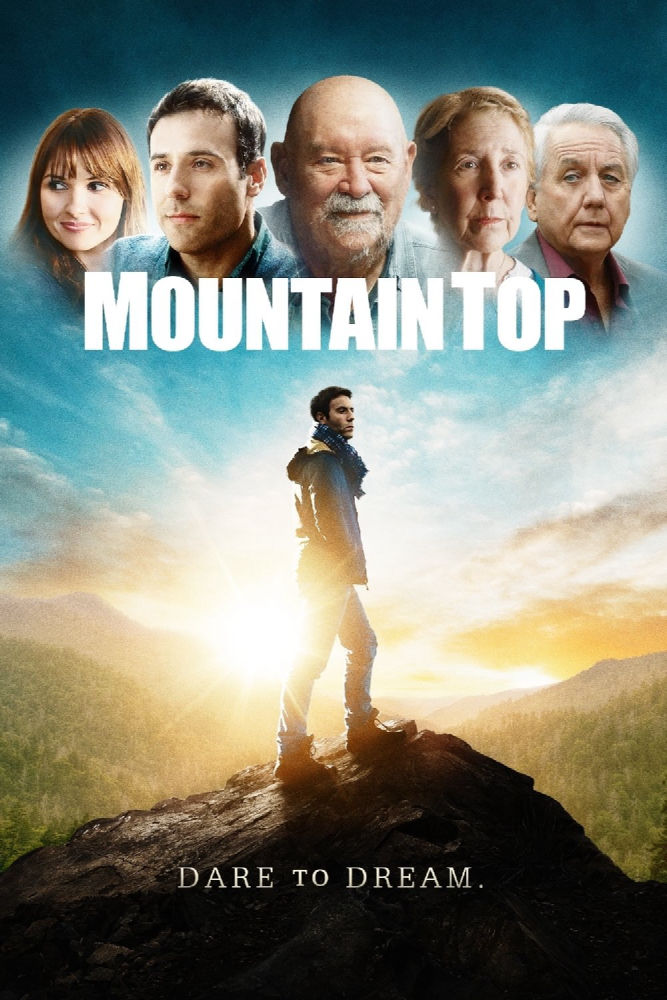
A lawyer-turned-preacher living in a small Appalachian town is pursued by an eccentric man to represent him in court.
Mountain Top follows Mike Andrews, a former attorney who walked away from his successful legal career to answer a higher spiritual calling as a small-town preacher in the Appalachian mountains. His quiet life is disrupted when he is approached by Muriel Miller to legally represent her eccentric husband, Sam Miller. Sam is an elderly local man who has landed in deep legal trouble after being accused of embezzling a substantial sum of church money.
Initially reluctant to return to the high-stakes friction of the courtroom, Mike is forced to reconsider when he discovers that Sam's defense hinges on unusual, prophetic visions and dreams. As Mike takes on the pro bono case, he finds himself entangled in a dangerous small-town mystery that directly intersects with his own life and congregation. Over the course of the trial, Sam's visions become deeply personal, forcing the preacher-turned-lawyer to navigate a complex path of faith, community politics, and legal maneuverings to uncover the truth and clear the old man's name.
Click any of the following icons below to rent or stream it!
Oops! Is this show WOKE?
Only an account holder or member can file. Cite a scene, a line, or a pattern. Other account holders +1 or −1 that argument, once each. The show is not WOKE until enough of them have given a +1. Enough −1s remove the write-up, and it is no longer shown.
Sign in to file a woke label. One of each criterion per member.
Comments and reviews
Report a mistake
Same rule as woke labels: one report, a written reason, and the community +1 or −1 it — once per member. A net +5 applies the change. Editors can hold it for review, or apply it immediately.
No mistake reports yet.
Sign in to report a mistake. One report per field, per member.
Member review
Toni Briggs Member
Oct 2, 2026
★★★★★★★★★★Mountain Top sits in that thin space between a Sunday sermon and a legal procedural, and it never quite decides which one it wants to be first. I came to it knowing it was tied to the same circle that made War Room, and you can feel that pedigree in the earnestness. A former lawyer turned pastor in a quiet Appalachian town gets pulled back into court by a couple who are convinced God himself is drafting the retainer. The man in jail is accused of serious embezzlement, and the wife and her eccentric husband will not take no for an answer. That setup alone carries the central tension: is the Lord calling this man back to the courtroom, or is he supposed to stay in the pulpit where he belongs?
I kept turning that question over while I watched. Pastoral work is not the same muscle as trial work. One is about presence and steady care; the other is about strategy, cross-examination, and the willingness to live inside someone else’s mess for a while. The film understands that friction and does not rush past it. Coby Ryan McLaughlin plays the pastor with a kind of weary sincerity that feels lived-in rather than performed. You believe he left the law for reasons that still matter to him. When Barry Corbin and Lin Shaye show up as the insistent couple, they bring a cracked, almost comic energy that keeps the whole thing from turning into pure piety. Corbin in particular has that weathered authority that makes you listen even when the dialogue leans hard into divine prompting.
What worked for me is how little the movie apologizes for its worldview. Faith is not treated as a costume or a punchline. It is the air these people breathe. In a lot of current storytelling you can feel the writers tiptoeing around belief, either mocking it or sanding it down until it becomes vague self-help. Mountain Top does not do that. It lets the characters talk about calling and obedience without winking at the audience. That honesty is rarer than it should be. At the same time, the crime itself—the embezzlement charge and the small-town politics that surround it—never fully catches fire. You get the outline of a case that touches the preacher’s own community, but the procedural beats feel secondhand. Scenes that should tighten the screws instead settle into familiar rhythms. I wanted sharper edges on the legal side and a little more doubt on the spiritual side. The balance tips toward reassurance more often than it should.
Robert Whitlow’s novel is the source, and you can sense the book’s longer breathing room behind the film. Novels can afford to sit with a man’s internal argument for chapters; movies have to compress it into looks and short conversations. Sometimes the compression works. Sometimes it leaves the pastor’s decision feeling inevitable rather than hard-won. I kept wishing for one more scene where he simply cannot reconcile the two callings, where the cost of stepping back into law is allowed to hurt. The film gestures at that cost and then moves on. Still, the mountain setting and the ordinary faces around him give the story a texture that bigger studio faith films often lack. These are not polished suburban Christians solving neat problems. They feel like people who know what a bad winter and a tight budget look like.
I am not someone who needs every movie to catechize me, but I also get tired of the opposite habit—treating sincere belief as the mark of a simpleton or a bigot. Mountain Top avoids that trap completely. It does not lecture the viewer into agreement; it just lets its people live inside their convictions and see what happens when those convictions collide with a courtroom. That collision is messier in real life than it is on screen, and the movie knows it even when it softens the landing. The embezzlement case ends up mattering less as a whodunit than as a test of whether a man can still be useful outside the role he chose. I found that question more interesting than the verdict itself.
There are stretches where the direction feels cautious, as if the filmmakers were afraid of losing the message if they pushed the drama too hard. War Room had a clearer dramatic engine. This one wanders a little, especially in the middle hour. Yet I never felt talked down to, and I never felt the story was embarrassed by its own heart. In a crowded field of faith-based titles that either preach or pander, that restraint counts for something. The performances hold it together when the plotting thins out. McLaughlin carries quiet weight. Corbin and Shaye refuse to play the couple as cartoon zealots. Even the smaller townspeople feel specific rather than generic.
By the end I was left with a modest respect rather than a rush of excitement. The film does what it sets out to do without much flash and without much compromise. It asks whether a man who left the law can pick it up again without betraying the pulpit, and it answers in the affirmative while still letting you feel the strain. That is enough for a solid afternoon watch, especially if you have any patience for stories that take calling seriously. It will not convert the skeptical, and it does not try to. It simply tells its story with a straight face and trusts that the audience can handle it. I can respect that even when I wanted a tougher, leaner version of the same material. Three stars feels honest—worth the time if the premise already interests you, forgettable if it does not, but never cynical and never hollow.