



 MOVIE · 2022
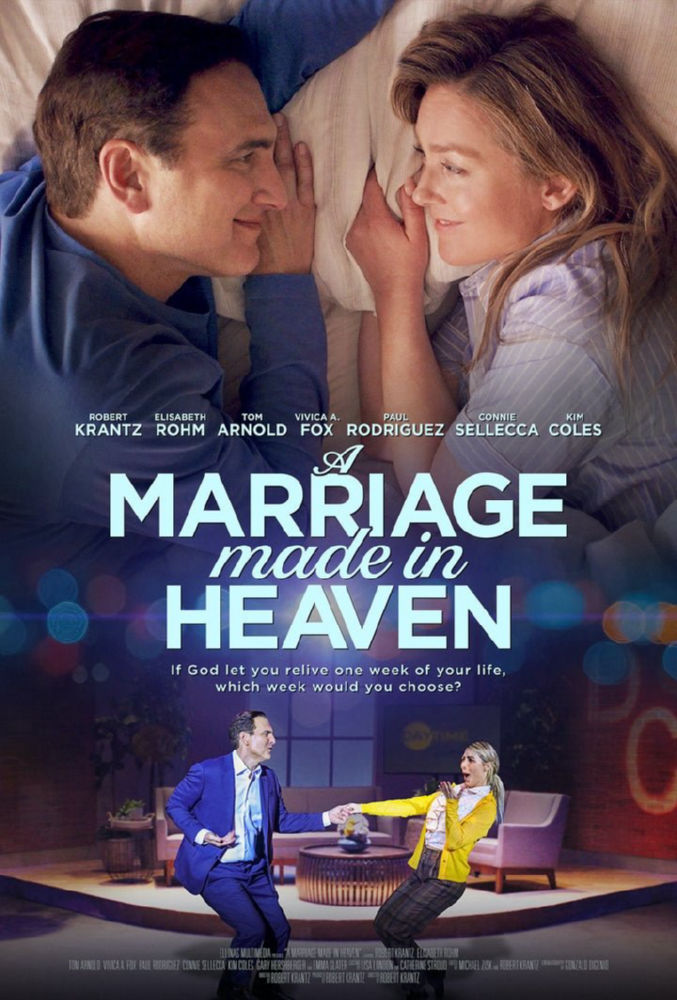
Marriage Made in Heaven
Demetri Chicopoulos is living a charmed life.
A Marriage Made centers on Demetri Chicopoulos, a successful daytime talk show host whose seemingly charmed public life masks deep personal grief. Struggling to cope with a recent, painful divorce from his wife (played by Elisabeth Röhm) and the devastating loss of his mother, Demetri falls into despair. In a vulnerable moment of prayer, he begs God for a second chance to relive just one pivotal week of his past, believing he can fix his mistakes and steer his life in a better direction.
To his astonishment, his prayer is answered when he is visited by his unorthodox guardian angel, Johnny Angel, played by comedian Tom Arnold. Granted a temporary trip back in time, Demetri must navigate the demands of his career—including pressure from his intense talk show producer, Patty Jensen (played by Vivica A. Fox)—while trying to mend his broken relationships with his wife and children.
Click any of the following icons below to rent or stream it!
Oops! Is this show WOKE?
Only an account holder or member can file. Cite a scene, a line, or a pattern. Other account holders +1 or −1 that argument, once each. The show is not WOKE until enough of them have given a +1. Enough −1s remove the write-up, and it is no longer shown.
Sign in to file a woke label. One of each criterion per member.
Comments and reviews
Report a mistake
Same rule as woke labels: one report, a written reason, and the community +1 or −1 it — once per member. A net +5 applies the change. Editors can hold it for review, or apply it immediately.
No mistake reports yet.
Sign in to report a mistake. One report per field, per member.
Member review
Dan Reilly Member
Oct 2, 2026
★★★★★★★★★★Marriage Made in Heaven sets itself up with a premise that should land harder than it does. Demetri has just come through a divorce and the death of his mother, and in a low moment he asks God for one more shot at a single week of his life. A guardian angel shows up and grants the request. That is the whole engine. On paper it has some weight. In practice the movie keeps bumping into the same soft spots that sink a lot of these faith-centered stories: the dialogue stays polite when it should get raw, the emotional turns arrive on schedule rather than from character, and the week itself never quite feels like a lived-in pressure cooker. You can see the beats coming from a fair distance. The angel is more of a gentle tour guide than a force that unsettles anything. Scenes that should hurt a little just sit there looking sincere.
The production does not help. Lighting is flat in too many interiors, the score leans on the expected strings at the expected moments, and a few supporting performances feel like they were locked on the first take. Chemistry between Demetri and the people from that pivotal week is uneven. Some exchanges land with real quiet, others sound like they were written to make a point rather than to sound like two people who already know each other’s faults. When the movie tries to show how small choices cascade, it sometimes just lists them instead of letting them accumulate. I kept waiting for the cost of the do-over to feel heavier. It never quite does. The film is so careful not to bruise anyone that it undercuts its own stakes.
That said, I am not writing this off. The central idea still has pull. Wanting to rewind one week after real loss is something most people can understand without a sermon attached. Demetri’s starting place—recent divorce, mother’s death—grounds the prayer in ordinary grief rather than abstract theology. When the movie stays close to that grief instead of rushing toward resolution, it works better. There are stretches where the actor playing Demetri lets the exhaustion show without overplaying it, and those are the parts that stuck with me. The guardian angel device could have been pure cheese; it mostly avoids that by keeping the tone measured instead of miraculous fireworks. No one is floating or glowing. The intervention is presented as a second chance with rules, and that restraint helps.
I also give it credit for not turning the divorce or the mother’s death into a lecture. A lot of films in this lane cannot resist making every personal failure a moral object lesson. This one mostly lets the regret sit. Demetri is not painted as a villain who needs to be fixed by cosmic forces; he is a guy who made ordinary mistakes and now has to live with the shape they left. That is more useful than a clean redemption arc. The week he relives is not packed with huge plot twists. It is smaller domestic and relational friction, which feels closer to how most of us would actually use a second chance if we got one. You keep hoping the script will dig one layer deeper into the marriage that fell apart or the things left unsaid with his mother. It does not always, but when it does the film earns its quieter moments.
Pacing is another mixed bag. The first act moves cleanly into the prayer and the angel’s appearance. Once the week begins, the structure gets a little circular—Demetri notices something, adjusts, watches the ripple, resets emotionally. It is not boring, exactly, but it lacks the tightening that would make the final stretch feel inevitable. By the time the consequences lock in, I was still interested, just not fully invested. The ending aims for hope without pretending everything is fixed, which is the right call. It just arrives a little softly. I wanted one sharper scene where the cost of changing the week collides with the original pain instead of dissolving it.
Technical complaints aside, there is a sincerity here that is hard to fake. Nobody is winking at the audience or hedging the faith element. The prayer is treated as real, the answer is treated as real, and the movie does not apologize for either. In a climate where religious stories often arrive either as parody or as propaganda, that straightforwardness counts for something. It is not trying to scold anyone into belief. It is trying to show what one man does with a limited gift of time. That is a cleaner ambition than most of these pictures manage.
I landed at 3.5 because the gaps are real and the execution never rises above competent-plus, yet the core still holds. If the script had trusted silence more and explanation less, or if a couple of the key relationships had been given messier edges, this could have been stronger. As it stands, it is a watchable, earnest film about second chances that does not insult the audience’s intelligence even when it fails to fully surprise them. I would not call it essential, but I also would not talk someone out of seeing it if the premise already interests them. It does enough right to leave a faint aftertaste of the week Demetri was given, and that is more than a lot of safer, glossier entries in the same lane manage.