



 MOVIE · 2025
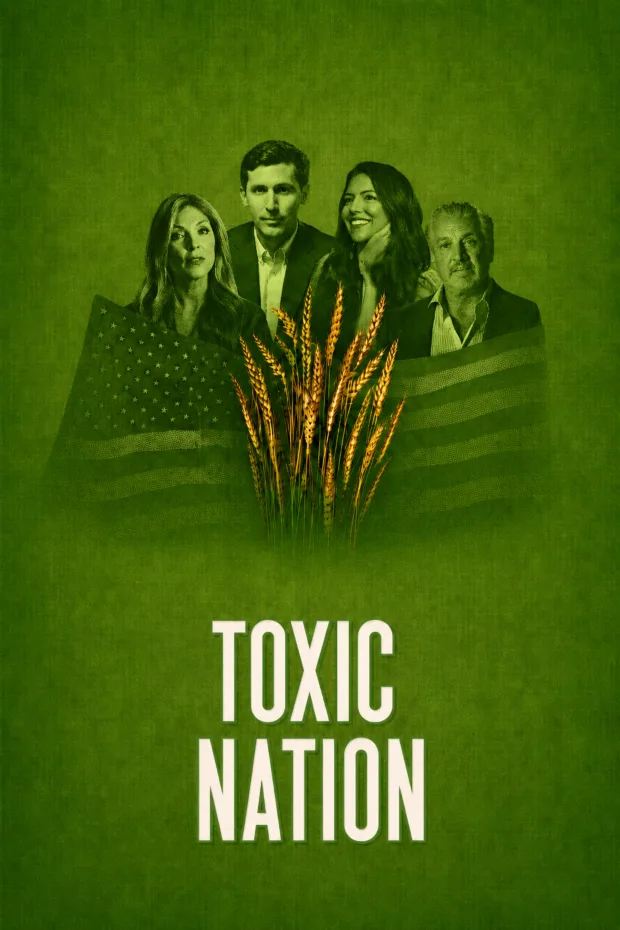
Maha Films Toxic Nation
MAHA Toxic Nation is a provocative health documentary examining the exposures Americans encounter in food, water, air, homes, and medical systems.
Toxic Nation investigates the underlying driving forces behind America’s surging chronic disease epidemic. Aligned with the “Make America Healthy Again” movement popularized by political figures like Robert F. Kennedy Jr., the film explores how everyday exposure to modern food manufacturing and environmental elements may be silently making the population sick. It specifically targets the prevalence of ultra-processed foods, seed oils, chemical pesticides like glyphosate, heavy metals, microplastics, and water fluoridation. Through internal document deep-dives and whistleblower accounts, the documentary argues that corporate interests across Big Food and Big Pharma have overlapping influence with captured government regulatory agencies, leaving major health warning signs unaddressed for decades.
Rather than just presenting alarming statistics, the documentary serves as an educational call to action that aims to empower families to reclaim their physical well-being. It features interviews with a diverse panel of doctors, journalists, advocates, and chefs—including Vani Hari (The Food Babe), Calley Means, and Dr. Cate Shanahan—who break down the science behind misleading nutrition labels and toxic consumer products. By examining the root causes of daily symptoms like chronic fatigue, anxiety, and metabolic disorders, Toxic Nation focuses on practical lifestyle changes and community awareness.
Creator: Jeff Hays
Oops! Is this show WOKE?
Only an account holder or member can file. Cite a scene, a line, or a pattern. Other account holders +1 or −1 that argument, once each. The show is not WOKE until enough of them have given a +1. Enough −1s remove the write-up, and it is no longer shown.
Sign in to file a woke label. One of each criterion per member.
Comments and reviews
Report a mistake
Same rule as woke labels: one report, a written reason, and the community +1 or −1 it — once per member. A net +5 applies the change. Editors can hold it for review, or apply it immediately.
No mistake reports yet.
Sign in to report a mistake. One report per field, per member.
Member review
Peg Harlan Member
Sep 19, 2026
★★★★★★★★★★Toxic Nation is the kind of documentary that doesn’t try to scare you out of your chair so much as make you look twice at the things you handle every single day. It walks through the ordinary exposures—what’s in the grocery cart, what’s coming out of the tap, what’s leaching from the containers and the household stuff, and even some of the routine things that show up in medical settings—and treats them as a slow pile-up instead of one dramatic villain. That approach felt right to me. Most of us aren’t living next to a factory spill. We’re just buying the same brands our parents bought and wondering why so many people seem to be dealing with more metabolic trouble, more developmental quirks in kids, more chronic complaints that never quite resolve.
The film brings in doctors, a few journalists, chefs who have to source ingredients for a living, and advocates who have spent years looking at labels and residue data. They talk about ultra-processed foods, the seed oils that ended up in everything, glyphosate traces, fluoride debates, heavy metals that turn up where they shouldn’t, and the plastics that seem to follow us from the store shelf into the kitchen and beyond. None of it is presented as a single smoking gun. The point keeps coming back to the cumulative load and the way regulatory bodies have gotten comfortable with industry language instead of plain public information. I didn’t need a conspiracy map to find that part believable. Captured agencies are not a new idea; they’re just usually discussed in jargon that most families never hear.
What worked for me was the refusal to turn it into a pure personal-responsibility lecture. Yes, people can make better choices when they have the information, but the movie keeps the focus on what is allowed into the supply in the first place. A chef talking about how expensive and inconsistent clean sourcing has become lands harder than any statistic. Same with parents noticing patterns that get shrugged off in a short clinic visit. Those moments feel like regular life, not activist theater. The documentary stays on the inputs—what enters the body day after day—rather than scolding anyone for buying the convenient option after a long shift.
I caught myself thinking about my own kitchen while it played. The oils I grab without reading the back, the packaged things that make weeknights easier, the water we assume is fine because the city says so. Nothing in the film pretends you can overhaul a household overnight or that every claim is settled science. It just argues that families deserve clearer transparency so they can decide for themselves. Some of the political voices lean in directions that will please one side more than the other, but the core material stays on the exposures and the health patterns tied to them. That kept me from tuning out.
They used to make them like this more often: lay out the problem, show the people who have looked closely, and stop short of telling you which party jersey to wear. Toxic Nation mostly holds that line. It doesn’t solve the regulatory tangle, and it shouldn’t have to. A few sections circle the same ground longer than necessary, and the production itself is plain—talking heads, footage of fields and processing lines, clinic corridors—without the glossy tricks that can make a documentary feel like a commercial. The plainness suits the subject. Fancy cutting would have undercut the everyday tone.
Medical care gets its share of attention too, not as an attack on doctors but as another place where plastics, residues, and accepted additives quietly add up. Linking that to broader metabolic and developmental trends is the thread that holds the interviews together. I don’t require every study cited on screen to be the final word; I want the film to make me notice what I had stopped noticing. It managed that. By the time it ended I was less interested in being frightened and more interested in asking better questions about what is permitted in the food and water systems we all share.
The call for families to push for honest information feels like the practical takeaway. Not a manifesto, just a reasonable demand that the people writing the rules prioritize clear public knowledge over comfortable relationships with the industries involved. Whether anyone in a position to change those rules is listening is another matter. The movie doesn’t pretend it has the leverage to force that. It simply puts the pattern in front of you and lets it sit.
I came away more alert to the steady drip of exposures than I was when I started, and that seems like a fair result for a documentary of this type. It isn’t perfect—some stretches could have been tighter, and a couple of the more pointed political inserts felt less necessary than the kitchen and clinic material—but the central idea holds. Systemic exposure is a different conversation from individual willpower, and this film keeps that distinction clear without turning preachy. For anyone who has ever stood in a store aisle wondering why the same products feel less trustworthy than they used to, it gives language and faces to that quiet suspicion. That is enough to make it worth the time.