



 MOVIE · 2016
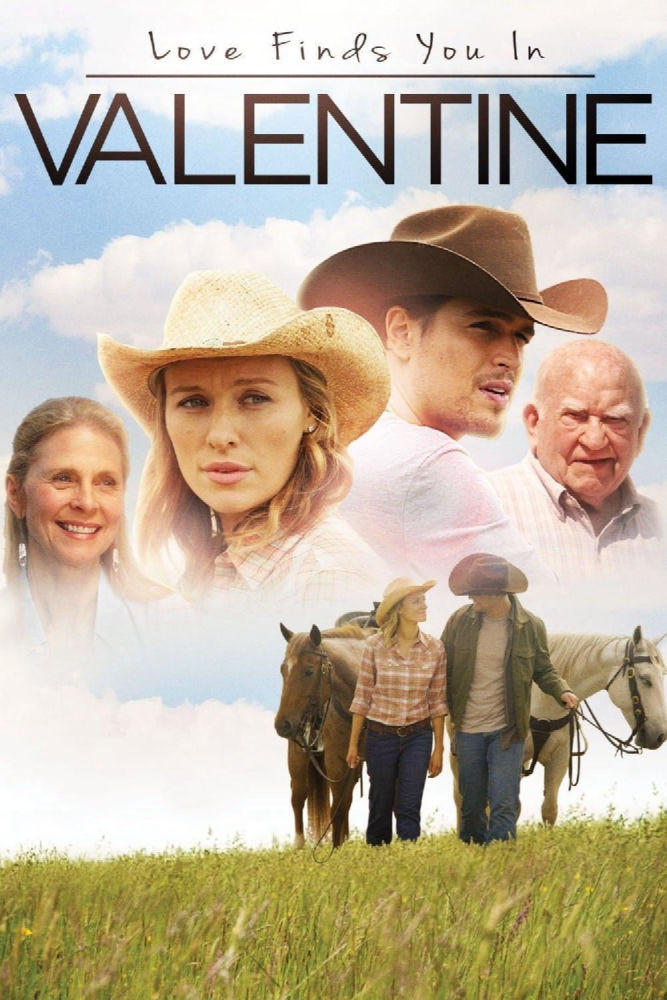
Love Finds You in Valentine
California law student Kennedy Blaine inherits a ranch in Valentine, Nebraska, and plans to sell it quickly.
Love Finds follows Kennedy Blaine (McManus), a law student from California who inherits a family ranch in the small town of Valentine, Nebraska. Although she initially travels there just to sign the sale papers and quickly return home, she decides to stay for the summer to learn more about her roots and the history of her estranged family.
During her time on the property, Kennedy grows closer to the ranch's rugged manager, Derek Sterling (Morgado), while uncovering old family feuds and hidden secrets. Her stay soon turns dangerous when an anonymous buyer or local threat tries to force her off the land. With Derek's help, Kennedy navigates these threats, reconciles with her past, and ultimately chooses to build a new life and find love in rural Nebraska.
Click any of the following icons below to rent or stream it!
Oops! Is this show WOKE?
Only an account holder or member can file. Cite a scene, a line, or a pattern. Other account holders +1 or −1 that argument, once each. The show is not WOKE until enough of them have given a +1. Enough −1s remove the write-up, and it is no longer shown.
Sign in to file a woke label. One of each criterion per member.
Comments and reviews
Report a mistake
Same rule as woke labels: one report, a written reason, and the community +1 or −1 it — once per member. A net +5 applies the change. Editors can hold it for review, or apply it immediately.
No mistake reports yet.
Sign in to report a mistake. One report per field, per member.
Member review
Ray Okonkwo Member
Oct 2, 2026
★★★★★★★★★★Love Finds You in Valentine ended up on my screen on a weeknight when I wanted something that would not demand much and would not leave me irritated. Kennedy Blaine inherits a working ranch in Valentine, Nebraska, and walks in with the clear plan of sorting the estate and leaving. That impulse felt honest. Sudden land and livestock do not automatically equal a new life, especially when the place already has people attached to it who never asked for a new owner.
The ranch manager is the first real obstacle and the part of the movie that stayed with me longest. He does not greet her with charm. He greets her with skepticism that comes from knowing the daily work and sensing she treats the place like a temporary problem. Their early exchanges over operations, paperwork, and who actually decides the future of the property have a plain stubbornness I liked. No big speeches, just two people who want different outcomes and keep bumping into each other while the cattle still need handling and the bills still arrive. Those scenes do more work than the later sentimental ones.
Outside pressure on the ranch keeps her from making a clean exit. Threats and complications force longer stays, and family secrets start surfacing in the middle stretch. That section dragged for me. Sorting documents and local conversations fill time and establish the small-town texture, but they also make the story feel like it is waiting for its own next beat. I caught myself checking the clock once or twice, which is never ideal even for light material. The inheritance stops being purely transactional once she has been there long enough for the land and the routine to register as more than an inconvenience. That shift is quiet and mostly earned through repeated contact rather than a single thunderclap moment.
I kept returning to the practical friction. A manager who lives the ranch and an heir who arrives ready to liquidate create natural conflict without needing villains. When they finally start sharing the load instead of blocking each other, the movie finds its better rhythm. A couple of quieter stretches out on the property—looking over the place after a long day, solving some ordinary problem together—landed cleaner than the louder confrontations. The romance builds the way these stories usually do, slow and expected, and the chemistry is serviceable rather than electric. It does not need to be more than that.
The Nebraska setting helps keep things from floating off into pure fantasy. Valentine reads like a town people actually live in: open, practical, not dressed up for postcards. That grounds the more familiar beats. Jokes stay mild. Stakes stay personal. Nothing tries to turn the ranch into a metaphor for larger cultural arguments or to punish ordinary competence. I noticed the absence of that kind of noise and was glad of it. The movie stays inside its lane of inheritance, attachment to land, and two people reassessing what they thought they wanted.
The threats to the property remain the weakest mechanical piece. They exist mainly to prevent a quick sale and keep Kennedy around, and they never develop enough edge of their own. Once or twice I wished the external pressure had clearer teeth so the internal change would feel less convenient. Even so, the core relationship between the new owner and the manager carries enough weight to hold the thing together.
I rated it three stars because that matches how it sat with me when the credits rolled. It held attention in the early push-and-pull and in the quieter working scenes. It lost me some in the middle paperwork and secret-revealing stretches. It never became annoying and never became memorable enough to recommend with urgency. If the mood is ranch romance with inheritance complications and a skeptical manager who slowly becomes something else, this one does the job without overreaching or lecturing. I would not hunt it down again soon, but I also would not turn it off if it came back on. The better moments—the ones where the land and the daily grind matter more than the dialogue—are enough to keep it from feeling like wasted time. Straightforward story, modest ambitions, serviceable execution. That is the whole of it.