



 MOVIE · 2014
Love Finds You in Sugarcreek
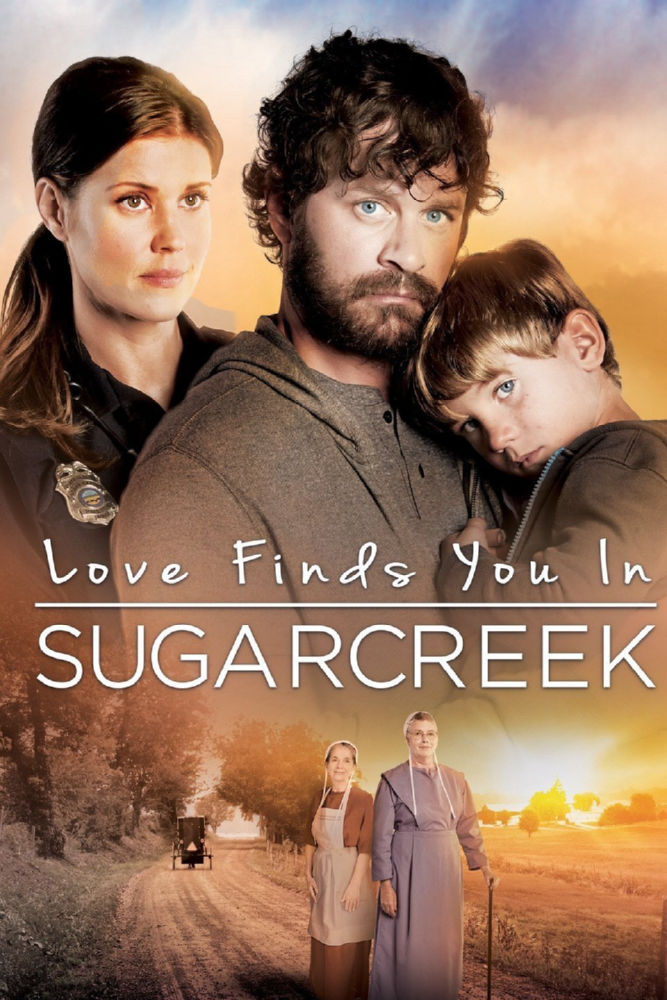
Rachel Troyler, a smart, focused policewoman in Amish country, watches over the inn her aunts run.
When a mysterious stranger and his young son arrive, the aunts welcome them as an act of faith, but Rachel’s instincts tell her he is hiding something.
Her investigation uncovers a shocking identity, an unsolved murder, and a past that brings danger into the heart of the quiet town.
Click any of the following icons below to rent or stream it!
Oops! Is this show WOKE?
Only an account holder or member can file. Cite a scene, a line, or a pattern. Other account holders +1 or −1 that argument, once each. The show is not WOKE until enough of them have given a +1. Enough −1s remove the write-up, and it is no longer shown.
Sign in to file a woke label. One of each criterion per member.
Comments and reviews
Report a mistake
Same rule as woke labels: one report, a written reason, and the community +1 or −1 it — once per member. A net +5 applies the change. Editors can hold it for review, or apply it immediately.
No mistake reports yet.
Sign in to report a mistake. One report per field, per member.
Member review
Ray Okonkwo Member
Oct 2, 2026
★★★★★★★★★★Love Finds You in Sugarcreek sat with me longer than I expected for a quiet little faith-and-mystery picture. Rachel Troyler is the kind of focused policewoman who keeps one eye on the job and the other on the inn her aunts run in Amish country. That setup already tells you where the tension will live: order and instinct on one side, open-handed welcome on the other. When the stranger and his boy show up, the aunts treat it as simple hospitality. Rachel does not. Her gut says something is off, and the movie is smart enough not to scold her for that. It just lets the two ways of seeing the world sit next to each other for a while.
I kept coming back to the early scenes at the inn. Nothing flashy happens. The aunts move through their routines, the boy is quiet and watchful, and Rachel is already running the mental checklist that comes with wearing a badge. You can feel the difference in tempo. The Amish setting is not treated as a cute backdrop or a place that needs fixing. It has its own rhythm, and the film respects that. When Rachel starts digging, the story does not turn the community into obstacles or cartoon purity. It just lets her investigation pull threads that the quiet surface had covered. The shocking identity and the unsolved murder land with enough weight that you understand why danger finally reaches the town. It never feels like the script is forcing fireworks; the danger grows out of what was already hidden.
What worked for me was how little the movie rushed the personal side. Rachel is competent without the film needing to prove it every five minutes by making every man around her look small. She watches, she asks questions, she follows the evidence. The stranger is not immediately framed as a threat or a project. You get enough of his care for his son that you start wondering whether Rachel’s instincts are complete. That uncertainty is the interesting part. The film lets faith and caution talk to each other instead of staging a lecture. The aunts’ decision to take people in is presented as an act of trust, not naivete that the plot will punish. At the same time, Rachel’s job is treated as real work that protects people. I liked that balance. It does not turn manhood or authority into the root of every problem, and it does not make the woman’s strength depend on shrinking everyone else.
There are quieter mechanics that stuck with me more than any big reveal. The way the boy watches the adults. The small gestures around the inn that show how the aunts keep life running. Rachel’s habit of standing a little apart even when she is home. Those details do more for the atmosphere than any speech about community. When the past finally surfaces, it does not feel glued on. You can trace it back to the first uneasy feeling Rachel had. That is good construction for a movie that could have coasted on scenery and soft music. I will say the romance side stays gentle and a little predictable once the pieces are on the table. You can see the shape of the ending coming. Still, it does not insult the earlier caution. The danger is real enough that the quieter moments earn their place instead of floating free.
I am not someone who needs every story set among the Amish to become a culture-war statement. This one mostly refuses that invitation. Faith here is ordinary practice rather than a costume for bigotry or a punch line. The police work is treated as necessary, not as an intrusion that the pure-hearted must endure. That combination kept me watching even when the plot followed familiar turns. A couple of scenes near the middle drag while characters circle the same suspicions, and the resolution ties things a bit neatly for my taste. Yet the core feeling remains honest: people can welcome strangers and still need someone who notices when the welcome is being used. Rachel carries that without the script turning her into a symbol.
By the end I felt I had spent time in a place that knows how to be still, then watched that stillness get tested. The movie does not overreach. It sits with a few careful choices—the aunts’ open door, Rachel’s refusal to ignore her training, the stranger’s careful silence around his son—and lets those choices create the drama. That is enough for a solid evening. It will not rewrite anyone’s idea of the genre, and it does not try to. What it does is keep its feet on the ground and its eyes open. I came away glad I watched it, even if I will not remember every plot beat a year from now. The tone stayed clean, the characters stayed human, and the mystery never needed to shout. Three stars feels right: sturdy, sincere, limited in ambition, but better company than a lot of louder pictures that forget how to let people simply be who they are.