



 MOVIE · 2010
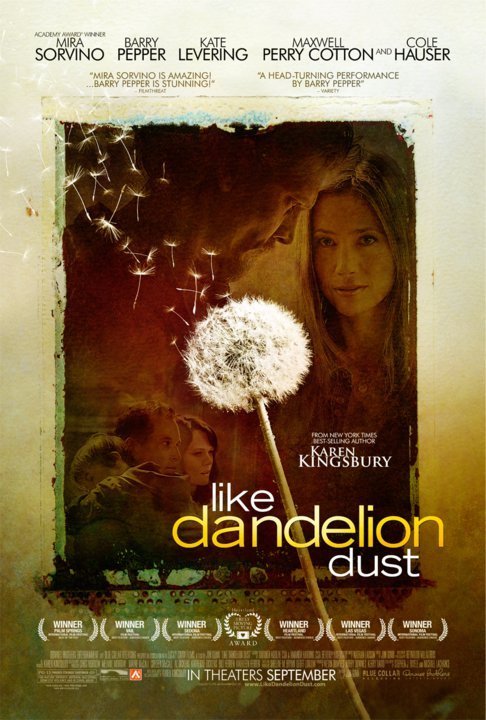
Like Dandelion Dust
An ex-convict released after beating his wife learns she gave their son up for adoption and battles the wealthy family raising the boy. Love, guilt, and the law collide as both households fight for the child they claim.
Like Dandelion Dust follows Rip Porter, who finishes a seven-year sentence for assaulting his wife Wendy and comes home expecting to rebuild. Instead he learns Wendy surrendered their son while he was locked up, and the privileged Campbell family has already adopted and raised the boy as their own. Rip refuses to accept the loss and pushes for custody, forcing Wendy to confront the violence she fled and the choice she made. The Campbells, who have given the child stability and affection, suddenly face a legal challenge that could tear their household apart. Court filings and visits turn private grief into a public contest over who has the stronger claim. Each adult must weigh past harm, present bonds, and what the child actually needs.
As hearings advance, Rip tries to prove he has changed while Wendy wavers between fear of his old temper and loyalty to the boy’s blood tie. The Campbells dig in to protect the only family the child has known, arguing that love and daily care outweigh biology after years of absence. Lawyers press both sides, old wounds reopen, and the adults’ motives are tested under scrutiny. Rip and Wendy’s fractured marriage and the Campbells’ settled life become opposing poles in the same fight. Decisions about visitation, parental rights, and permanent placement force painful reckonings. In the end the adults confront whether holding on or letting go is the truer act of love for the son caught between them.
Creator: Jon Gunn
Click any of the following icons below to rent or stream it!
Oops! Is this show WOKE?
Only an account holder or member can file. Cite a scene, a line, or a pattern. Other account holders +1 or −1 that argument, once each. The show is not WOKE until enough of them have given a +1. Enough −1s remove the write-up, and it is no longer shown.
Sign in to file a woke label. One of each criterion per member.
Comments and reviews
Report a mistake
Same rule as woke labels: one report, a written reason, and the community +1 or −1 it — once per member. A net +5 applies the change. Editors can hold it for review, or apply it immediately.
No mistake reports yet.
Sign in to report a mistake. One report per field, per member.
Member review
Ray Okonkwo Member
Sep 30, 2026
★★★★★★★★★★Like Dandelion Dust sits in that tough spot where family loyalty and legal paperwork collide, and I kept coming back to a handful of moments instead of the whole chain of events. The Porter house early on feels lived-in rather than staged. Wendy moves through ordinary routines with Joey—school drop-offs, quiet evenings—while Jack stays practical and steady beside her. Those scenes land because nothing big is happening yet. You just watch people who have already done the hard work of turning a placement into a real home, and the camera doesn’t rush them. When the Campbells reappear, the air changes fast, but the movie doesn’t lean on speeches right away. It lets the small disruptions pile up: a phone call that lasts too long, a glance between Wendy and Jack when Joey is in the next room, the way they start measuring every word in front of him.
One stretch that stuck with me is the early hearing sequence. The paperwork from the original arrangement gets picked apart, and you feel how thin some of those protections actually were. It’s not flashy courtroom theatrics. Lawyers talk in measured tones, the judge asks plain questions, and both sides look exhausted rather than triumphant. Wendy’s face during those exchanges carries most of the weight. She isn’t delivering monologues; she’s holding still while the ground shifts under her. Jack stays quieter, the kind of support that shows up in logistics and late-night planning rather than big declarations. Their dynamic never turns into a contest of who loves the boy more. It’s two adults trying to keep a kid’s world from splitting while the adults around him rewrite the rules.
Molly’s side of it doesn’t get softened into pure villainy, which helps. Her determination reads as genuine even when her judgment looks shaky, and the husband brings a volatility that makes every new development feel riskier. I noticed how the film handles the pressure on Joey without turning him into a prop. He picks up on the tension the way kids do—quieter at dinner, asking questions that don’t have clean answers—and the adults keep failing at shielding him completely. There’s a scene late where the parents try to explain pieces of the situation without dumping the full adult mess on him, and it feels clumsy in a way that rings true. Nobody has the perfect script for that conversation.
The mechanics of the custody fight stay grounded in process more than melodrama most of the time. Evidence gathering, attorney meetings, the waiting between hearings—these parts could have dragged, but they keep a steady rhythm. You see the cost in sleeplessness and strained patience more than in tears on cue. That said, the movie does tip into heavier emotional territory in places, and a couple of confrontations land harder than they need to. The score swells at moments when silence would have worked better, and a few lines of dialogue push the theme a little too directly. Still, the core conflict holds because the stakes feel specific: this particular boy, these particular parents who raised him, this particular birth mother who believes she can reclaim what she once gave up.
What kept me watching wasn’t surprise twists. It was the way ordinary competence and ordinary fear sit next to each other. Wendy’s devotion isn’t framed as superhuman; it’s the daily continuation of choices she already made years earlier. Jack’s steadiness isn’t heroic posturing; it’s showing up for the next hard conversation and the next court date. The film doesn’t pretend the legal system will deliver perfect justice or that love alone rewrites statutes. It just sits with the mess of competing claims and the people stuck inside them. I found myself thinking about how fragile “settled” can be once paperwork and second thoughts enter the picture. The adoptive home looks solid until it isn’t, and the movie doesn’t rush to tidy that up.
By the later stretches the emotional toll is clear on everyone, and the performances stay restrained enough that you believe the fatigue. No one is giving a master class in scenery chewing. They’re tired people making imperfect decisions under pressure. That restraint is what earns the movie its keep for me. It could have gone full soap or full sermon and didn’t. It stays with the practical and the personal: how you protect a child when the adults can’t agree on who gets to define the family, how you keep showing up when the outcome isn’t guaranteed. Some sequences feel longer than they need to, and the resolution carries the weight of real compromise rather than clean victory, which fits the material even if it leaves a few threads less sharp than I’d like.
I rated it 3.5 because the stronger scenes outweigh the occasional heavy hand, and the central performances make the custody fight feel like something that could happen to people you know rather than a constructed parable. It’s not reinventing the family drama, and it doesn’t need to. It just takes a wrenching situation seriously enough that you sit with the discomfort instead of waiting for the next plot turn. If you come for fireworks you might leave underwhelmed. If you come for the quiet dread of watching a home get pulled between two sets of parents who both believe they’re right, it holds. The title image of something light and easily scattered works better than any speech about it. Dust doesn’t argue; it just moves when the wind does. The movie understands that better than it sometimes trusts itself to show.