
Find a mistake?


 MOVIE · 2015
Legend IS WOKE
–
Not ratedCommunity rating
Label it
IS WOKE
No summary on file yet. Know this one? Tell us.
WHAT CRITERIA MAKES IT WOKE?

Oops! Is this show WOKE?
Only an account holder or member can file. Cite a scene, a line, or a pattern. Other account holders +1 or −1 that argument, once each. The show is not WOKE until enough of them have given a +1. Enough −1s remove the write-up, and it is no longer shown.
Sign in to file a woke label. One of each criterion per member.
Comments and reviews
Report a mistake
Same rule as woke labels: one report, a written reason, and the community +1 or −1 it — once per member. A net +5 applies the change. Editors can hold it for review, or apply it immediately.
No mistake reports yet.
Sign in to report a mistake. One report per field, per member.
Member review
Lila Marsh Member
Sep 19, 2026
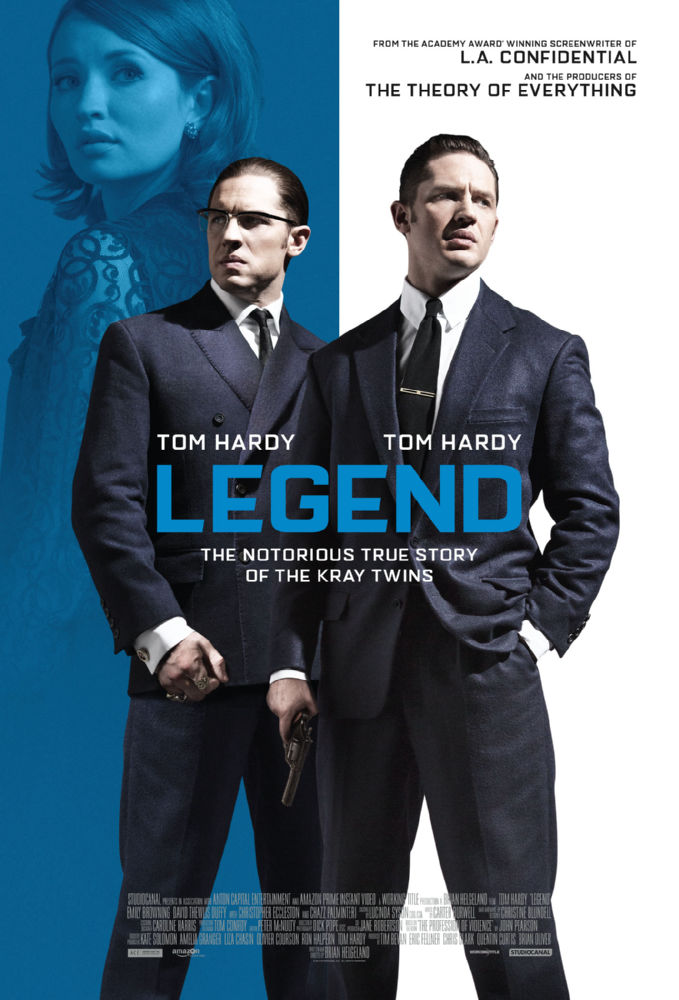
★★★★★★★★★★I put on Legend because the dual Tom Hardy thing kept coming up in conversation and I finally wanted to see whether it held for a full movie or just looked clever in clips. It holds more than I expected. He plays both Reggie and Ronnie Kray, the twin brothers who muscled their way through 1960s London protection rackets and clubs, and the separation between them is the part that stays with you after the credits. Reggie is the one who can walk into a room, smile, make a deal look almost respectable. Ronnie is the one who makes people decide not to test the deal. Same face, different weight in the shoulders, different eyes. You stop thinking about the technical trick pretty quickly and start watching two men who need each other and cannot stand what that need costs them.
The movie does not pretend these guys were charming antiheroes. They were thugs who liked control and liked being feared, and the film lets that sit without soft-pedaling it. Their firm grows from East End street work into West End clubs and celebrity proximity, and the higher they climb the more the violence stops being quiet enforcement and starts becoming something people talk about in the papers. That shift feels earned. You see how the twin loyalty that built the operation also locks them into every bad decision the other one makes. Shared secrets, shared enemies, no clean way out once paranoia sets in. Ronnie’s volatility keeps rivals off balance until it starts keeping everyone off balance, including Reggie. The bond is the engine and the bomb at the same time.
Frances, Reggie’s partner, gets caught in the middle of the glamour they sell and the reality underneath it. I paid attention to her because the movie could have treated her as window dressing and mostly does not. You watch her try to live inside the nicer version of the life while the uglier version keeps leaking through the walls. It is not a big emotional speech kind of role; it is smaller and more uncomfortable, and that worked for me. The supporting faces around the twins feel period-correct without turning into a costume parade. Nightclubs, suits, the careful public manners next to the private brutality. The look of it never got in the way of the story.
Where it loses me a little is the middle stretch. Once the dual performance has made its point and the firm is established, the film settles into a pattern of threats, retaliation, and the slow tightening of police and press attention. Some of those sequences land hard. Others feel like they exist to confirm what you already know about these men rather than push anything new. I did not need another reminder that Ronnie could snap; I needed a clearer sense of how Reggie kept rationalizing the next step after the last one went wrong. The script sometimes tells you about their reach instead of just showing the room go quiet when they walk in. Hardy papers over a lot of that with the physical work, but you still notice the seams.
I am not someone who needs every gangster picture to reinvent the form. I like watching the rise and the collapse when the details feel specific. Legend gets enough of those details right that I stayed with it. The paranoia, the refusal to split even when splitting might have saved something, the way ordinary ambition turns into spectacle once the papers and Scotland Yard take an interest. It understands that the twins’ real problem was never just the law or rival firms. It was each other, and the movie keeps returning to that without becoming a psychology lecture. That restraint helped.
Still, when I finished I did not feel the urge to start it over the next night. It is a solid piece of work carried by one very committed central performance and a clear sense of place and period. It is not deeper than its premise, and it does not pretend to be. Some of the violence is ugly in a way that fits; some of it starts to feel like punctuation. The ending arrives where you know it has to, and by then the air has mostly gone out of the room. I rated it 3.5 because Hardy makes the twin split believable and the early grip on London feels lived-in, but the back half circles familiar ground and never quite finds a sharper angle on why these particular men burned so hot and so briefly. If you like crime biopics and you have not seen the dual role yet, it is worth the time. If you have already sat through a few rise-and-fall gangster stories this decade, you will recognize the shape early and may wish it cut a little closer to the bone. That is where I landed. Good enough to finish, not quite good enough to argue about for weeks afterward.