
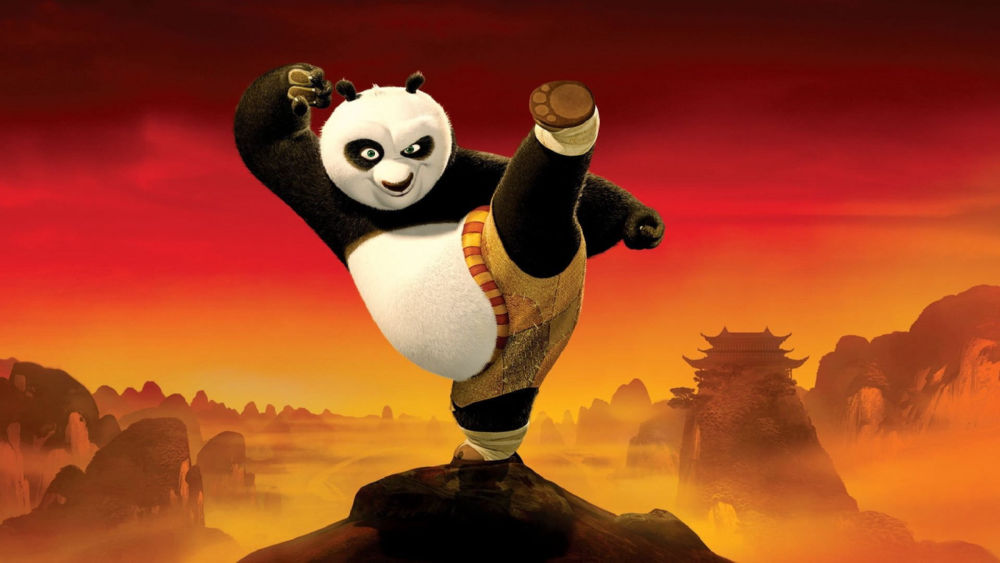


 MOVIE · 2008
Kung Fu Panda
IN REVIEW · the community verdict is still open
A clumsy panda working in a noodle shop is unexpectedly chosen as the Dragon Warrior and must train in kung fu to defend the Valley of Peace from a vengeful escaped warrior.
Kung Fu Panda follows Po, a large and clumsy giant panda who dreams of kung fu greatness while helping his adoptive goose father Mr. Ping run a noodle restaurant in the Valley of Peace. When the wise tortoise Master Oogway has a vision that the imprisoned snow leopard Tai Lung will escape and seek the powerful Dragon Scroll, a tournament is held to select the Dragon Warrior from among Master Shifu's students, the Furious Five. Po arrives late and accidentally tumbles into the arena just as Oogway points to him as the chosen one, stunning everyone including the strict red panda Shifu and the skilled fighters Tigress, Monkey, Crane, Viper, and Mantis. Shifu and the Five initially mock and try to drive away the unfit Po through harsh training, but Oogway urges perseverance. Po befriends most of the Five through his humor and determination while learning of Shifu's past with the ambitious Tai Lung, whom he once raised as a son.
Tai Lung breaks free from prison using his nerve-strike technique and heads for the valley, defeating the Furious Five when they try to intercept him. Shifu discovers Po's hidden potential when food motivates him and trains the panda into a capable fighter using that drive. The blank Dragon Scroll confuses everyone until Mr. Ping reveals that his famous secret-ingredient soup has no secret ingredient at all, only belief that makes it special. Po realizes the same truth applies to himself, races back, and confronts the defeated Shifu and rampaging Tai Lung. Drawing on his unique body and self-taught moves including the Wuxi Finger Hold, Po overpowers and banishes Tai Lung, earning the respect of the Five and restoring peace as the true Dragon Warrior.
Creator: Mark Osborne, John Stevenson
Oops! Is this show WOKE?
Only an account holder or member can file. Cite a scene, a line, or a pattern. Other account holders +1 or −1 that argument, once each. The show is not WOKE until enough of them have given a +1. Enough −1s remove the write-up, and it is no longer shown.
Sign in to file a woke label. One of each criterion per member.
Comments and reviews
Report a mistake
Same rule as woke labels: one report, a written reason, and the community +1 or −1 it — once per member. A net +5 applies the change. Editors can hold it for review, or apply it immediately.
No mistake reports yet.
Sign in to report a mistake. One report per field, per member.
Member review
Ray Okonkwo Member
Oct 20, 2026
★★★★★★★★★★Kung Fu Panda caught me off guard the first time I put it on. The trailers made it look like pure goofball filler, another round of animal gags with a martial arts coat of paint. What you actually get is a story that takes its time with a character who has no business being the chosen one and somehow makes that the whole point. Po works the noodle shop, daydreams about legendary fighters, and can barely climb a flight of stairs without looking like a disaster. When the scroll ceremony goes sideways and he ends up as the Dragon Warrior, nobody in the valley is more shocked than he is. That setup still works because the movie never pretends he is secretly elite. He is loud, hungry, and awkward, and the film lets those traits stay visible even as he starts learning.
The early training stretches with Shifu are where it clicks for me. Shifu is small, furious, and completely unconvinced. He tries to break Po with the same drills that built the Furious Five, and Po keeps failing in ways that feel physical and funny at the same time. The bowl of dumplings on the pole, the chopsticks chase, the way Po turns eating into an accidental form of discipline—these moments do more than score laughs. They show a teacher who finally stops trying to hammer a panda into a tiger shape and starts working with what is actually in front of him. Jack Black’s voice sells every beat of that. He does not play Po as a cartoon of fatness or laziness. He plays someone who wants the life so badly that embarrassment cannot kill the want. That energy carries the quieter scenes and keeps the louder ones from tipping into pure noise.
I keep coming back to the sequence where Po finally sits with the Furious Five after they have spent half the movie treating him like a joke. They are not soft about it at first. Tigress especially draws a hard line. The movie lets that friction stay real instead of sanding it into instant friendship. When the group starts opening up—Crane’s self-doubt, the small stories about how each of them trained—it feels earned. Po’s reaction is not a speech about believing in yourself. He just listens and keeps showing up. That is the part that lands for a lot of people who grew up feeling like the outsider in a room full of specialists. You do not need a perfect origin or a body built for combat. You need the stubbornness to keep walking into the room.
The action itself is cleaner than I expected from a 2008 animated comedy. Tai Lung’s prison break sets the tone: tight, inventive, and a little mean. The snow leopard moves like someone who was trained for greatness and then left to rot on the idea that greatness was owed to him. His fights with the Five have weight. When he finally faces Po, the movie does not suddenly turn the panda into a blur of perfect technique. It uses the environment, the food, the awkward bulk, and the simple fact that Po has stopped apologizing for existing. The Dragon Scroll reveal is the kind of quiet punch that could have felt cheap, yet it fits because everything before it has been about looking past the surface. There is no secret technique waiting inside the paper. The power was the willingness to see yourself clearly and keep going.
Hans Zimmer and John Powell’s score does serious work underneath all of this. The percussion and the strings give the valley a real sense of place without turning every scene into a tourist brochure. The animation holds up the same way. Fur, fabric, the way light hits the jade palace steps—it still looks considered rather than cheap. I do not love every choice around the Five. A couple of their early jabs at Po land a little harder than necessary, and Tai Lung’s rage sometimes feels more like a plot engine than a fully settled character. Those are small dents. They do not ruin the whole machine.
What stays with me is how honestly the movie plays the unlikely hero without turning it into a lecture. We are used to leads who arrive already sharp. Po arrives soft, loud, and full of noodles. The story makes space for the idea that heart and the daily choice to learn can matter as much as natural gifts. It is funny without being empty and sincere without getting sticky. I connected with the longing more than I expected to. Plenty of us know what it is like to want a place at a table that does not look built for us. Kung Fu Panda does not solve that feeling with a montage and a wink. It lets the feeling sit, then shows the work that follows. Four stars feels right. It is not flawless, but it is generous, sharp, and still worth putting on when you need a reminder that the first version of yourself does not have to be the final one.