



 TV · 2001
Justice League
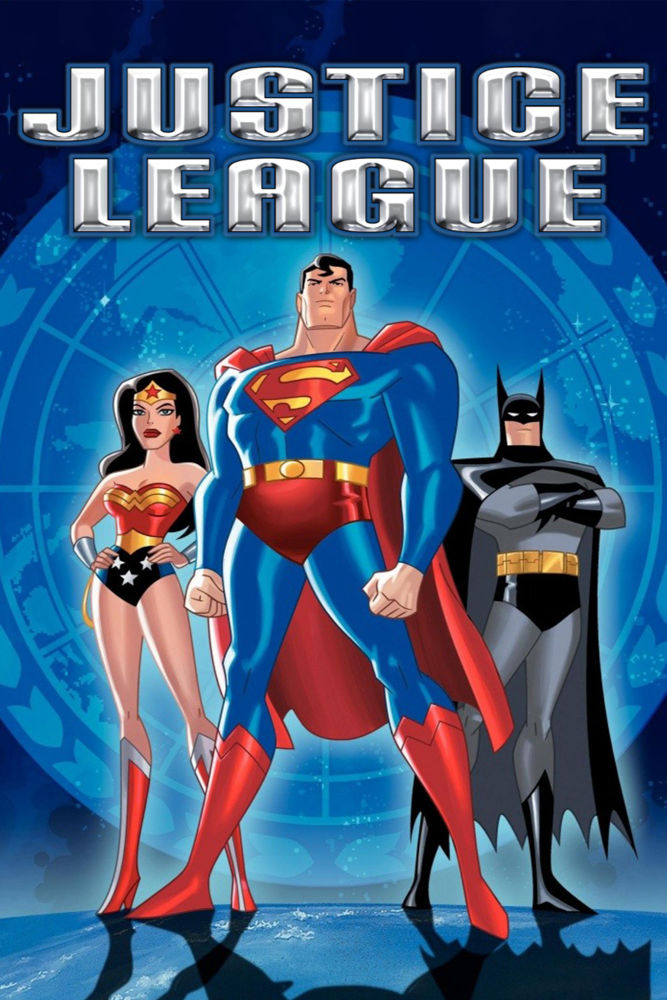
Earth's strongest heroes join forces as the Justice League when solo power is no longer enough. Superman, Batman, Wonder Woman, Flash, Green Lantern, Hawkgirl, and Martian Manhunter confront invasions, gods, and super-villains that threaten the entire planet.
Justice League follows Superman, Batman, Wonder Woman, Wally West as the Flash, Green Lantern John Stewart, Hawkgirl, and Martian Manhunter as they abandon purely solo crime-fighting after an otherworldly invasion nearly conquers Earth. Shape-shifting alien forces overwhelm individual defenses, forcing the heroes to share intelligence, coordinate strikes, and cover one another's weaknesses in open battle. Superman supplies unmatched strength and flight while Batman contributes planning, gadgets, and refusal to kill. Wonder Woman brings Amazon combat skill and a warrior's code; the Flash clears civilians and disrupts enemy lines with super-speed. John Stewart's power ring creates hard-light constructs under pressure, Hawkgirl's Nth-metal mace shatters armored foes, and Martian Manhunter's telepathy and shape-shifting hold the fragile new alliance together. Once the invaders are driven off, the seven agree the world still needs a standing team and formally become the Justice League.
Later missions pull the League into conflicts with familiar rogues, cosmic tyrants, magical threats, and political intrigue that test both their powers and their trust. Batman remains the strategist who questions every alliance; Superman wrestles with how much force a living symbol should use; Wonder Woman balances diplomacy with the directness of Themyscira. Flash lightens tense moments yet proves decisive in crises that demand speed over strength, while John Stewart's military discipline sometimes clashes with the others' improvisation. Hawkgirl's Thanagarian past and fierce independence create friction and later revelations that shake the group, and Martian Manhunter quietly mediates while hiding the depth of his own losses. Across arcs the members learn to rely on one another against enemies no single hero could defeat, solidifying the League as Earth's first line of defense without losing the distinct voices that made each character iconic.
Creator: Carl Lumbly, Phil LaMarr
Click any of the following icons below to rent or stream it!
Oops! Is this show WOKE?
Only an account holder or member can file. Cite a scene, a line, or a pattern. Other account holders +1 or −1 that argument, once each. The show is not WOKE until enough of them have given a +1. Enough −1s remove the write-up, and it is no longer shown.
Sign in to file a woke label. One of each criterion per member.
Comments and reviews
Report a mistake
Same rule as woke labels: one report, a written reason, and the community +1 or −1 it — once per member. A net +5 applies the change. Editors can hold it for review, or apply it immediately.
No mistake reports yet.
Sign in to report a mistake. One report per field, per member.
Member review
Ray Okonkwo Member
Oct 21, 2026
★★★★★★★★★★Justice League from 2001 still holds up as the version of the team that feels like adults who already know their jobs and just need a reason to share the same room. I keep coming back to how the show handles the Watchtower and the call-ins. Someone spots a problem too big for one cape, the others gear up, and the plan is already half-formed before the first punch lands. That rhythm never gets old.
Batman’s contingencies are the quiet engine. He does not monologue about them. He just has the next move ready when Superman’s strength hits a wall or when magic shows up and physics stop mattering. I like that the show never makes him the sour guy in the corner for long. He argues, he plans, then he fights next to people who can level city blocks. The friction feels earned instead of written in as personality flavor. Superman gets to be the public face without turning into a walking lecture. When the team needs raw power and a steady voice, he supplies both, and the others do not shrink around him.
Wonder Woman’s early episodes are some of my favorites for how she reads a battlefield. She is not there to correct the men’s manners. She closes distance, uses the lasso when talk fails, and treats justice as something you enforce rather than debate. The Amazon training shows in how she moves through groups of enemies. Hawkgirl does similar work with the mace and the wings—direct, physical, no speeches required. Green Lantern’s constructs give the fights their shape. Shields that actually hold, cages that buy time, bridges when the ground drops out. The ring is a tool with limits, not a free wish. Flash’s job is often the unglamorous one: pull civilians out, scout the edge of the fight, create openings. He jokes, but the speed is treated as logistics as much as spectacle.
Martian Manhunter sits in the middle of all of that as the one who can be anywhere and still sound calm. Shape-shifting and phasing let the writers solve problems without always defaulting to a bigger punch. I notice how often the team splits across multiple fronts instead of lining up for a group pose. One group holds the street, another takes the orbital threat, someone else tracks the real source. That division of labor is the show’s real mechanic. It makes the victories feel like coordination instead of a power ranking.
The villains and the odd threats—aliens, gods, old magic—work because the league has to adjust mid-fight. When pure strength fails, Batman’s prep or Lantern’s creativity or Diana’s combat sense has to carry a stretch. The show trusts the audience to follow those shifts without stopping to explain the rulebook every time. Jokes land in the downtime or in the middle of movement, never as the main event. Flash needling someone, Batman’s dry refusal to be impressed, Hawkgirl’s blunt assessments. They feel like people who have worked together long enough to know which buttons are safe to push.
I rated it 4.5 because the core seven click in a way later team-up shows often chase and miss. The animation style of the period has its limits, and some episodes lean harder on formula than others, but the average stay high. You get clear stakes, clean division of roles, and characters who keep their edges. No one is rewritten to make another look better. The strong woman on this team earns it in the same frame as everyone else—through skill and choices, not by shrinking the men. Ordinary competence and ordinary friction between powerful people are allowed to exist without a sermon attached.
Rewatching a few key arcs recently, what sticks is the Watchtower as a workplace more than a fortress. Briefings, arguments over approach, the moment someone has to trust a plan they did not invent. That texture is why I still put it on when I want the league to feel like a functioning unit instead of a poster. The show knows when to let a fight be messy and when to let a quiet conversation carry the weight. It does not need to reinvent the characters every season. It just lets them work, and that turns out to be enough to keep the thing sharp more than twenty years on. If you want the team operating at full strength without the modern habit of apologizing for having heavy hitters in the same shot, this is still the one that gets the balance right. Solid, repeatable, and respectful of the source without freezing it in amber.