



 TV · 2025
Iggy and Mr Kirk
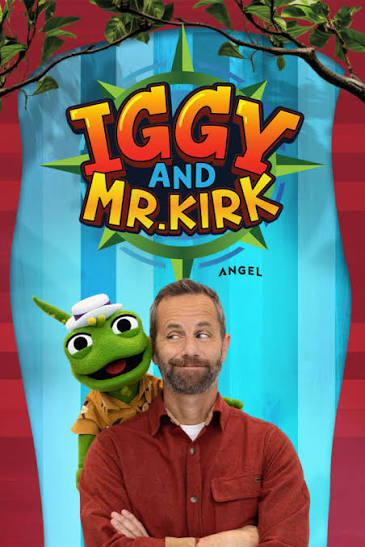
Kirk Cameron and puppet Iggy lead a gentle kids series of short adventures that turn everyday moments into simple lessons about honesty, kindness, and courage.
Iggy and Mr Kirk follows Kirk Cameron and his puppet sidekick Iggy as they greet young viewers and dive into light, story-driven segments with other animated puppets. Each half-episode-length outing sets up a familiar childhood situation—sharing, telling the truth, handling disappointment, or welcoming a new friend—and lets Iggy’s curiosity push the conversation forward. Cameron steers the tone with plain talk and humor rather than lectures, while colorful puppet pals react, joke, and model the choice at hand. Fun guest stars stop by to join a game, song, or mini-skit that keeps the pace bright for TV-Y audiences. The focus stays on concrete actions the kids on screen can copy, not on abstract slogans.
As the series continues, Iggy and Kirk return to the same friendly puppet world so recurring characters can grow a little with each topic. A guest might help Iggy practice patience during a messy craft, or a puppet neighbor might need courage to apologize after a mix-up, giving Cameron a chance to walk through the fix step by step. Episodes string these beats into a clear beginning, middle, and resolution without heavy conflict or scares. Relationships among the puppets stay warm and straightforward, and the pair always lands on a practical takeaway kids can try the same day. The show keeps circling back to character habits—gratitude, responsibility, kindness—through play, songs, and short skits rather than long speeches.
Click any of the following icons below to rent or stream it!
Oops! Is this show WOKE?
Only an account holder or member can file. Cite a scene, a line, or a pattern. Other account holders +1 or −1 that argument, once each. The show is not WOKE until enough of them have given a +1. Enough −1s remove the write-up, and it is no longer shown.
Sign in to file a woke label. One of each criterion per member.
Comments and reviews
Report a mistake
Same rule as woke labels: one report, a written reason, and the community +1 or −1 it — once per member. A net +5 applies the change. Editors can hold it for review, or apply it immediately.
No mistake reports yet.
Sign in to report a mistake. One report per field, per member.
Member review
Ray Okonkwo Member
Oct 19, 2026
★★★★★★★★★★Iggy and Mr Kirk sits in that thin space where a kids show knows exactly what it wants to teach and still can’t make the teaching stick for longer than the runtime. Kirk Cameron and the puppet Iggy open most segments the same way: a quick greeting, a little banter, then straight into some everyday kid problem like sharing toys or owning up after a lie. The setup is clean enough. Cameron keeps his voice even and a little wry, never raising it into full preacher mode, and Iggy’s job is to ask the obvious next question so the lesson has somewhere to land. On paper that works. In practice the whole thing feels like it’s running on low batteries.
I sat with the honesty episode longer than the others. A kid puppet breaks something, hides it, then gets walked through why coming clean is better. Cameron doesn’t lecture; he just lets Iggy poke at the guilt until the choice is clear. The puppet reactions are bright and the colors pop, but the dialogue never finds a second gear. Everything resolves in the space of a commercial break, which is fine for the age group, yet it leaves no residue. You finish and already forget which puppet learned what. The courage bit with the new-friend welcome follows the same pattern. Someone is nervous, Iggy is curious, a guest drops in for a short song or game, and by the end everyone has modeled the right action. The guest stars keep the energy from flatlining completely, but they feel slotted in rather than necessary. A game of catch or a silly rhyme later and the segment is done.
The mechanics are the real tell. Each outing is half-episode length and built around concrete actions kids can copy: say the truth, offer the toy, try the hard thing once. That focus is honest and better than a lot of the abstract slogan shows out there. Still, the repetition of the structure starts to grind. Curiosity from Iggy becomes a button you can predict. Cameron steers with plain talk and light humor, which I respect more than the alternative, but the humor rarely lands harder than a polite chuckle. The puppet pals joke and model, yet none of them develop enough personality to make you care who is speaking. It’s all serviceable and then it’s over.
I kept waiting for a moment that felt lived-in instead of demonstrated. The disappointment segment comes closest. A planned outing falls through, Iggy frets, Cameron reframes it without turning it into a speech. For a minute the pacing breathes. Then the mini-skit arrives, the lesson locks into place, and the show moves on. That habit of tidying everything before it can get messy is both the point and the problem. Young viewers get clear models. Older ones, or anyone watching alongside, get a series that never risks an unresolved feeling or a joke that might actually surprise.
Production stays bright and TV-Y safe. No one is mean for long. No one stays confused. The everyday situations are chosen well—sharing, truth, new friends—but the execution stays so gentle it starts to feel weightless. I don’t need edge in a preschool show. I do need something that holds attention past the first viewing. Iggy’s design is fine; the voice work is clear; Cameron never talks down. Those are real pluses. They just aren’t enough to lift the material when every adventure resets to the same curious-puppet-plus-plain-talk formula.
After a few episodes the pattern is locked. Greet, situate, question, model, guest beat, resolve. It does what it claims: turns ordinary moments into simple lessons about honesty, kindness, and courage. The trouble is that simplicity becomes sameness. I can see a three-year-old locking onto the colors and the puppet faces. I can’t see anyone asking to rewatch once the novelty fades. The show never betrays its own aims, which is rarer than it should be, yet it also never discovers a rhythm that feels like more than a checklist of virtues.
So the rating lands at two. It isn’t broken. It isn’t sneaky. It just doesn’t give you enough life between the lessons to make the lessons memorable. Cameron and Iggy are pleasant company for twenty minutes. Pleasant isn’t the same as good enough to seek out again. If the series ever loosens the formula—lets a joke run longer, lets a puppet stay wrong for an extra minute, lets a guest actually change the temperature—it might climb. Right now it stays exactly where it started: gentle, clear, and easy to leave behind once the credits roll.