



 MOVIE · 2023
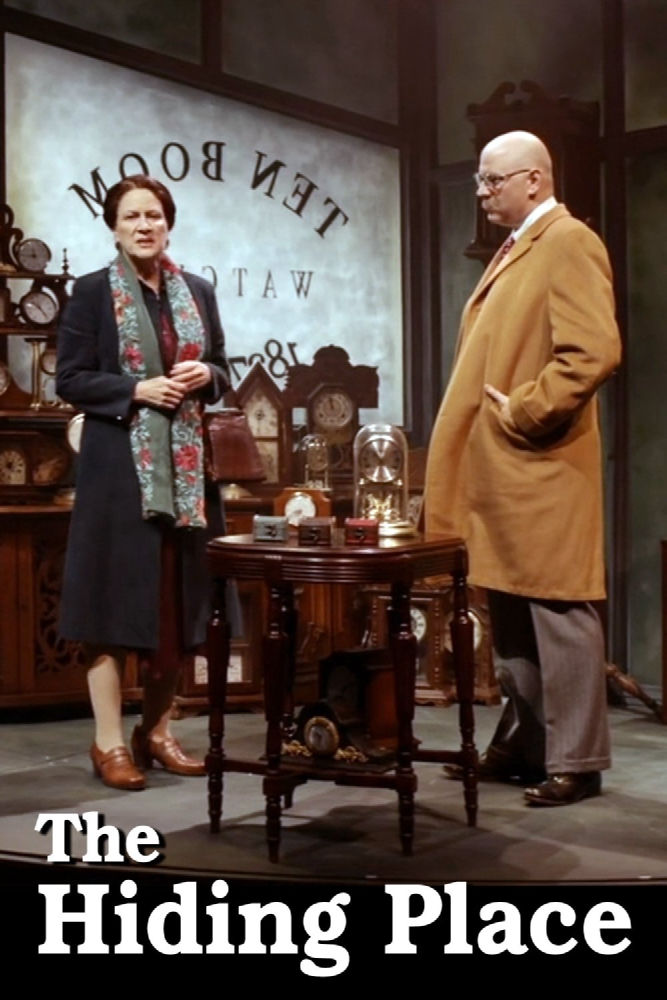
The Hiding Place
During World War II, Corrie Ten Boom and her family in Holland secretly hide Jews from the Nazis.
When their efforts are discovered, they are arrested and sent to concentration camps.
In the face of unimaginable suffering, Corrie relies on her unwavering faith to survive. This powerful true story, based on her best-selling book, showcases courage, sacrifice, and forgiveness, revealing how one woman’s compassion transformed many lives.
Click any of the following icons below to rent or stream it!
Oops! Is this show WOKE?
Only an account holder or member can file. Cite a scene, a line, or a pattern. Other account holders +1 or −1 that argument, once each. The show is not WOKE until enough of them have given a +1. Enough −1s remove the write-up, and it is no longer shown.
Sign in to file a woke label. One of each criterion per member.
Comments and reviews
Report a mistake
Same rule as woke labels: one report, a written reason, and the community +1 or −1 it — once per member. A net +5 applies the change. Editors can hold it for review, or apply it immediately.
No mistake reports yet.
Sign in to report a mistake. One report per field, per member.
Member review
Wes Calder Member
Sep 30, 2026
★★★★★★★★★★Hiding Place sits in that awkward middle ground where the story is stronger than the movie made from it. Corrie ten Boom’s account has weight on its own. A watchmaker’s household in Haarlem deciding to hide people, build a false wall, deal in ration cards, and keep going even as the Gestapo closes in is not material that needs dressing up. The 2023 film knows that and mostly stays out of the way, which is both its virtue and its limit.
What works is the quiet. The ten Booms are not framed as larger-than-life resisters. Casper is old and methodical. Betsie is steady in a way that never turns into speeches. Corrie carries the practical load—coordinating arrivals, managing the space, holding the network together—without the camera insisting she is a symbol. Faith is present the way it would have been in that house: prayers, scripture, the assumption that this is what obedience looks like when the state has gone mad. It is not used as a costume for bigotry or as a punchline. That alone keeps the film from collapsing into the usual period-piece sermon.
The production itself is serviceable and sometimes thin. Interiors feel lived-in rather than art-directed to death. The concealed room is treated as a fact of the house, not a set piece waiting for a reveal. When the raid comes, the film does not milk the chaos for cheap shocks. People are taken. The sisters move through prisons and then to Ravensbrück. Cold, hunger, and the slow grind of the camp are shown without turning every frame into a gallery of suffering. That restraint is welcome. It also means the second half can feel a little flat if you came expecting dramatic peaks. The movie trusts the historical record more than it trusts cinema, and the result is honest without being especially gripping.
Performances stay in the same register. No one is phoning it in, and no one is swinging for awards either. The actors playing Corrie and Betsie keep the relationship grounded in shared work and shared belief rather than in tearful monologues. Supporting roles—neighbors, other hiders, the occasional official—fill space without becoming types. You get the sense of a community under pressure more than a collection of heroic profiles. I preferred that. It matches the real story better than a polished resistance epic would have.
Where it loses me is pace and texture. Long stretches settle into a dutiful march from one known event to the next. You can feel the screenplay checking boxes: occupation, first guests, construction of the hiding place, growing risk, betrayal, transport, camp. Because the source is so well-known in certain circles, the film sometimes acts as if simply arriving at each station is enough. It isn’t. A few more specific textures—the smell of the workshop, the weight of forged papers, the ordinary friction of too many people in too little space—would have helped. Instead you get competence and a slight airlessness.
I also never fully shook the sense that the movie was made primarily for people who already revere the book. That is not a crime. It is a limitation. If you walk in cold, you get a clear outline of what happened and why it mattered. If you already know Corrie’s account, you may find yourself waiting for the film to surprise you with an angle or a detail that the page did not already supply. It rarely does. The ending lands with appropriate gravity and then exits without overstating its case, which I respected even while wishing the journey there had more life in it.
On balance this is a solid, unshowy telling of a story that deserves to be told. It does not distort the moral stakes. It does not apologize for the family’s Christianity or treat their choices as quaint. It also does not quite find a cinematic language equal to the material. Three stars feels right: worth seeing if the subject draws you, easy to respect, hard to get excited about twice. I left thinking more about the real ten Booms than about any particular shot or line, and in this case that is half a compliment and half a diagnosis. The movie did its job without ever quite becoming necessary on its own terms.