
Find a mistake?


 MOVIE · 2024
Here IS WOKE
–
Not ratedCommunity rating
Label it
IS WOKE
No summary on file yet. Know this one? Tell us.
WHAT CRITERIA MAKES IT WOKE?

Oops! Is this show WOKE?
Only an account holder or member can file. Cite a scene, a line, or a pattern. Other account holders +1 or −1 that argument, once each. The show is not WOKE until enough of them have given a +1. Enough −1s remove the write-up, and it is no longer shown.
Sign in to file a woke label. One of each criterion per member.
Comments and reviews
Report a mistake
Same rule as woke labels: one report, a written reason, and the community +1 or −1 it — once per member. A net +5 applies the change. Editors can hold it for review, or apply it immediately.
No mistake reports yet.
Sign in to report a mistake. One report per field, per member.
Member review
Omar Quill Member
Sep 20, 2026
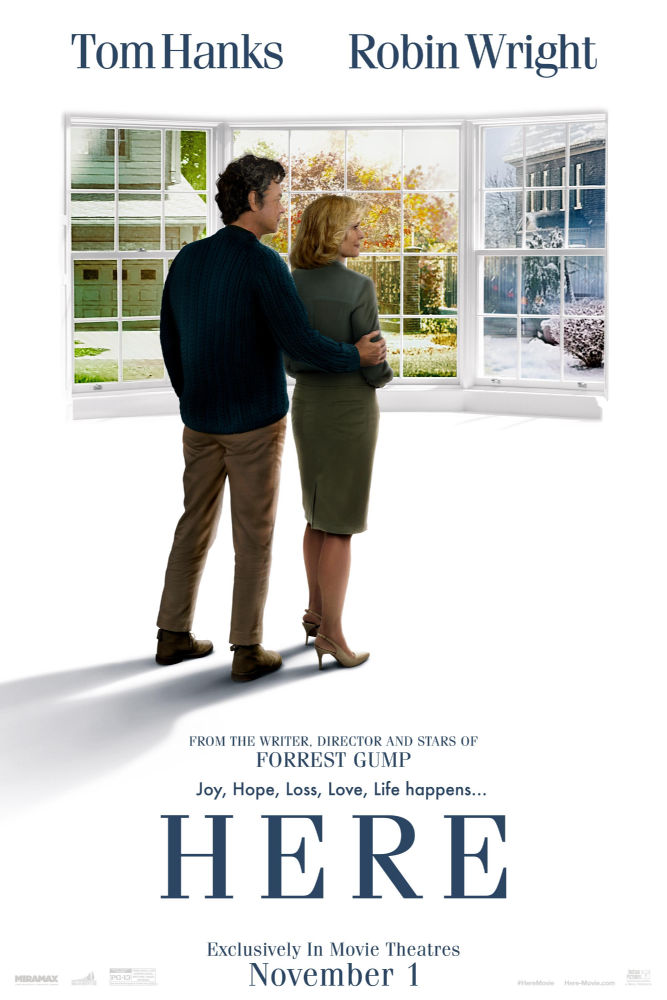
★★★★★★★★★★I sat down with Here mostly because the idea of one fixed camera angle for an entire movie sounded like a weird experiment, the kind of constraint that either clicks or turns into a slog. It follows this living room and the land under it across a long stretch of time, centering on Richard Young growing up in that space, meeting Margaret, getting married, and trying to hold a life together while the shot never moves. Earlier people on the same ground show up too, and his parents Al and Rose drift through in ways that overlap. You stay locked in that one viewpoint the whole time, watching routines, arguments, holidays, kids arriving and growing, job stress, quiet letdowns, all of it jumping years without ever leaving the room.
The fixed spot is the whole hook. It reminded me a little of those old adventure games where the camera is nailed down in a room and you just watch events unfold in the same frame, except here nobody is solving puzzles. You get generations stacking on the same parcel. Indigenous people first, then the couple who actually put the house up, then Richard’s family filling it out. The panes that put Al and Rose beside Richard’s timeline are neat when they work. You see how the room holds all of them at once. I spent a couple evenings with it after long game sessions, and the stillness kind of matched the feeling of camping in one spot for hours while a boss fight or a build run stretches out. You notice small shifts more because nothing else is moving.
Richard’s path is the spine. Boy to man inside that living room, career pressures piling up, Margaret beside him, kids changing the temperature of the place. The film jumps around the decades without ceremony, so a Christmas one minute can sit next to a rough patch the next. Some of those quiet disappointments land. You feel the weight of trying to keep a household steady when the camera refuses to cut away or give you a break outside. Birthdays, arguments over money or direction, the slow accumulation of ordinary days. It does not rush. That can be a plus if you are in the mood for it. I was, for stretches. Other times I caught myself wanting the frame to tilt or cut just so something would breathe differently.
What keeps it at a three for me is how the concept does a lot of the lifting and then kind of runs out of fresh moves. Once you lock into the idea that we are never leaving this spot, the movie has to rely on the performances and the writing of the daily stuff to carry the rest. Sometimes it does. The way the room itself becomes the constant while faces age and furniture shifts is effective. You start reading the space the way you read a familiar level layout after dozens of hours. Other times the jumps feel more like a device than a story choice, and the emotional beats repeat in a pattern that loses some punch. Job stress, family tension, trying to build something stable — it is real, but the single viewpoint starts to make the highs and lows feel a little flattened because you are always looking from the exact same place.
I liked the earlier layers more than I expected. Seeing the ground before the house, the people who were there first, then the builders, gives the later family scenes a different texture. It is not preachy about it. It just puts them in the same frame so the parcel feels older than any one generation. Richard and Margaret’s stretch is the bulk of it, and their attempts at a normal life inside those walls are the part that stuck with me after. Not because every scene hit hard, but because the film commits to watching them try without leaving. That commitment is honest. It also means when a scene is thinner, you feel the thinness longer. No cut to a different location to reset the energy.
Technically the choice is clean. Everything has to play inside that locked view, so blocking and timing matter more than usual. Little details in the corners become important. I noticed myself scanning the frame the way I scan a static game screen for changes after a long grind. A photo on a shelf, a chair moved, light shifting through the same window across seasons. Those things do work. The overlapping generations can feel clever or a bit gimmicky depending on the moment. When Al and Rose share space with Richard’s timeline it sometimes deepens the room; other times it just reminds you the movie is doing a trick.
I am not someone who needs every film to move fast or cut constantly. Plenty of games I like are slow burns in fixed spaces. Here just does not quite sustain the full runtime at the level the idea promises. There are stretches that feel lived-in and specific, and stretches that feel like the concept is holding the story up instead of the other way around. The family stuff is ordinary in a good way — no big speeches, just the grind of years in one place. That ordinariness is both the point and the limit. If you go in expecting a conventional drama with reverse shots and location changes, you will bounce off it. If you treat it like an experiment in staying put, it has more to offer, even if it does not fully stick the landing for me.
Three stars feels right. I respected the restraint and the way it makes you sit with the same walls long enough to notice how time piles up. I also got restless in places and wished a few of the emotional turns had more force once the novelty of the fixed camera settled. It is the kind of movie I would mention to a friend who likes odd formal choices, not the kind I would push on everyone. Watched it, thought about the room afterward while queuing another game session, and that is probably the best measure. The land and the house hold more history than any single family can fill, and the film lets you feel that without forcing a big statement. Solid idea, uneven follow-through, worth the time if the constraint sounds interesting to you.