


 TV · 2023
Hell’s Paradise
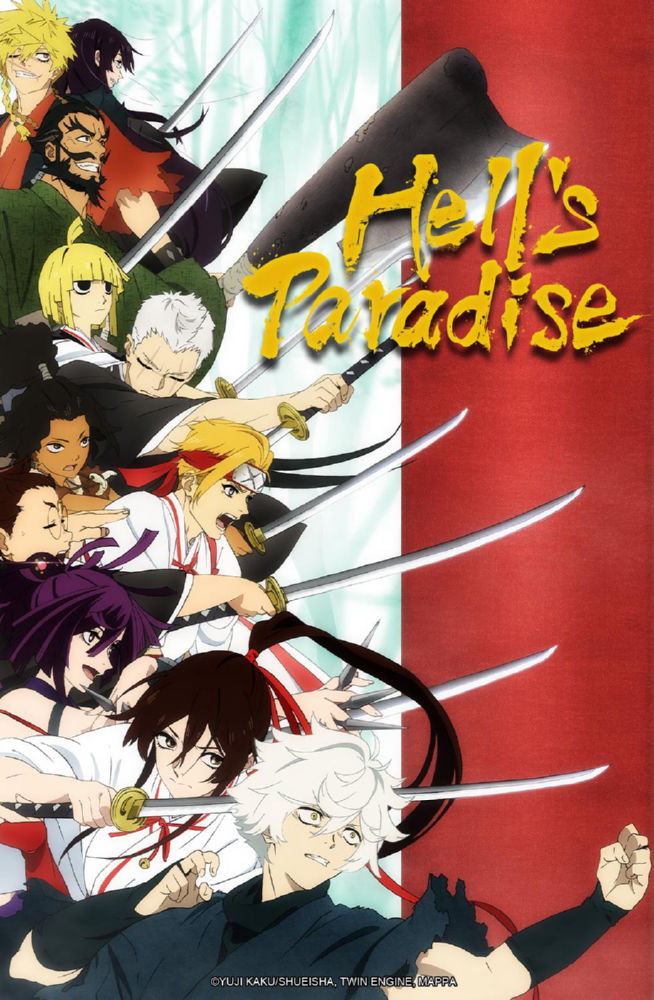
Death-row ninja Gabimaru and other condemned criminals are offered one path to freedom: retrieve the Elixir of Life from a deadly island while watched by elite executioners. Monsters, rival convicts, and the island’s secrets force uneasy alliances just to stay alive.
Hell’s Paradise follows Gabimaru, a feared ninja known as the Hollow, who is pulled from death row with a single offer of pardon. He must travel to the island said to hold the Elixir of Life and return with it, or die. Assigned as his watcher is Yamada Asaemon Sagiri, a skilled swordswoman from the clan that carries out official executions. Other condemned prisoners receive the same bargain and are paired with their own Asaemon minders. Once the group reaches the shore, the mission collapses into survival against grotesque creatures and the island’s hostile environment. Gabimaru’s cold efficiency and Sagiri’s duty collide as every step inland raises the body count.
Rivals among the convicts immediately turn on one another, treating the elixir as a prize worth murder. Gabimaru’s past and his reason for wanting to live surface in flashes while he cuts through threats that ordinary steel barely harms. Sagiri must decide how far her orders stretch when keeping Gabimaru alive becomes the only way either of them leaves. New factions and the island’s true nature push the survivors into temporary pacts that can shatter at any moment. Battles grow more desperate as the group learns the land itself rejects ordinary humans. The remaining pairs press deeper, knowing failure means death on the island or the executioner’s blade back home.
Oops! Is this show WOKE?
Only an account holder or member can file. Cite a scene, a line, or a pattern. Other account holders +1 or −1 that argument, once each. The show is not WOKE until enough of them have given a +1. Enough −1s remove the write-up, and it is no longer shown.
Sign in to file a woke label. One of each criterion per member.
Comments and reviews
Report a mistake
Same rule as woke labels: one report, a written reason, and the community +1 or −1 it — once per member. A net +5 applies the change. Editors can hold it for review, or apply it immediately.
No mistake reports yet.
Sign in to report a mistake. One report per field, per member.
Member review
Omar Quill Member
Oct 19, 2026
★★★★★★★★★★Hell’s Paradise clicked for me the same way a tough co-op raid does when the squad finally stops dying to the same stupid mechanics. I went in knowing almost nothing beyond the basic hook of death-row criminals hunting an elixir on some cursed island with executioners babysitting them. That setup alone sold me. Gabimaru being this empty shell of a ninja who still has one soft spot left felt honest instead of forced. He moves like someone who has already accepted the end screen and is just trying to clear the last map with whatever scrap of reason he has left.
The island itself is the real star. Every new stretch feels like loading into a different boss arena with its own rules. The flowers, the creatures, the way the ground and air can turn on you mid-fight—it all kept me locked in the way a good Metroidvania keeps you checking every corner because something nasty is waiting. I burned through the first season in a couple long nights after school, same way I burn weekends on a new souls-like. The fights have weight. When Gabimaru goes full Hollow mode it is not just flashy animation; it is the kind of cold efficiency I chase in my own builds when I finally stop overthinking and just delete the health bar. Sagiri watching him, blade ready, adds this constant pressure that never lets the story feel safe. She is not there to cheerlead. She is the timer and the fail state rolled into one person.
What surprised me is how the other convicts and their Asaemon pairs actually matter. It is not a solo carry. You get these uneasy temporary parties forming because the island does not care about your backstory or your crimes. Survive first, figure out the rest later. That reminded me of random matchmaking where you end up coordinating with people you would never party with outside the instance. Some of those pairings get real tense, and the show does not rush past the cost. People lose limbs, minds, and whatever dignity they still had. It stays grim without turning into pure misery porn.
I liked that Gabimaru’s past comes out in pieces instead of a giant monologue dump. You see the training, the missions, the way he was shaped into a weapon, and it lands harder because the present-day island keeps interrupting with new threats. The animation holds up in the big set pieces. Motion is clean, impacts feel heavy, and the monster designs are properly nasty without needing endless gore for the sake of it. There are quieter stretches too—conversations about what freedom even means when you have already been written off by the world. Those bits could have dragged, but they usually sit right next to some fresh horror so the pacing never fully stalls.
If I am being picky, a couple of the side criminals feel like they exist mainly to pad the body count, and one or two revelations near the middle could have used another episode of breathing room. Still, the core loop of explore, clash, regroup, and push deeper kept me coming back the next night. It scratches the same itch as grinding a hard game where the map itself is the enemy and your party is half the problem. I finished wanting the next batch of episodes the way I want the next DLC when a world finally hooks me. Four stars feels right. It is sharp, mean, and weirdly hopeful in the cracks, without pretending the island is going to hand anyone an easy win. Worth the watch if you like stories that treat survival like a raid with permanent death on the table.