



 MOVIE · 2025
Green and Gold
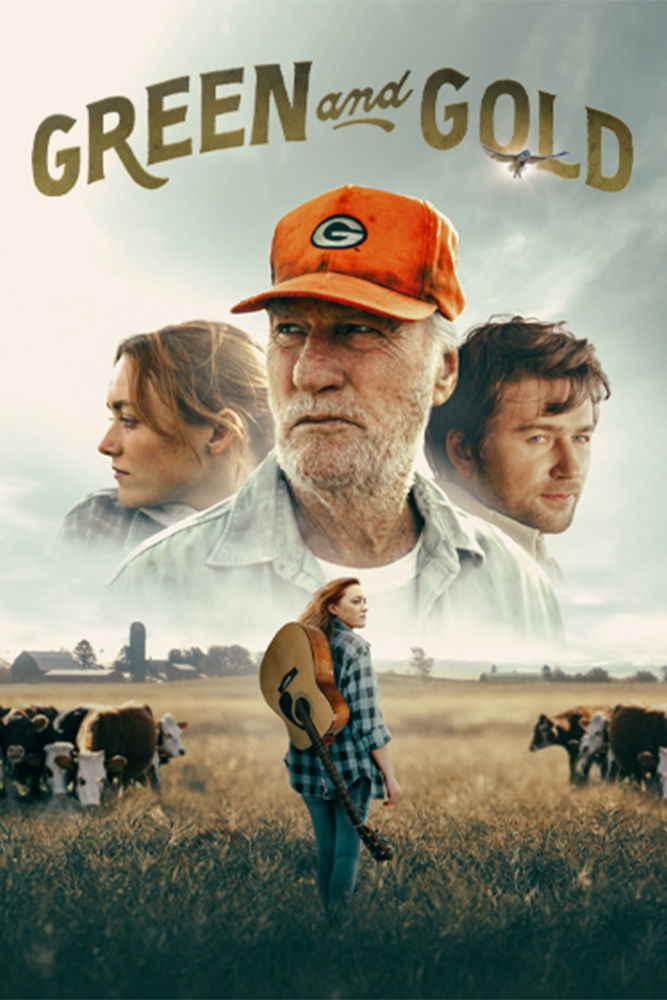
A fourth-generation Wisconsin dairy farmer and his granddaughter wager their last hope on the Green Bay Packers to keep the family farm from foreclosure.
Green and Gold follows Buck, a fourth-generation dairy farmer whose land and livelihood are slipping away as American farms vanish around him. Facing foreclosure and the end of a way of life his family has held for generations, he refuses to walk away quietly. His granddaughter stands with him, sharing the daily work, the worry, and the stubborn attachment to their little chunk of dirt. Together they decide on a desperate Hail-Mary plan that ties the farm’s survival to their beloved Green Bay Packers. The early stretch of the story stays close to chores, bills, and the quiet pressure of a community that knows how fast a place like theirs can disappear. Every choice they make is measured against the risk of losing the only home they have ever known.
As the season unfolds, Buck and his granddaughter double down on the wager that could either rescue the farm or finish it. They lean on each other through long days, tense game nights, and the practical realities of keeping cattle and equipment running while the bank closes in. Neighbors, family history, and the Packers’ fortunes become part of the same fight to hold onto the land. The pair keep pushing even when the odds look impossible, treating the bet as both a last financial move and a statement of who they are. Later turns test their resolve, their relationship, and how much of the old life they can still protect. The story stays with their concrete efforts to save the farm rather than stepping outside it for speeches or side agendas.
Creator: Anders Lindwall
Click any of the following icons below to rent or stream it!
Oops! Is this show WOKE?
Only an account holder or member can file. Cite a scene, a line, or a pattern. Other account holders +1 or −1 that argument, once each. The show is not WOKE until enough of them have given a +1. Enough −1s remove the write-up, and it is no longer shown.
Sign in to file a woke label. One of each criterion per member.
Comments and reviews
Report a mistake
Same rule as woke labels: one report, a written reason, and the community +1 or −1 it — once per member. A net +5 applies the change. Editors can hold it for review, or apply it immediately.
No mistake reports yet.
Sign in to report a mistake. One report per field, per member.
Member review
June Pell Member
Sep 19, 2026
★★★★★★★★★★Green and Gold sat with me longer than I expected for a story that never pretends to be more than it is. I grew up around people who talked about land the way other folks talk about inheritance or blood, so the Wisconsin dairy farm setting felt familiar in the bones even if I’ve never milked a cow at 4 a.m. The grandfather’s situation is laid out without speeches: bills stacking up, the land slipping toward foreclosure, that slow pressure that turns every meal into a calculation. He decides the only way out is a high-stakes bet tied to a championship run, which sounds reckless until you sit with how few options are left when the bank and the weather and the price of milk all line up against you. I kept thinking about the quiet math of it—how one improbable football outcome becomes the difference between keeping the place and watching it go.
What held my attention was the parallel track with his granddaughter. She’s pouring herself into music, practicing when the chores allow, carrying that private hope that her talent might open a door the farm can’t. The film doesn’t force a big confrontation between the two paths. They just exist side by side, both long shots, both rooted in the same stubborn love of something that might not love them back. I liked that restraint. Too many movies would have turned the music into a tidy moral lesson or the bet into pure folly. Here the grandfather’s gamble feels like the last honest move a man can make when tradition and daily work have stopped paying the bills. The granddaughter’s practicing feels just as desperate in its own way, only quieter.
There’s a stretch in the middle where the daily chores and the tight finances start to blur together, and I found myself wishing the film had sharpened a few of those scenes instead of letting them settle into a kind of respectful haze. You feel the weight of the land and the family history, but sometimes that weight sits on the story rather than driving it. I wanted one or two moments where the cost of the bet or the stretch of the granddaughter’s hope landed harder—something that made me lean forward instead of just nodding along. The bond between them is genuine, though. You see it in the way he watches her practice when he thinks she isn’t looking, and in the way she still shows up for the farm work even while she’s dreaming past it. That part didn’t need dialogue to work.
I took a short detour in my own head while watching, thinking about how many family farms I’ve driven past that look half-abandoned, the equipment rusting, the house still lived-in but tired. This movie doesn’t romanticize that. It treats the practical stakes as real—money, weather, the sheer physical labor—and it treats the emotional ones the same way. The championship bet isn’t played for laughs or for some big underdog speech. It’s a man putting everything on a single outcome because the alternative is watching the place disappear piece by piece. The music side could have tipped into inspirational territory, but it stays grounded in the same soil. She’s not waiting for a miracle; she’s working at it the same way he works the herd.
Where it lands at 3.5 for me is that mix of honesty and slight softness. The film knows the territory and respects the people in it. It doesn’t sneer at the grandfather’s risk or turn the granddaughter into a symbol. Yet it also doesn’t quite push either storyline far enough to make the ending feel earned rather than hoped-for. I left caring about both of them and still wondering what the farm would look like six months later, win or lose. That lingering question is a strength, but the movie itself could have lived inside that uncertainty a little more fiercely.
I keep coming back to the small details: the way the light hits the barn early, the sound of practice scales competing with the radio scores, the quiet calculations over coffee. Those stuck. The larger arc felt true without ever surprising me. Maybe that’s fitting for a story about people who keep showing up for work that may not reward them. Green and Gold doesn’t try to fix rural life or scold it. It just watches two people chase different versions of a fresh start while the land keeps asking for more. I rated it the way I did because it got the feeling right even when the drama stayed a little too polite. I’d watch it again on a quiet night, probably with the same mix of recognition and mild hunger for one sharper turn. It earns its place without overreaching, and sometimes that’s enough.