



 MOVIE · 2024
For the One
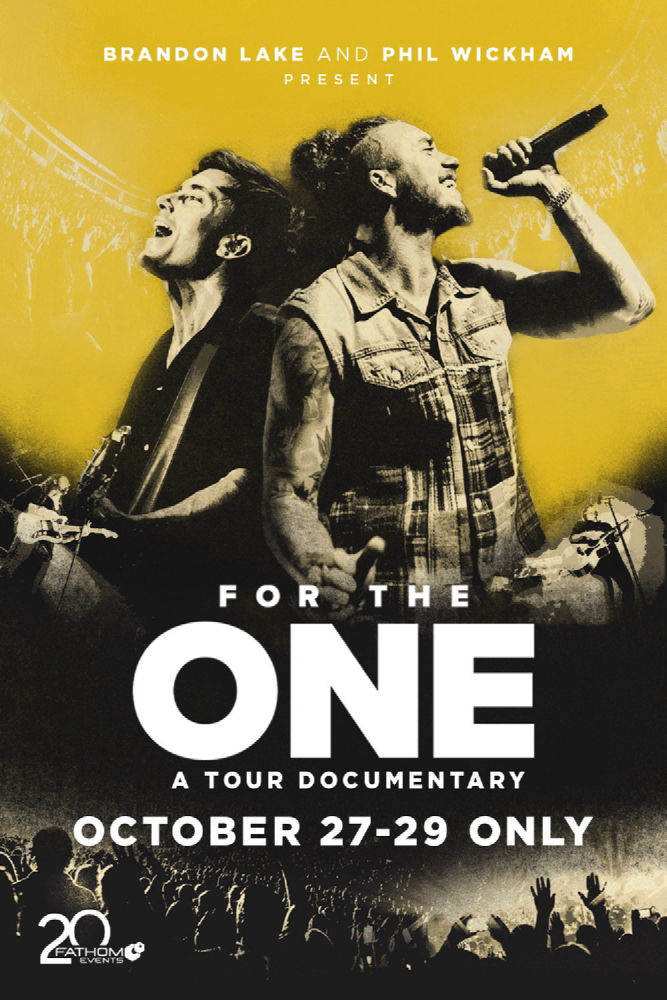
Worship artists Brandon Lake and Phil Wickham take audiences inside the Summer Worship Nights Tour, blending live songs, personal stories, and community moments into a faith-focused concert documentary.
For the One follows Brandon Lake and Phil Wickham as they prepare and perform across the Summer Worship Nights Tour. The film moves between stage performances and quieter moments that explain how the tour’s songs and vision took shape. Lake and Wickham share the passion behind the set lists and the worship nights that draw crowds together. Cameras capture rehearsals, travel, and the energy of live gatherings built around music and shared faith. Stories connected to the tour’s creation surface alongside the performances themselves. The documentary keeps its focus on the artists, the music, and the communities that gather for the nights.
As the tour continues, Lake and Wickham keep weaving new and familiar songs into each stop while reflecting on the purpose that drives the shows. Fellow musicians and crew appear in the flow of travel days and sound checks that lead into full worship sets. Audiences respond in the venues as the pair lead nights centered on music and spiritual connection. The film tracks how individual stories and the larger tour vision reinforce one another from city to city. Later stretches show the sustained rhythm of performance, recovery, and preparation that defines the run. The documentary closes on the lasting impression of those shared nights of song and community.
Creator: Noah Taher
Click any of the following icons below to rent or stream it!
Oops! Is this show WOKE?
Only an account holder or member can file. Cite a scene, a line, or a pattern. Other account holders +1 or −1 that argument, once each. The show is not WOKE until enough of them have given a +1. Enough −1s remove the write-up, and it is no longer shown.
Sign in to file a woke label. One of each criterion per member.
Comments and reviews
Report a mistake
Same rule as woke labels: one report, a written reason, and the community +1 or −1 it — once per member. A net +5 applies the change. Editors can hold it for review, or apply it immediately.
No mistake reports yet.
Sign in to report a mistake. One report per field, per member.
Member review
June Pell Member
Oct 2, 2026
★★★★★★★★★★I went into For the One mostly because I already knew a handful of Brandon Lake and Phil Wickham songs from Sunday mornings and a couple of summer playlists, not because I was hunting for a concert film. What surprised me is how little it behaves like the usual arena-tour documentary. It stays close to the work of getting people into a room and keeping the center on shared worship instead of the artists’ biographies or the production flex. That choice is quiet and steady, and it holds for most of the runtime.
You see them building set lists, running rehearsals, talking through what the nights are actually for. There is footage of the crowds singing, stretches of prayer that aren’t cut for pace, and the ordinary logistics of partners and venues that make an event like Summer Worship Nights possible. The cameras don’t chase spectacle. They linger on the practical side—how a space gets shaped so people can respond together—and on the artists trying to stay honest about the call that pulled them into leading corporate worship in the first place. It feels less like a highlight reel and more like being allowed to sit in the room while the thing is being made.
I kept thinking about the difference between a song that works on a recording and a song that works when a few thousand people are actually singing it. Lake and Wickham clearly care about that second kind. The film shows them adjusting, listening, letting the night breathe instead of forcing a climax every eight minutes. There is a G-rated clarity to the whole project that I didn’t expect to find restful, but I did. No manufactured tension, no attempt to turn faith into a brand story with a three-act arc. Music and short stretches of testimony carry the weight, and the community around the events is treated as the point rather than the backdrop.
One side path that kept coming back to me: I’ve sat through enough “worship experiences” that felt like they were designed for the cameras first. The lighting cues, the perfect tear shot, the carefully timed key change. For the One mostly refuses that. When the crowds sing, it sounds like crowds singing—uneven in places, full in others—and the film doesn’t clean it up into something prettier than it was. That choice matters. It keeps the focus on encounter, which is the word the project keeps circling, rather than on performance. I noticed myself relaxing into that. It is rare for a filmed night of worship to trust silence and ordinary prayer as much as the big chorus moments.
The vision pieces—how the nights took shape, who stepped in to help, why they wanted the gatherings to feel different from a standard tour stop—are handled without speechifying. You get enough context to understand the through-line without being walked through a mission statement. Lake and Wickham appear onstage and off with the same unhurried tone. They talk about the call, about keeping the focus right, about the temptation to let the production become the main character. None of it feels like content. It feels like two people who have done this long enough to know where the drift usually starts and who are trying, in public, to stay on the other side of it.
If I am holding back from a full five, it is only because a couple of the transitional sections run a little long and the film sometimes assumes you already care about the Summer Worship Nights brand. Someone coming in completely cold might need a tighter opening map. I didn’t mind; I was already halfway in the door. But the pacing dips once or twice when it could have stayed leaner. The strength is still the same: it never confuses volume with depth, and it never treats the audience as an audience to be impressed. People gather, they sing, they pray, and the cameras stay with that instead of inventing a subplot.
I left thinking about how rare it is to watch something in this lane that isn’t either cynical or over-produced into numbness. For the One sits in a simpler place. It believes the songs and the shared response are enough, and it builds the film around that belief without apology. That won’t be for everyone. It was for me. I have already gone back to a couple of the live moments just to sit with them again, which is more than I can say for most concert docs that cross my path. The heart of it is exactly what it claims—live worship, shared vision, community—and it keeps that heart in view the whole way through. Four and a half stars feels honest. I am glad it exists in this form.