
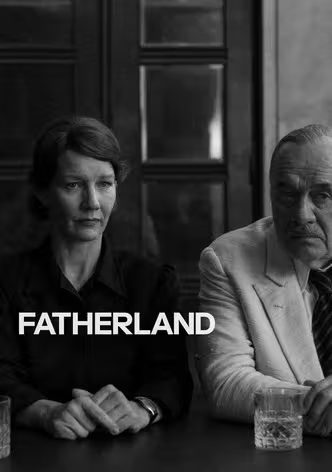




 MOVIE · 2026
Fatherland IS WOKE
Admin tally (from the live show page GET, 2026-11-12): NOT WOKE 0 · IS WOKE 1. Snapshot files do not include vote counts.
In the summer of 1949, Nobel-winning novelist Thomas Mann returns to a ruined, divided Germany for the first time since fleeing the Nazis, with his sharp-tongued daughter Erika at the wheel of a black Buick, and the trip from American-run Frankfurt to Soviet-run Weimar is shattered by terrible news about her brother.
Sixteen years after fleeing Hitler for exile in California, Thomas Mann, author of Death in Venice and The Magic Mountain, is invited back to Germany to receive the Goethe Prize on the 200th anniversary of the poet’s birth. His daughter Erika, an actress, writer, former war correspondent and rally driver, serves as his driver, translator and fierce protector. Before leaving, she phones her twin brother Klaus, a despairing, drug-addicted writer living in Cannes, and begs him to join them. He promises to think about it. In American-run Frankfurt, father and daughter find anonymous letters calling Mann a traitor, reporters asking whether he dares visit the Soviet zone, Wagner’s grandsons angling for his help, and old Nazi collaborators drinking at the hotel bar, including Erika’s ex-husband, the actor Gustaf Gründgens, whom she slaps in front of the room.
Then word comes that Klaus has killed himself. Erika is devastated and wants to go to the funeral. Her father insists the tour continue. They drive on in silence to Weimar, where Communist officials greet Mann with banquets, children’s choirs and talk of a new German utopia. A stranger pleads with him to tell the world that prisoners are being held at the former Buchenwald camp, and is taken away mid-sentence. As Mann tries to stay above politics and talk only of Goethe, Erika’s years of grief and resentment finally break into the open, until a stop at a bombed-out church on the road home offers the two of them one quiet chance at reconciliation.
Click any of the following icons below to rent or stream it!
WHAT CRITERIA MAKES IT WOKE?

WOKE EVIDENCE:
-
 NOT WOKE SHOWS admin Member
The Gay Ratio
- The film opens on a long single take of Klaus Mann, “openly gay,” sitting naked by a bed where his sleeping male lover wakes in the background.
- The ending names “homophobia” among the family’s losses
On the show.Evidence id
flag-fmvou2hdawwgfn(from the live show page).
Admin only · visitors do not see this
Labeled IS WOKE — not in the catalog.

Submitted by
Guest
Stars is out of 10, the same number visitors see. Moving the rating slider updates this field. Not woke is the door tally visitors see. Set rank saves these numbers and overrides the community tally. It does not change an IS WOKE label or remove evidence.
On file from 7 IMDb comments. Regenerating will write the woke evidence on this page into the review.
Oops! Is this show WOKE?
Only an account holder or member can file. Cite a scene, a line, or a pattern. Other account holders +1 or −1 that argument, once each. The show is not IS WOKE until enough of them have given a +1. Enough −1s remove the write-up, and it is no longer shown.
Sign in to file a woke label. One of each criterion per member.
Comments and reviews
Report a mistake
Same rule as woke labels: one report, a written reason, and the community +1 or −1 it — once per member. A net +5 applies the change. Editors can hold it for review, or apply it immediately.
No mistake reports yet.
Admin tally: 0 mistake reports on file (live show page, 2026-11-12). The Nov 11 snapshots do not include a corrections store.
Sign in to report a mistake. One report per field, per member.
Member review
Omar Quill Member
Nov 6, 2026
★★★★★★★★★★7/10Caught Fatherland on a weeknight showing when the main auditorium was maybe two-thirds full. Trailers ran long, then the lights dropped and that opening shot just sat there. Long single take of Klaus Mann, framed as openly gay, sitting naked by a bed while his sleeping male lover stirs in the background. No cut, no hurry. It sets a tone before Thomas or Erika even appear, and I noticed it right away because the camera never flinches or explains. At the end the film lists the family’s losses and straight-up names “homophobia” among them. Those two bookends stuck with me more than some of the middle stretches.
The rest is Thomas Mann coming back to a wrecked, split Germany in summer 1949 for the Goethe Prize, sixteen years after he bailed on Hitler. Erika’s driving the black Buick, translating, shielding him, doing the talking when he won’t. She’s the one who actually moves. Sandra Hüller plays her with real bite; everybody else stays buttoned-up and careful, which is probably the point but also why the movie kept me at a distance. You get the American zone in Frankfurt, then the Soviet side toward Weimar, galas and speeches that start repeating, and the news about Klaus that breaks the trip open. I kept thinking about how weird it must feel to be handed an honor when half the people handing it out want your name for their side of a bigger fight. Are they actually into the books, or just trying to borrow the reputation? That disappointment hangs over the whole drive.
Visually it’s sharp as hell on a big screen. Black-and-white that looks carved, sculpture lighting, the two Germanys feeling like different planets. Pawlikowski knows how to hold a frame. I sat there clocking the compositions the way I sometimes stare at a boss arena layout before the fight starts—clean lines, no wasted space. But the people inside those frames stay cold. Thomas is all restraint and careful sentences. Klaus is mostly absence and bad news. Even the arguments feel like they’ve already been rehearsed. Hours of beautiful images and I still walked out wanting one more scene where somebody just drops the mask completely.
I’m not usually the historical-drama guy—more mid-to-late game grind, theorycrafting builds, chasing clear times—but the father-daughter road stretch worked for me. Erika behind the wheel, Thomas half-present, the Buick cutting through ruins and checkpoints. You feel the weight of the return without a voiceover spelling it out. The prize itself feels hollow once you see how both sides want a piece of him. That part lands. What doesn’t always land is the emotional temperature. Restraint is fine until it starts feeling like the movie is protecting itself from its own characters. Hüller gets to break that a little; almost nobody else does.
The Klaus material is the clearest place the film pushes. Opening on that naked long take, ending by naming homophobia in the family ledger—it puts the brother’s life and the costs around it front and center instead of leaving it as background tragedy. I noticed both choices because they bookend everything else. Whether that helps or freezes the story is the part I’m still turning over. For me it made the losses concrete, but it also fed the overall chill. Beautiful frames, careful performances, a road trip that should gut you and sometimes only coolly impresses you.
Crowd was quiet most of the way. A few shifts during the speeches, bigger reaction when the news about the brother hits. Walking out into the lobby lights felt abrupt after all that gray. I landed on 7 out of 10. The craft is high, Hüller is the reason to stay locked in, the divided-Germany texture plays huge in a theater, and the Mann family mess has real shape. The coldness and the repetitive formal stuff keep it from climbing higher. I’d watch the opening and the drive again. The gala loop I can live without. Still glad I bought the ticket instead of waiting. It’s the kind of movie that looks like a museum piece until somebody finally cracks, and then you remember why they made it.
Generated site review · id
gen-fatherland-2026· source IMDb · source rating 7.3 · comments read 7 · generatedAt Nov 5, 2026, 6:10 PM America/Phoenix · stored stars 7 (out of 10) · previous copies: noneNWS staff review. Member
Oct 29, 2026
★★★★★★★★★★6/10I'll be honest, I picked this one because it was short. Eighty-two minutes. After a week of three-hour movies that think they're the Bible, a black-and-white European film that promised to be done before my coffee got cold sounded like a gift. And for most of it, it is. It's also one of the coldest movies I've sat through this year, and I mean that as half a compliment.
The setup: it's 1949, and Thomas Mann, the Nobel Prize guy who wrote Death in Venice and The Magic Mountain, goes back to Germany for the first time since he ran from Hitler. He's getting the Goethe Prize, and he wants to give speeches on both sides of the new line, American-run Frankfurt and Soviet-run Weimar. His daughter Erika drives him around in a big black Buick and plays translator, bodyguard and press secretary all at once. Sandra Hüller plays Erika. Hanns Zischler plays the old man. Paweł Pawlikowski directed it, the same guy who did Ida and Cold War, and MUBI put it out.
Hüller is the reason to watch. Full stop. She plays Erika like a woman holding a lit match in a room full of gasoline, polite and clipped and smiling at reporters, and you can see her doing the math on every person who walks up. There's a scene at a fancy hotel bar in Frankfurt where she runs into her ex-husband, an actor who did just fine under the Nazis, and she slaps him right there in front of everybody. I actually said "good" out loud. My dog looked up. Zischler is good too, in a stiffer way. His Mann is proud, a little vain, and very sure the world needs to hear what he thinks about Goethe. You believe this man won a Nobel Prize and you also believe he was hard to have as a dad.
The middle of the movie is where it earns its keep. Word comes that Erika's twin brother Klaus has killed himself back in Cannes. She wants to go to the funeral. Her father wants to keep going with the tour. Then they drive into the Soviet zone in near total silence, and the Communists roll out the banquets and the children's choirs and all this talk about a brand-new German utopia. A stranger tries to tell Mann that people are being locked up at the old Buchenwald camp, and he gets hustled away mid-sentence. That little moment gave me more chills than most horror movies. You can see a new kind of tyranny putting on its Sunday clothes while the old one is still smoking in the ruins. If you like history, that stretch is really sharp.
Every frame looks like a museum photograph. The rubble, the hotel lobbies, the empty roads. It's gorgeous. It's also so careful and so tidy that I kept wanting somebody to knock a glass over. People mostly talk in calm, smart sentences about big ideas, and after a while it feels more like a seminar than a story. When Erika finally blows up at her father and lets years of grief and resentment out, it's the best scene in the movie, and I wished there were three more like it. Because the movie is so short, a lot of the family history just gets hinted at. Why is Klaus so far gone? Why is Erika this angry? You get pieces. You don't get the whole thing.
Now for the part this site cares about. It got the woke stamp, but only on The Gay Ratio, and barely. Klaus Mann is presented as openly gay, and the movie makes a point of it. Early on there's a shot of him sitting naked near a bed while his sleeping male lover wakes up in the background. It's not long, and it's not graphic in a sex-scene way, but it's right at the front of the film, so it sets a tone you didn't ask for. And at the end, the on-screen wrap-up lists "homophobia" among the things this family was up against. That's it. No speeches, no lectures, nothing else in the story leans that way. To be fair, the real Klaus Mann was gay, so it isn't made up out of thin air. But the movie chose to open on it, and it chose to name it in the closing text, and that framing is what landed it here. If that opening is a dealbreaker in your house, now you know. It's a "skip the first few minutes" situation, not a whole-movie problem.
What I didn't expect was the ending. They stop at a bombed-out church on the way home, an organ plays Bach, "Jesu, Joy of Man's Desiring," and for a minute the father and daughter just sit there. After all that ice, it's genuinely moving. Put it next to the Buchenwald moment and you can tell the movie knows what it means for a country to lose God and try to replace Him with a party or a philosophy.
So, 6 out of 10. Great acting, beautiful to look at, and smart about history, but a bit too chilly and too short to really hit home, with that one choice up front that will put some people off. Watch it for Hüller, and keep the remote close for the opening.
Not in the Nov 11 generated-review store. Text, date, and 6/10 score taken read-only from the live show page HTML. No generated id, sourceName, or previous copies were published on that page.