
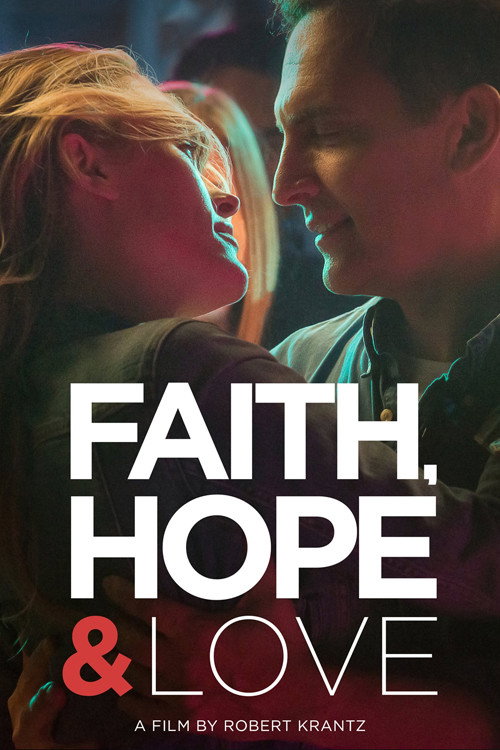



 MOVIE · 2019
Faith Hope and Love
Faith Hope and Love follows Valeria Karpin, a standout football player who becomes an ambitious coach.
She builds her reputation through performance on the field before stepping into a leadership role. The story tracks her efforts to guide a team while managing the demands of coaching. Her background as a player shapes the approach she takes to the new position.
Valeria Karpin works to implement her vision for the team amid the pressures of competition. The narrative shows her balancing on-field strategy with the personal drive that defined her playing days. Events center on her transition and the professional challenges that arise from it.
Creator: J.J. Englert
Click any of the following icons below to rent or stream it!
Oops! Is this show WOKE?
Only an account holder or member can file. Cite a scene, a line, or a pattern. Other account holders +1 or −1 that argument, once each. The show is not WOKE until enough of them have given a +1. Enough −1s remove the write-up, and it is no longer shown.
Sign in to file a woke label. One of each criterion per member.
Comments and reviews
Report a mistake
Same rule as woke labels: one report, a written reason, and the community +1 or −1 it — once per member. A net +5 applies the change. Editors can hold it for review, or apply it immediately.
No mistake reports yet.
Sign in to report a mistake. One report per field, per member.
Member review
Ray Okonkwo Member
Oct 2, 2026
★★★★★★★★★★Faith Hope and Love sits in that comfortable middle space a lot of these smaller dance-and-romance pictures occupy. You know the setup going in: Faith is trying to keep her studio alive after a divorce that clearly left marks, and the competition she signs up for is pure desperation more than ambition. Pairing her with Jimmy, a guy still carrying his late wife around like a quiet weight, gives the movie its actual pulse. I kept coming back to the rehearsal scenes more than the big stage numbers. They are not flashy. Someone misses a step, they stop, talk it through without turning it into a monologue, then try again. That felt honest. Jimmy does not suddenly become a natural dancer; he stays a little stiff and self-conscious, which makes the moments when they lock in land better.
There is a kitchen conversation late in the second act that stuck with me. No big music swell, just two people admitting they are tired of protecting the same old wounds. Faith talks about the divorce without naming the ex every five seconds, and Jimmy does not turn his grief into a performance. It is small and specific, the kind of exchange that makes you believe they might actually be good for each other instead of just plot-convenient. The dance competition itself is serviceable. You get the expected flubs, the rival pairs who look too polished, the last-minute costume panic. None of it reinvents the wheel, but it does not feel cynical either. The “Pro and a Schmo” framing is goofy on purpose and the movie never pretends otherwise.
What keeps it at a solid three for me is how uneven the supporting pieces are. The studio students get a few cute beats—kids who cannot keep time, an older regular who shows up just to feel useful—but they vanish whenever the central romance needs the screen. Same with Faith’s friends. They exist to push her toward the competition or to crack a light joke, then step back. I wanted one extra scene where the studio itself felt like a living place instead of a set that exists to be saved. The score does a lot of heavy lifting in the quieter stretches; sometimes it underlines a look that already worked fine on its own. Still, when Faith and Jimmy are just working through a routine in an empty room, the movie finds a rhythm that feels earned rather than manufactured.
I am not someone who needs every romance to end in fireworks. This one chooses the slower burn and mostly sticks the landing. There is a moment on the competition floor where they almost lose the thread, lock eyes, and decide to finish what they started. No speech. Just the choice. That landed cleaner for me than any of the more polished lifts. The film understands that healing is not a straight line and does not rush either character past their hesitation. Jimmy’s daughter gets a handful of scenes that actually matter; she is not pure comic relief or a plot device. Watching him try to be present for her while learning to open up again gives the whole thing some texture beyond the dance floor.
Pacing drags a little in the middle when the training montages start repeating the same emotional beats. You see the progress, then you see it again with slightly different lighting. Cutting ten minutes there would have tightened everything without losing the heart. The divorce backstory stays vague in a way that mostly works—enough shadow to explain why Faith is guarded, not so much detail that it turns into a different movie. Same with Jimmy’s loss. The movie trusts the actors to carry the weight in glances and pauses rather than endless exposition, and that trust mostly pays off.
By the time the final number arrives I was rooting for them in a quiet way, not because the script demanded it but because the small accumulations of trust felt real. It is not a perfect picture. Some dialogue lands soft, a couple of side characters feel like placeholders, and the competition structure is pure formula. But the central pairing has enough genuine warmth and restraint that I did not mind the familiar shape. I would watch the rehearsal scenes again before I rewatched the big finale. That tells me where the movie’s real strength sits. Three stars feels right: enjoyable, occasionally touching, never quite special enough to push higher, but far from a waste of an evening. If you like gentle second-chance stories that let the leads stay a little broken while they figure things out, this one earns its time.