




 MOVIE · 2023
Elemental IS WOKE
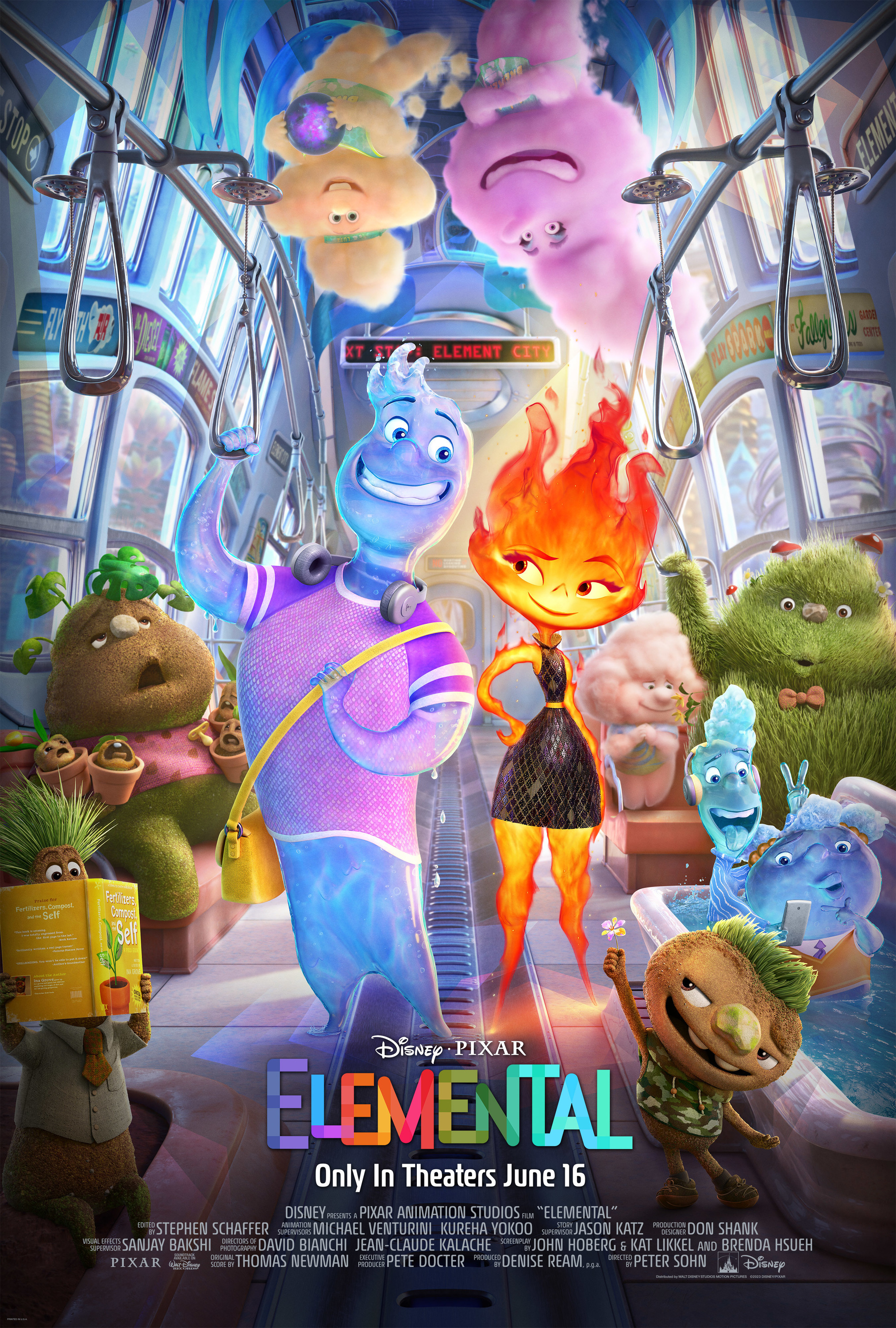
Elemental follows a fire element named Ember Lumen as she meets a water element named Wade Ripple and the pair work to keep her father's store open in a bustling city of anthropomorphic elements.
Elemental follows Ember Lumen, a quick-tempered fire element helping run her father's convenience store in Element City. When a clumsy water element named Wade Ripple arrives to inspect a leak, the two are forced to spend time together investigating the damage. Ember's father Bernie expects her to take over the family business and uphold traditional expectations, while Wade's easygoing nature clashes with her controlled life. Their investigation leads them through different neighborhoods where they encounter residents who test their growing connection.
As Ember and Wade search for solutions to the store's problems, they share personal stories about their families and the challenges of fitting into the city. Ember confronts her fear of disappointing her parents while Wade encourages her to pursue her own interests in glassmaking. The pair must navigate physical differences that make their friendship risky and ultimately decide how far they will go to protect the store and each other.
Creator: Trip Jennings
WHAT CRITERIA MAKES IT WOKE?



Oops! Is this show WOKE?
Only an account holder or member can file. Cite a scene, a line, or a pattern. Other account holders +1 or −1 that argument, once each. The show is not WOKE until enough of them have given a +1. Enough −1s remove the write-up, and it is no longer shown.
Sign in to file a woke label. One of each criterion per member.
Comments and reviews
Report a mistake
Same rule as woke labels: one report, a written reason, and the community +1 or −1 it — once per member. A net +5 applies the change. Editors can hold it for review, or apply it immediately.
No mistake reports yet.
Sign in to report a mistake. One report per field, per member.
Member review
Toni Briggs Member
Sep 19, 2026
★★★★★★★★★★Elemental sits in that odd middle ground where the raw material is strong enough to hold your attention, yet the finished thing never quite locks in as something you’d push on friends without a few caveats. I came in curious about the Paradise fire coverage and walked out feeling I’d learned a handful of concrete things about embers, house materials, and why some neighborhoods vanish while others don’t. That’s worth something. It just never builds the kind of sustained momentum that turns information into a lasting gut punch.
The opening stretch with the escape from Paradise still lands hardest. People describing how fast the wind-driven fire moved, how embers jumped roads and turned ordinary streets into fuel lines, carries real weight. You hear the speed in their voices. That section does what good documentary footage should: it puts the chaos right in front of you without needing a narrator to underline every beat. From there the film shifts into the research side, where crews deliberately burn full-scale house setups to see what fails and what holds. Watching materials char under controlled heat, noting clearances and design choices that either invite disaster or buy time, felt useful. I caught myself thinking about my own place and the dry brush near the fence line. Those sequences are methodical in a way that works; they tie the lab work back to the survivors’ stories so the measurements never float free of actual loss.
Where it starts to lose me is the stretch that tracks climate stress on forests and the long discussion of traditional burning practices. The Indigenous practitioners come across as practical people with a working knowledge of the land, and the idea that controlled, low-intensity burns can reduce fuel loads makes straightforward sense. I’ve heard versions of that argument for years and it still holds water. The trouble is the film sometimes treats the climate angle like the master key that explains every dead tree and every hard fire season. It doesn’t scream the point, but the framing leans that direction often enough that you notice the thumb on the scale. Weather patterns and forest conditions matter; turning them into a kind of original sin starts to feel like homework. I wanted more time spent on the engineering side of survival—what roofs and vents and setbacks actually do under ember attack—and less on the broader sermon about how the woods got this way.
Pacing is uneven. Some of the controlled-burn testing runs long without adding new insight, and a couple of the expert interviews circle the same points. At the same time, the film earns credit for not turning the whole thing into pure spectacle. It keeps returning to people who barely got out, and that keeps the technical talk from going cold. I appreciated that the house-design work was presented as solvable problems rather than inevitable doom. You can build smarter. You can clear better. Those are actionable takeaways, and the movie is at its best when it stays there.
I rated it 3.5 because the core reporting on wind-driven fire behavior and structural resilience is solid and occasionally gripping, yet the overall shape never fully coheres. It feels like three strong short films stitched together—survivor testimony, burn science, land-management history—without a single through-line that makes the whole greater than the parts. There’s real value in seeing which construction choices buy you minutes when embers start landing, and in hearing how traditional fire use once kept fuel loads down. Those pieces stay with me. The stretches that drift into broader climate framing and repeat the same cautionary notes don’t. I didn’t need the movie to pretend fire risk is simple, but I also didn’t need it to act like every hard season is a moral failing of the modern world.
Would I watch it again? Probably not cover to cover. I’d skip back to the Paradise accounts and the house-torching tests if I wanted a refresher on practical defenses. For anyone living in fire country or just trying to understand why some towns disappear in an afternoon, those sections alone justify the time. The rest is competent without being essential. It’s the kind of documentary that does honest work for long stretches and then lets the air out by insisting on a bigger lesson than the evidence cleanly supports. Still, the honest work is there, and that keeps it well above a wash. I’d call it worth a look if the subject already interests you, with the understanding that you’ll be doing some of the sorting yourself between the useful engineering and the heavier editorial hand.