
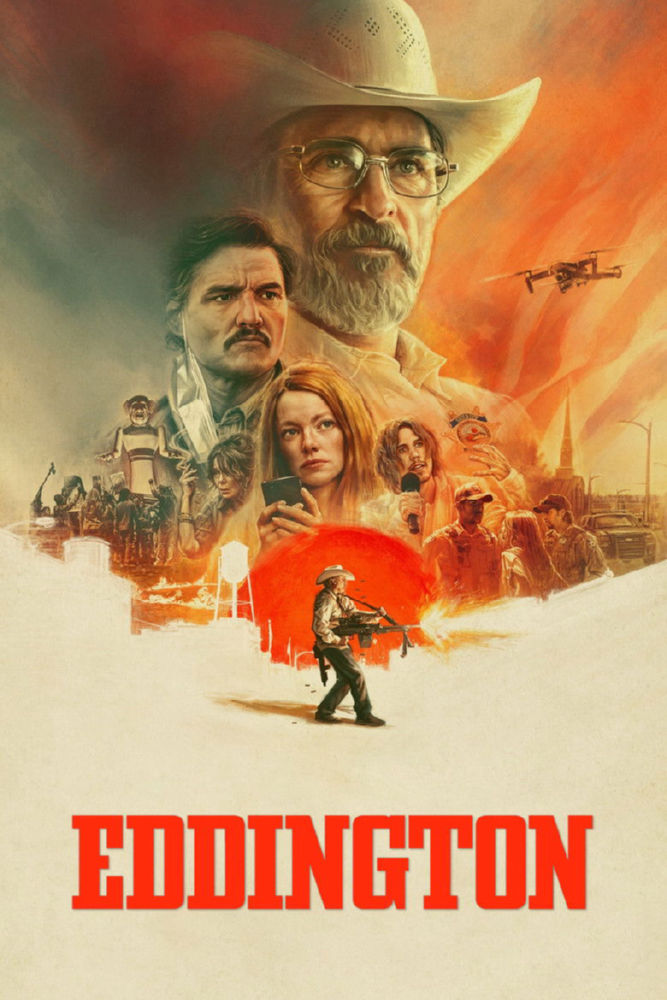




 MOVIE · 2025
Eddington IS WOKE
In a small New Mexico town in May 2020, Sheriff Joe Cross locks into a bitter mayoral fight with Ted Garcia that turns pandemic rules and street unrest into a violent local powder keg. Neighbors choose sides as the contest spirals beyond ordinary politics.
Eddington follows Sheriff Joe Cross, a small-town lawman who decides to challenge Mayor Ted Garcia for control of Eddington, New Mexico, while COVID restrictions and outside protest energy already fray daily life. Cross pushes back against the mayor’s handling of masks, lockdowns, and public order, turning routine enforcement stops and town-hall friction into open campaign warfare. Garcia digs in, using his office and local alliances to paint Cross as reckless and unfit. Residents begin picking camps; old grudges surface at stores, clinics, and street corners. A single standoff between the two men lights the wider fuse, and Cross finds his badge and home life pulled into the same fight. Concrete clashes over authority and safety replace quiet Main Street routines.
As ballots and accusations fly, Cross tries to hold the center of town while Garcia rallies supporters who see the sheriff as the real threat. Outside agitators and online noise bleed into local streets, and Cross’s circle—including people closest to him—gets dragged through threats, surveillance, and sudden violence. Alliances shift after night-time confrontations and public spectacles that leave property damaged and trust broken. Cross keeps pressing the election even as the cost lands on deputies, shopkeepers, and families who once stayed neutral. Garcia answers with sharper political theater and personal pressure. By the later turns the contest is no longer only about who wins City Hall; it is about who survives the town they both claimed to protect.
Creator: Ari Aster
Click any of the following icons below to rent or stream it!
WHAT CRITERIA MAKES IT WOKE?



Oops! Is this show WOKE?
Only an account holder or member can file. Cite a scene, a line, or a pattern. Other account holders +1 or −1 that argument, once each. The show is not WOKE until enough of them have given a +1. Enough −1s remove the write-up, and it is no longer shown.
Sign in to file a woke label. One of each criterion per member.
Comments and reviews
Report a mistake
Same rule as woke labels: one report, a written reason, and the community +1 or −1 it — once per member. A net +5 applies the change. Editors can hold it for review, or apply it immediately.
No mistake reports yet.
Sign in to report a mistake. One report per field, per member.
Member review
Stu Kline Member
Sep 19, 2026
★★★★★★★★★★Eddington drops you into a small New Mexico town right as May 2020 hits and refuses to let anyone stay neutral for long. Sheriff Joe Cross and Mayor Ted Garcia start with a practical disagreement over local rules and public safety. It turns personal fast, then political, then personal again until the whole place is choosing sides.
I gave it 3.5 because the central idea works better than most movies that touch that year. The isolation of the setting does real work. There is nowhere to drive off the anger or the fear. Streets, stores, and meeting rooms become the only stages left, so ordinary errands pick up charges they never used to carry. You watch people who shared fences and church pews start measuring each other by which man they back. That spread feels earned instead of forced.
What I liked most is how the feud stops belonging to the two men. It moves into households and shop counters. A family dinner turns into a quiet interrogation. A clerk rings up a sale while deciding whether the customer is still “one of us.” The movie does not need big speeches to show trust thinning out. You just see daily habits start to tear. I lived through 2020 in a place small enough that everyone knew your truck. Some of those moments landed with a dull recognition I did not expect from a film.
Cross and Garcia themselves stay human longer than the usual versions of this story allow. Neither is written as pure villain or pure saint. Their stubbornness feeds the town’s stubbornness. Once residents begin using the two men as banners, the original policy fight almost becomes secondary. That felt true to how local arguments actually ballooned that spring. People grabbed whatever symbol was handy and swung it at neighbors they used to wave to.
The movie loses some steam once the lines are fully drawn. Confrontations multiply, and a few of them start to feel like the same scene wearing different shirts. I wanted tighter focus on how specific people lived inside the split rather than one more raised voice in the street. Supporting characters sometimes exist mainly to declare a side and hold it. When the film slows down and stays with one household or one business for a stretch, it is stronger. When it rushes to the next public blow-up, the air goes out a little.
Still, the temperature is mostly right. Fear arrives, old grudges wake up, and leaders who should have lowered the heat decide to score points instead. The Western emptiness seals it in. No big-city anonymity to hide behind. That pressure cooker is the movie’s best tool, and it uses it well enough that I kept thinking about certain face-offs a day later. Most pandemic-adjacent films leave my head by the time I hit the driveway. This one stuck around.
I never felt lectured. That alone puts it ahead of a crowded field. It watches people break their own town instead of telling you how to feel about the break. The craft on the central clash is solid. The edges around it are softer and sometimes repetitive. That balance is why 3.5 sits right for me. Good enough to recommend if you want the neighbor-against-neighbor texture of that month without the usual moral scoreboard. Not so polished that I would call it essential.
The way ordinary life frays is the real subject. Groceries, school talk, who gets to speak at the next meeting—all of it gets weighted with loyalty tests. Once that starts, walking it back is almost impossible. Eddington understands the speed of that shift and the stubbornness that keeps it going. I have seen versions of the same shift in real life, smaller and quieter, and the movie’s version rang true more often than it missed.
Some quiet dread would have served better than a couple of the louder public scenes. A few turns announce themselves early. Those are the soft spots. They do not kill the whole thing. The core holds: two local men, a remote town, and a national panic dropped on top of whatever was already simmering. The community’s daily fabric starts to tear, and you feel the threads pull. That is enough to make the watch worthwhile even when the second half circles the same ground a little too long.
I walked out neither thrilled nor disappointed. Just sat with it. That is the rating. Three and a half. It does the hard part—showing how fast neighbors can become opponents—well enough that the uneven stretches do not erase the effect. If you have any memory of how thin the peace felt in smaller places that May, pieces of this will hit. If you do not, it still shows the mechanism clearly. Either way, it earns the time more than it wastes it.