



 VIDEO GAME · 2012
Dishonored
Framed for the empress’s murder, a royal bodyguard becomes a masked supernatural assassin hunting a corrupt conspiracy through a plague-ridden industrial city. Player choices of stealth or slaughter reshape the city’s fate and the story’s end.
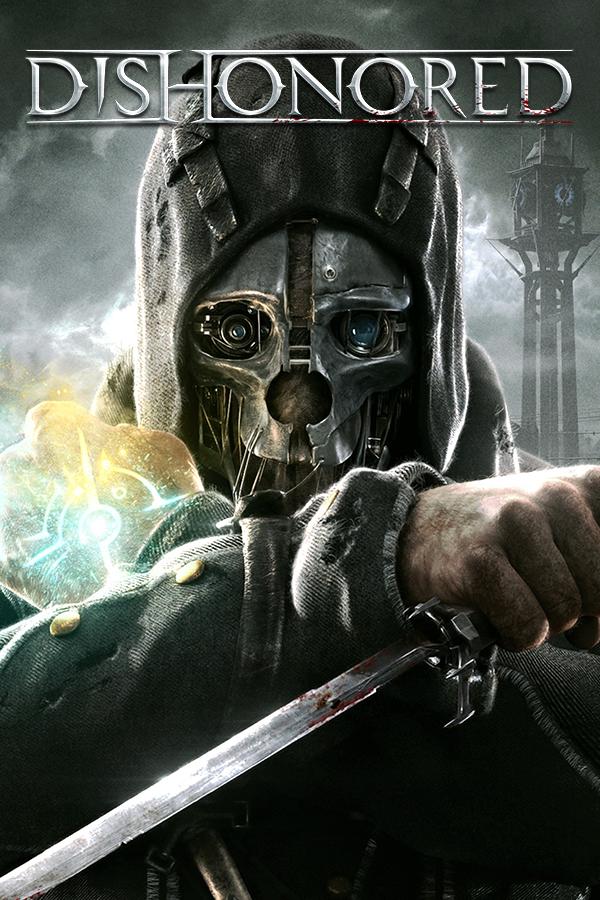
Dishonored follows Corvo Attano, loyal Lord Protector to Empress Jessamine Kaldwin, after he is betrayed, framed for her assassination, and cast into the dungeons of Dunwall. The city is an industrial whaling capital where steampunk machinery, whale-oil power, and occult forces collide under a spreading rat plague. Stripped of rank and left for dead, Corvo is freed by loyalists who need an agent capable of reaching the conspirators who seized power. Marked by the mysterious Outsider, he receives strange abilities that let him blink through walls, possess living beings, and bend time. Wearing an unsettling mask that becomes his signature, he moves through flooded streets, aristocratic towers, and quarantined districts while the young heir Emily remains a pawn in the new regime’s hands. Every target and every civilian death feeds a rising chaos that changes how the world reacts to him.
Corvo’s path is a sequence of carefully chosen eliminations against the officials, industrialists, and religious enforcers who orchestrated the coup and now rule through fear and plague control. He can ghost past guards with gadgets and supernatural tricks or cut a bloody swath; the game never forces one style, yet the city’s suffering, the fate of allies, and the final state of the throne all shift with the body count. Supporting figures—loyalists, street urchins, inventors, and the Outsider himself—offer information, tools, and moral pressure without turning the narrative into a sermon. The whaling industry’s cruelty, the Overseers’ rigid faith, and the aristocracy’s indifference form the backdrop of a revenge tale rather than modern identity checklists. In the end Corvo’s choices decide whether Dunwall collapses into darker tyranny or finds a fragile restoration, closing a self-contained story of betrayal, power, and consequence.
Developer: Arkane Studios
Oops! Is this show WOKE?
Only an account holder or member can file. Cite a scene, a line, or a pattern. Other account holders +1 or −1 that argument, once each. The show is not WOKE until enough of them have given a +1. Enough −1s remove the write-up, and it is no longer shown.
Sign in to file a woke label. One of each criterion per member.
Comments and reviews
Report a mistake
Same rule as woke labels: one report, a written reason, and the community +1 or −1 it — once per member. A net +5 applies the change. Editors can hold it for review, or apply it immediately.
No mistake reports yet.
Sign in to report a mistake. One report per field, per member.
Member review
Omar Quill Member
Oct 22, 2026
★★★★★★★★★★I put a lot of hours into Dishonored after finally grabbing it on a quiet week, and it clicked harder than most stealth games I have tried. I am around seventeen and I usually bounce between multiplayer builds and single-player campaigns when I need something that actually lets me mess with the systems. This one did both for me. First run I treated it like a power fantasy and leaned into the loud tools. Second run I slowed down, ghosted more, and the whole city felt different. That is the part that stuck.
You play as Corvo, once the Empress’s bodyguard, now framed and working through a string of targets with a weird set of gifts from the Outsider. The story moves clean and does not waste time explaining every note on the wall, which I liked. Dunwall itself does most of the talking. Whaling city, plague in the streets, tallboys stomping around on stilts, whale oil powering everything. It still looks sharp even now if you bump the settings a bit. The art direction is colorful in a grim way, oil paint skies over rusty metal and flooded alleys. I kept stopping just to look down a canal or through a broken window.
Combat and stealth sit on the same flexible kit. Blink is the one I never stopped using. Short teleport that lets you hop ledges, drop behind a guard, or bail when a plan falls apart. Add possession, windblast, dark vision, the crossbow, the sword, spring razors, sleep darts, and you can approach almost any room five different ways. Want to knock a guy out and stash him in a dumpster? Fine. Want to chain a throat cut into a bolt through the next guy’s helmet? Also fine. I spent whole evenings just replaying the early sections until the routes felt clean. It never felt like the game was punishing me for trying something stupid. It mostly rewarded it.
Chaos is the system that ties it together. Kill a lot and the streets get nastier, more rats, more weepers, harsher endings. Keep it low and the city stays a little more human. It is not a morality lecture about whether killing an evil official is wrong. It just shows what happens when leaders disappear and people fill the vacuum. That framing felt smarter than most choice meters I have seen. The maps are built for it too. Vertical routes everywhere, side doors, rooftops, sewers. On my first playthrough I still missed whole wings of buildings. Lore notes and books fill the gaps if you care to read, and a lot of it is worth reading.
I somehow skipped this game for years and only got around to it recently. It is really fun and I would call it a masterpiece of the stealth-action type, which makes you wonder what happened to Arkane across the years that followed. There will not be another game like Dishonored in the same exact way. The powers, the level design, and the way your choices actually rewrite the streets all work together without feeling like checkboxes. Performance was solid on my machine. Higher FOV on PC helps a lot with the first-person movement. Once it is dialed in, the controls feel tight.
The campaign is shorter than some open-world stuff I play, and things do move along at a good clip. That can feel jarring if you are used to hundred-hour sandboxes, but the replay value balances it. Different loadouts, different chaos levels, different nonlethal paths for the same targets. I have not hit a true New Game Plus yet, but I already want another full run just to clean up the routes I botched. The stealth itself is more line-of-sight than pure shadow play, which threw me for a minute, but the supernatural kit makes up for any old-school roughness.
I treat a lot of older games the way I treated early Assassin’s Creed runs: pick it up, learn the loop, then sink hours into perfecting the feel. Corvo’s kit rewards that. The mask, the gadgets, the way a quiet approach can still turn into controlled chaos if you want it to. Granny Rags and a few other side characters left strong impressions even when I was just trying to stay hidden. Nothing felt repetitive. Missions stay varied because the tools stay creative.
If you have never played this kind of immersive first-person assassin game, it is still one of the best entry points. If you have played it before on another device, it holds up. I finished it once, immediately started thinking about the next chaos level, and kept finding little routes I had walked past. That is rare. Most games lose me after the main story. This one made me want to live in the systems a while longer. Five stars easy. It earned the time and I still open it when I want something that feels like pure player freedom mixed with a world that actually reacts.