
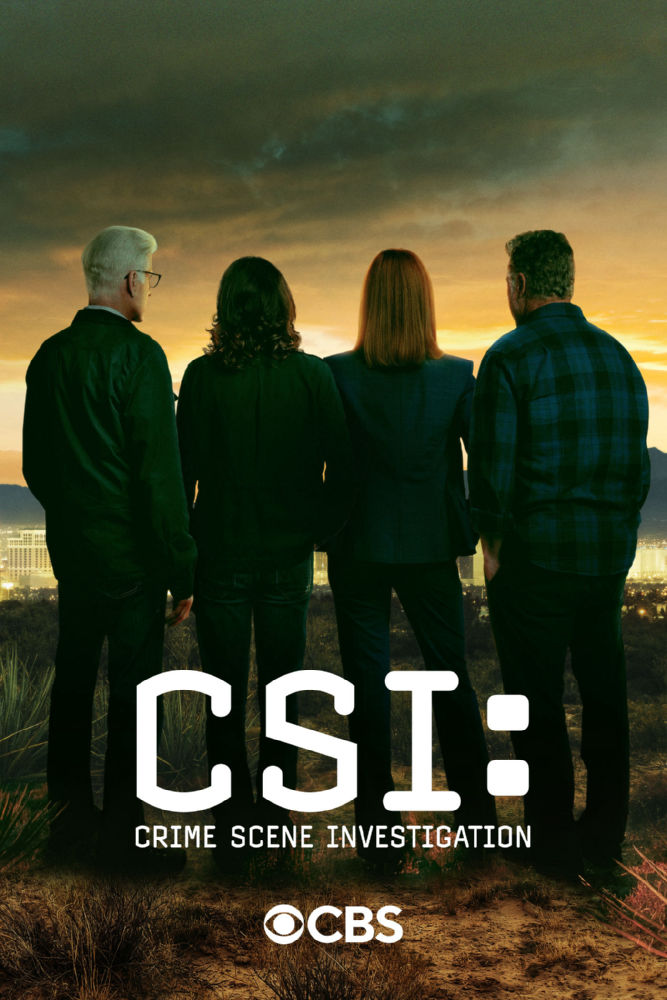


 TV · 2000
CSI: Crime Scene Investigation
IN REVIEW · the community verdict is still open
Las Vegas crime lab scientists turn blood, fibers, and trace evidence into airtight cases against killers and other offenders. Night after night the team rebuilds what happened from the scene outward.
CSI: Crime Scene Investigation follows Gil Grissom, the eccentric entomologist who runs the Las Vegas PD night-shift crime lab, as he leads Catherine Willows, Nick Stokes, Warrick Brown, and Sara Sidle through bloody hotel rooms, desert dumpsites, and casino back corridors. Each episode opens on a fresh body or crime scene; the investigators photograph, bag, and catalog every shell casing, hair, and fingerprint before the lab turns the material into timelines and suspect lists. Grissom insists on letting the evidence speak, often clashing with detectives who want faster arrests. Catherine balances single parenthood with fieldwork while Nick and Warrick handle the physical recovery of remains and weapons. Sara’s meticulous lab work and later personal tie to Grissom deepen the unit’s internal stakes without derailing the case structure. Brass and the detectives bring suspects in for interrogation once the science points a direction.
As seasons continue, Greg Sanders moves from lab tech to field CSI, and later arrivals such as Raymond Langston join the rotation after major cast changes. The unit confronts serial killers, staged suicides, and high-profile Strip crimes while personal arcs—Warrick’s gambling troubles, Nick’s abduction, Grissom’s hearing loss and eventual departure—play out between the forensics. Catherine rises into leadership when Grissom steps back, keeping the lab’s standards intact under political and media pressure. Cases still hinge on DNA matches, ballistics, and insect evidence rather than speeches about identity. Relationships inside the team, including Grissom and Sara’s long-building romance, remain secondary to the next crime scene. The series closes its original run with the same core method: scour the scene, trust the science, and let the missing piece close the mystery.
Creator: William Petersen, Laurence Fishburne
Oops! Is this show WOKE?
Only an account holder or member can file. Cite a scene, a line, or a pattern. Other account holders +1 or −1 that argument, once each. The show is not WOKE until enough of them have given a +1. Enough −1s remove the write-up, and it is no longer shown.
Sign in to file a woke label. One of each criterion per member.
Comments and reviews
Report a mistake
Same rule as woke labels: one report, a written reason, and the community +1 or −1 it — once per member. A net +5 applies the change. Editors can hold it for review, or apply it immediately.
No mistake reports yet.
Sign in to report a mistake. One report per field, per member.
Member review
Becky Soto Member
Oct 21, 2026
★★★★★★★★★★I still remember the first time I sat down with CSI back when it was new, and that early stretch with Holly Gribbs has stayed with me longer than I expected. She walks in, introduces herself to Gil Grissom on the graveyard shift, and he just casually asks her for a pint of blood like it’s the most normal onboarding step in the world. That little beat told me right away this show was going to be about the work first and the personalities second. It felt practical and a bit odd in the best way, and it hooked me without needing a big speech about justice or destiny.
What I like about this series is how it treats the science as the real engine. The team uses the lab, the evidence, the little details most people would walk right past, and they build the story from there. Las Vegas at night gives everything a specific texture—neon, casinos, the desert right outside the city—and the cases feel tied to that place instead of floating in some generic city. Grissom is the calm center. He is curious more than he is dramatic, and that curiosity makes the process interesting even when the crime itself is grim. You watch him and the others move through a scene, and you start noticing things the way they do. I never felt talked down to. The show assumes you can keep up if you pay attention.
Nick Stokes and Warrick Brown come in with their own styles, and the early episodes let those differences sit without forcing everyone into the same mold. Nick has that easy confidence; Warrick carries a quieter weight. Their work together and apart feels like real shift dynamics more than a constructed buddy act. Catherine and Sara round out the group in ways that feel earned by what they actually do on the job, not by some checklist. I appreciate that the show mostly lets competence speak. When someone is good at processing a scene or reading a blood spatter pattern, you believe it because you have watched them do the steps.
There is a rhythm to these episodes that I find comforting even when the cases are ugly. You get the call, the walkthrough, the lab work, the interviews, and then the pieces click. Sometimes the answer arrives with a quiet satisfaction rather than a big courtroom speech. I like that. Life is messy, evidence is partial, and the show does not pretend every night ends with perfect closure. At the same time it rarely feels hopeless. The point is that careful work still matters. Someone has to look at the carpet fiber or the shoe print or the trace under the fingernails, and someone has to care enough to do it right.
One scene that keeps coming back is the way Grissom handles new people on the team. That blood request for Holly is funny and slightly unsettling, but it also sets a standard: you are here to do the science, not to perform. Later episodes build on that idea without turning it into a lecture. The graveyard shift has its own personality—quieter halls, different kinds of calls, a sense that the city never really sleeps. I used to put an episode on after a long day and feel like I was tagging along on the shift. It is company without being noisy company.
I gave it four stars because it holds up as solid, character-driven procedural television that respects the audience’s attention. It is not perfect. Some later stretches lean harder on shock or formula, and a few guest arcs feel thinner than the core ensemble. But the foundation is strong. The original run understands that the fascination is in the method: how a team turns chaos into a sequence of facts. The writing trusts that watching people think carefully is entertaining. You do not need constant shouting matches or moral grandstanding to stay invested. A well-observed crime scene and a lab tech who knows her equipment can carry an hour just fine.
I also like how the show sits with ordinary manhood and ordinary work without turning either into a problem that needs fixing. The men on the team are competent, flawed, sometimes awkward, sometimes steady, and the story lets them be those things. The women are the same—skilled, human, not required to shrink anyone else to look strong. That balance feels natural rather than engineered. When the cases touch on heavier social topics, the focus usually stays on the evidence and the people in the room instead of turning the hour into a sermon. That restraint is part of why I keep returning to early seasons.
Watching it again now, I notice how cleanly it establishes its world. You learn the layout of the lab, the habits of the shift, the small jokes that pass between people who have worked too many nights together. Holly’s first night is a good example of how the show introduces stakes without overplaying them. You feel the weight of the job settling on her shoulders, and Grissom’s understated way of testing her readiness says more than a monologue would. Those kinds of choices make the whole series feel lived-in.
If you want flashy speeches and constant reinvention, this might not be your first pick. If you want to watch a group of people who take physical evidence seriously and build stories out of what the scene actually contains, then CSI still delivers that pleasure. I come back for Grissom’s quiet focus, for the night-shift atmosphere, and for the satisfaction of watching a careful process unfold. Four stars feels right to me—reliable, smart enough, and still able to make a single odd request for a pint of blood stick in my head years later. That is the kind of small, specific moment that tells you the show knows what it is doing.