



 VIDEO GAME · 2022
Crash Bandicoot™ 4: It’s About Time
IN REVIEW · the community verdict is still open
It’s About Time - the critically-acclaimed Crash Bandicoot™ 4: It’s About Time is now on Steam!
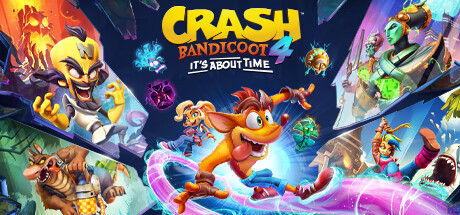
Crash fourward into a time shattered adventure with your favorite marsupials. Neo Cortex and N. Tropy are back at it again and launching an all-out assault on not just this universe, but the entire multiverse! Crash and Coco are here to save the day by reuniting the four Quantum Masks and bending the rules of reality.
New abilities
Developer: Toys for Bob
Oops! Is this show WOKE?
Only an account holder or member can file. Cite a scene, a line, or a pattern. Other account holders +1 or −1 that argument, once each. The show is not WOKE until enough of them have given a +1. Enough −1s remove the write-up, and it is no longer shown.
Sign in to file a woke label. One of each criterion per member.
Comments and reviews
Report a mistake
Same rule as woke labels: one report, a written reason, and the community +1 or −1 it — once per member. A net +5 applies the change. Editors can hold it for review, or apply it immediately.
No mistake reports yet.
Sign in to report a mistake. One report per field, per member.
Member review
Omar Quill Member
Oct 22, 2026
★★★★★★★★★★Crash Bandicoot 4 sat in my library for a while before I actually committed. I had the N. Sane Trilogy already and figured I knew the loop. I was half right. The bones are still Crash—spin, jump, boxes, that little panic when a nitro is sitting one pixel too close—but the levels stretch longer and the timing windows get meaner the deeper you go. I put in something like thirty-five hours just clearing the story and poking at N.verted runs, and another chunk chasing gems I knew I would never finish cleanly. That feels about right for how the game is built.
The movement is the part that sold me first. There is basically no input lag compared to the remakes, and it plays closer to how I remember the older console versions feeling under your thumbs. Once the Quantum Mask abilities kick in you start bending jumps and phases in ways the early games never let you, and the shadow under Crash makes aerial landings readable instead of guesswork. I still hit a stretch where double jump felt inconsistent for me—sometimes it fired clean, sometimes it ate the input and I dropped into a pit I should have cleared. That kind of thing is death in a platformer because you stop trusting the tool. Everything else around it held up, so I adjusted by tapping earlier and staying more deliberate, but it bugged me for a couple of sessions.
Difficulty is the big conversation piece and I get why. Later levels, especially the Castle Cortex run, demand pixel timing and full use of the masks or you eat it. Checkpoints are generous enough that dying does not always send you back to the start of a ten-minute gauntlet, and you can leave infinite lives on so a tough section does not turn into a life-farm loop. I still rage-quit one evening after work because I wanted something chill and got the opposite. Pure joy for the first several hours, then the real test starts. If you treat it like a casual unwind game you will hate it. If you treat it like a skill check that happens to look like Crash, it clicks. I am not crazy enough to 100% the whole thing; the hidden crates and the flashback tape loops would burn me out. Playing the story straight and then dipping into N.verted for extra challenge felt like the sweet spot. Casual and hardcore both get a lane if you set your own bar.
Level design is tight more often than not. Classic side-to-side and into-the-screen sections show up, and the new mask tricks keep routes from feeling like carbon copies of 1990s layouts. Some stages go on too long and a few crate placements feel like they only exist to force a second or third full clear with a guide open. That is the wrong lesson to take from the originals if you ask me—the old games were hard because the systems were simple and unforgiving, not because every room needed twenty extra hazards. Still, when a run lands and you clear a section that wrecked you five times, the reward lands harder than most modern platformers manage. Controls stay responsive the whole way. Graphics hold up and the game ran smooth on my setup with no weird hitching.
I bounced between Crash and Coco depending on the stage, and the extra characters are mixed. Some of the gun sections feel clunky compared to the core spin-and-jump loop. Masks are the real toys. Phase through walls, reverse gravity, that kind of stuff turns a familiar formula into something that still surprises after you think you have the rhythm. Boss fights are the usual theatrical Cortex nonsense and they are paced well enough that they do not overstay. I never felt the story needed more weight; it is Crash, the point is the platforming and the slapstick.
Would I call it the best in the series? For pure challenge and polish on the controls, maybe. For the feeling of breezing through a world and scooping everything in a couple of tries, no—the older ones and the trilogy still win that. Price at full is steep if you only want a light nostalgia hit; waiting for a sale makes more sense unless you already know you want the grind. I still finished it happier than not and I would recommend it to anyone who already likes Crash or tough platformers in general. Especially if a good challenge is the point for you. We could have used a proper Crash 5 built on this foundation because the core is that strong, but what we got is already more than a cash-in remake.
My controller survived. Barely. I took breaks like I should have, stopped forcing 106% runs, and the game stopped feeling like it was designed only to annoy. It is fair more often than it is cheap, the movement is polished, and the hours I sunk into learning the later stages felt earned instead of wasted. Four stars from me. Hard, rewarding if you meet it halfway, and still recognizably Crash under all the new rules. Just do not boot it up already stressed.