



 MOVIE · 2025
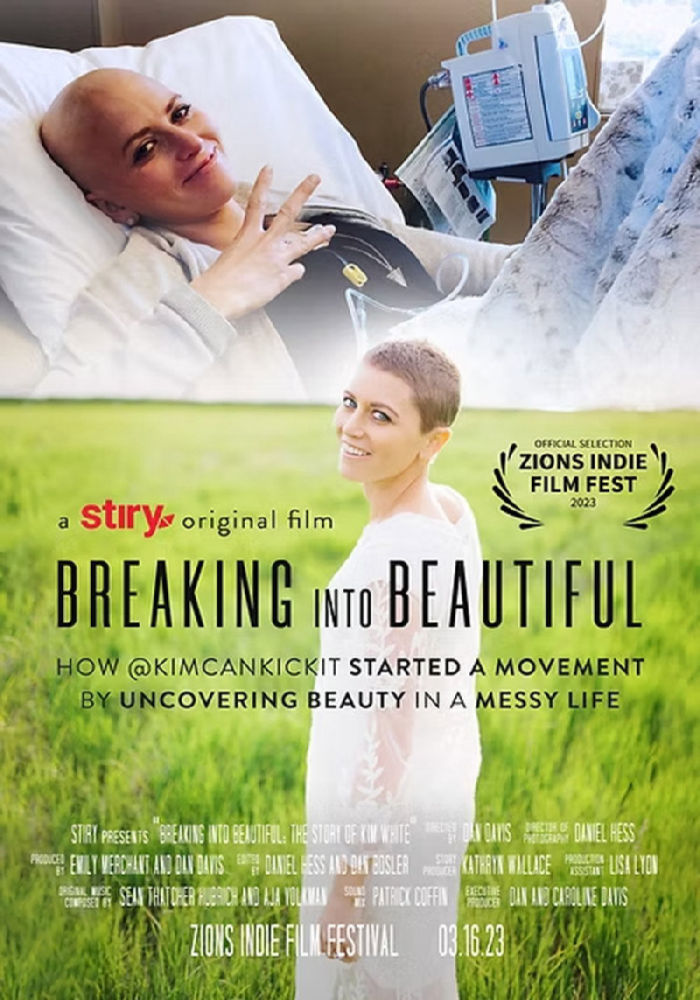
Breaking Into Beautiful
Kim White confronts a rare aggressive cancer through surgeries, setbacks, and an unshakable faith that reframes despair into gratitude and perseverance.
Breaking Into Beautiful follows Kim White as she learns she has a rare, aggressive cancer and begins a long medical fight. The documentary gathers her own raw social media posts, sit-down interviews, and testimony from family and friends to show the early shock, hospital stays, and successive operations. Kim leans on her faith in God and her love for her family while the cameras capture both private low points and small moments of humor. Viewers see how she documents her days, processes fear, and keeps searching for meaning when recovery stalls. The film stays close to her voice rather than turning the illness into a broader social lecture.
As treatments continue and complications mount, Kim’s circle rallies around her and the footage records their practical care and emotional support. She keeps returning to prayer, everyday beauty, and gratitude even when the outlook darkens again. Loved ones reflect on how her outlook shifts their own sense of what endurance looks like. The later passages track her ongoing resolve to live fully amid uncertainty, without tidy medical miracles or manufactured conflict. The story closes on the texture of her perseverance and the relationships that sustain it.
Creator: Dan Davis
Click any of the following icons below to rent or stream it!
Oops! Is this show WOKE?
Only an account holder or member can file. Cite a scene, a line, or a pattern. Other account holders +1 or −1 that argument, once each. The show is not WOKE until enough of them have given a +1. Enough −1s remove the write-up, and it is no longer shown.
Sign in to file a woke label. One of each criterion per member.
Comments and reviews
Report a mistake
Same rule as woke labels: one report, a written reason, and the community +1 or −1 it — once per member. A net +5 applies the change. Editors can hold it for review, or apply it immediately.
No mistake reports yet.
Sign in to report a mistake. One report per field, per member.
Member review
Toni Briggs Member
Oct 2, 2026
★★★★★★★★★★Breaking Into Beautiful hit me harder than I expected from a story built around one woman’s cancer fight. I went in knowing the basics—Kim White gets hit with a rare aggressive form that forces her through a string of surgeries that rewrite her body and her plans—and I came out feeling like I’d sat through something honest instead of something engineered for tears. That matters. A lot of these films treat illness like a three-act arc with a swelling score and a tidy speech at the end. This one stays closer to the ground.
What works is how little it flinches. Kim doesn’t get cast as a saint or a warrior poet. She’s scared, she’s angry, she’s exhausted, and she says so. The cameras linger on the ordinary damage—the way a recovery room can feel like a holding cell, the way family members hover without knowing what to say, the way a single patch of sunlight on a windowsill can suddenly feel like proof you’re still here. Those small interruptions of beauty aren’t presented as miracles. They’re just the things that keep a person from folding. I appreciated that restraint. It keeps the hope from turning syrupy.
I rated it 4.5 because the film earns most of its weight through presence rather than plot twists. The early stretch stays locked on the physical ordeal, and it doesn’t rush past the dull, grinding parts of treatment. You feel the repetition of hospital corridors and the slow math of what each procedure might cost her. Family stays close in practical ways—rides, quiet company, the kind of help that doesn’t need a monologue. Kim decides, moment by moment, how much of the raw truth she will speak out loud. That choice feels real. Plenty of people in her position learn to edit themselves for the comfort of others; she mostly refuses, and the film respects the cost of that refusal.
There’s a toughness here that doesn’t need to announce itself. Resilience isn’t a slogan. It’s the decision to keep showing up for the next appointment when your body already feels like a stranger. The movie understands that. It also understands that beauty can be small and still matter—a shared laugh that breaks the clinical quiet, a hard-won step that used to be automatic. Those beats land because they aren’t oversold. I found myself thinking about people I know who’ve gone through similar tunnels, and how rarely the public version of their story matches the private one. This gets closer to the private version without turning voyeuristic.
If I have a complaint, it’s that the later stretch could have trusted silence a little more. A couple of scenes lean on dialogue that restates what the faces already told us. Not enough to sink it, but enough that I noticed. Still, the overall shape holds. The film doesn’t pretend the cancer is a character-building vacation. It shows the fear and the anger as permanent residents, not temporary guests. Hope survives alongside them, not by erasing them. That balance is harder to pull off than most directors admit.
I don’t need every story about illness to be inspirational. I need it to be straight. Breaking Into Beautiful mostly is. Kim White’s ordeal is specific—rare diagnosis, life-altering surgeries, an uncertain future—yet the texture feels familiar to anyone who’s watched someone they love get reduced to charts and waiting rooms. The movie keeps its focus tight on her body and her decisions rather than spinning off into speeches about the meaning of it all. That discipline is why the small moments register. When she finds a reason to keep fighting, it doesn’t feel like a scripted beat. It feels like someone choosing daylight over the alternative.
Watching it left me with a quiet respect more than a rush of emotion, and I prefer it that way. Tears are easy to manufacture. Respect takes longer. The film gives you the unglamorous middle of the fight—the exhaustion that doesn’t photograph well, the honesty that can make family flinch, the stubborn refusal to disappear into the patient role. Kim stays a person. That’s rarer than it should be in this genre.
I’d tell a friend this is worth the time if they’re tired of sanitized versions of the same story. It doesn’t invent drama where the facts already supply enough. It doesn’t dress the cancer up as a metaphor. It just follows one woman through the wreckage and the thin, hard-won spaces of beauty that keep appearing anyway. Four and a half stars feels right. It’s not flawless, but it’s solid, clear-eyed, and free of the usual sugar coating. I’ll remember the sunlight-through-the-window moments longer than any big speech, and that tells me the film did its real job.