
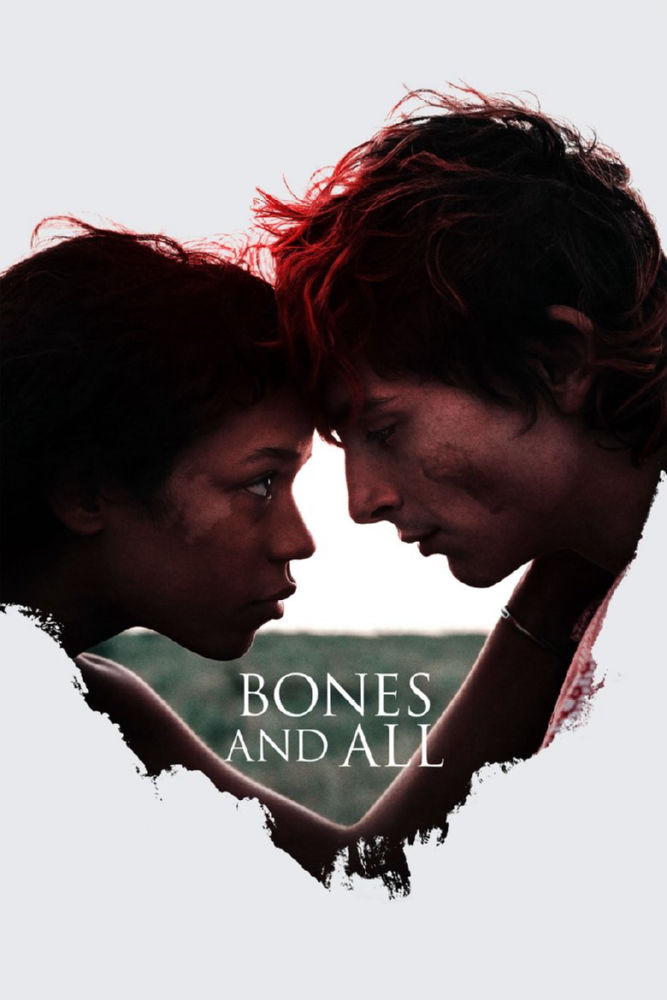



 MOVIE · 2022
Bones and All IS WOKE
Abandoned by her father, a young woman embarks on a thousand-mile odyssey through the backroads of America where she meets a disenfranchised drifter.
But despite their best efforts, all roads lead back to their terrifying pasts and to a final stand that will determine whether their love can survive their otherness.
WHAT CRITERIA MAKES IT WOKE?



Oops! Is this show WOKE?
Only an account holder or member can file. Cite a scene, a line, or a pattern. Other account holders +1 or −1 that argument, once each. The show is not WOKE until enough of them have given a +1. Enough −1s remove the write-up, and it is no longer shown.
Sign in to file a woke label. One of each criterion per member.
Comments and reviews
Report a mistake
Same rule as woke labels: one report, a written reason, and the community +1 or −1 it — once per member. A net +5 applies the change. Editors can hold it for review, or apply it immediately.
No mistake reports yet.
Sign in to report a mistake. One report per field, per member.
Member review
Wes Calder Member
Oct 10, 2026
★★★★★★★★★★Bones and All is one of those movies that keeps threatening to become something simpler and then keeps refusing. I rated it 3.5 because that number matches how I felt walking out: engaged, a little worn down by the thesis, and still willing to admit the craft mostly holds. It is a road picture first, a romance second, and a horror movie only when it remembers to be. The late-1980s Midwest look is plain and convincing. You feel the bus stations and the cheap rooms without the camera lingering like it wants a postcard.
Taylor Russell carries most of it. Maren starts the film already half-broken by what she is, and Russell plays the caution and the hunger without begging for sympathy. Timothée Chalamet, as Lee, is better here than I usually find him. He keeps the restlessness quiet instead of turning it into a performance of restlessness. Their early recognition of each other works; you buy that two people who eat people would spot the same hunger across a parking lot and decide, almost immediately, that traveling alone is worse. Mark Rylance appears long enough to make every scene around him feel stranger and more dangerous, then exits, which is both a relief and a loss.
What I kept noticing, and what settled into a real irritation by the middle hour, is how the central romance handles the cannibalism. It is not treated as a curse the two of them might fight or a sickness they try to contain. It is framed as their unavoidable identity. Love, in this movie’s logic, has to accommodate the eating rather than reject it. Maren and Lee’s bond only deepens once both of them stop pretending the hunger is something temporary or shameful. The film returns, again and again, to the question of whether their relationship can survive that otherness, and the answer it keeps offering is that survival depends on full acceptance of the urge as a trait. Cannibalism becomes the stand-in for any difference that demands total accommodation. I understood the metaphor. I also got tired of watching the story rearrange itself around the metaphor instead of around the two people carrying it.
That choice bleeds into the tone. Some of the kills are properly unsettling; you feel the mess and the aftermath. Others feel like the movie is checking a box so it can get back to soft talk about belonging and whether the world will ever make room. The score by Trent Reznor and Atticus Ross does a lot of quiet work holding the mood together when the script leans didactic. The first half is sharper. New encounters still feel risky. Later the road stretches grow longer and more meditative, and the film seems more interested in whether love can outlast the stigma of what they are than in what they actually do to stay fed.
I am not asking a cannibal romance to moralize. I am saying the movie already has a moral, and it is the familiar one: the otherness is fixed, the only failure is rejection, and intimacy means making permanent room for the thing that would get you locked up or worse. Once you see that pattern it is hard to unsee. It turns what could have been a bleak, specific story about two damaged kids into a broader lesson about acceptance that the cannibalism is only there to illustrate. That is the part that kept me at 3.5 instead of higher. The performances are committed. The chemistry is real enough. The atmosphere mostly works. But the romance is built on the idea that love’s job is to normalize the killing rather than to flinch from it, and the movie will not let that idea rest.
There are still stretches I liked without reservation. Russell’s quieter scenes, the way the two of them share a meal and then have to live with the silence afterward, a few moments of actual dread when an outsider gets too close. The film never becomes pure slog. It just keeps circling the same question about whether their love can hold under the weight of what they are, and it answers by insisting the hunger itself is an identity trait that requires accommodation. I noticed it every time the dialogue drifted that direction. It is effective filmmaking in service of a point I did not need repeated for two hours.
So 3.5. Worth seeing if you can tolerate the sermon baked into the love story. Not something I am eager to revisit. Russell is the reason I stayed with it. Chalamet stays out of his own way for once. Rylance is briefly excellent. And the whole thing would have sat cleaner with me if it had trusted the horror and the loneliness more than the identity parable.