



 MOVIE · 2021
Blue Bayou IS WOKE
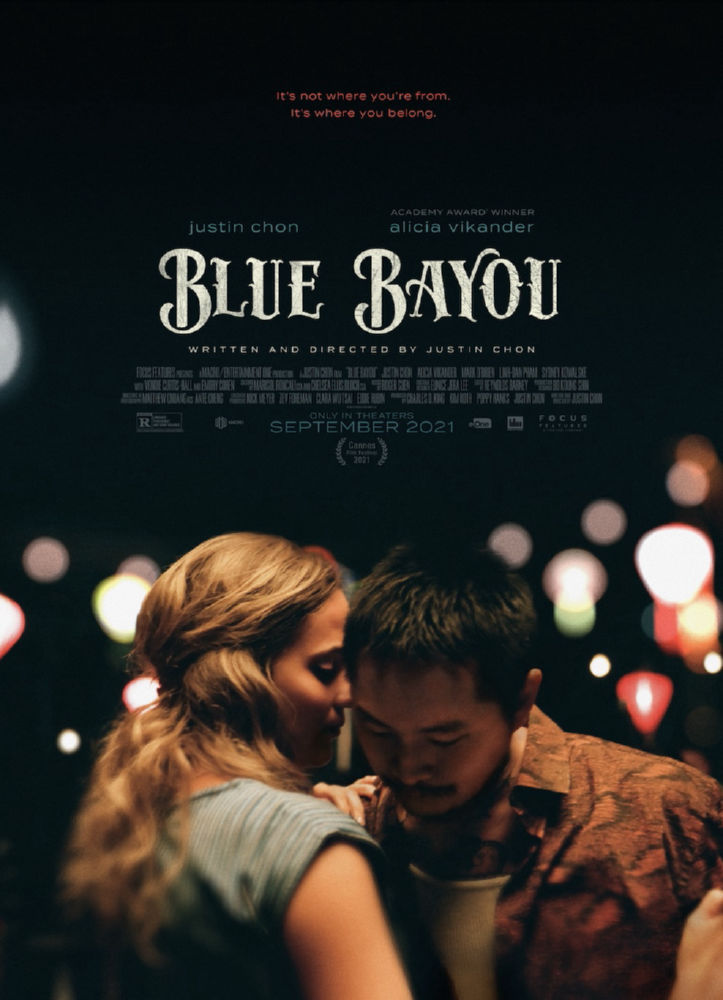
As a Korean-American man raised in the Louisiana bayou works hard to make a life for his family, he must confront the ghosts of his past as he discovers that he could be deported from the only country he has ever called home.
WHAT CRITERIA MAKES IT WOKE?

Oops! Is this show WOKE?
Only an account holder or member can file. Cite a scene, a line, or a pattern. Other account holders +1 or −1 that argument, once each. The show is not WOKE until enough of them have given a +1. Enough −1s remove the write-up, and it is no longer shown.
Sign in to file a woke label. One of each criterion per member.
Comments and reviews
Report a mistake
Same rule as woke labels: one report, a written reason, and the community +1 or −1 it — once per member. A net +5 applies the change. Editors can hold it for review, or apply it immediately.
No mistake reports yet.
Sign in to report a mistake. One report per field, per member.
Member review
Toni Briggs Member
Sep 24, 2026
★★★★★★★★★★Blue Bayou sat with me longer than I expected, which is half the reason I landed on 3.5 instead of something cleaner. It is a quiet, heavy movie about a man who has built an ordinary American life in the Louisiana bayou and suddenly finds that life can be taken from him by paperwork and timing he never controlled. Justin Chon plays Antonio with a kind of exhausted steadiness that feels earned rather than performed. You watch him work the docks, try to stay present for his stepdaughter, and hold his marriage together while the ground under him turns soft. That part worked for me. The guy is not a saint and he is not a cartoon victim. He makes mistakes, he snaps, he loves his people the messy way real people do. I believed him.
The bayou itself is almost another character, humid and slow and indifferent. The film does not dress it up as postcard scenery. It just lets the place sit there, full of the kind of everyday labor that does not make speeches. I appreciated that. Too many movies about “roots” turn the landscape into a metaphor factory. Here it mostly stays dirt and water and heat. When Antonio’s past starts catching up, the threat feels practical rather than symbolic. Deportation is not treated like an abstract idea; it is a clock running out on a family that already has enough ordinary problems. That grounded quality is what kept me watching even when the script wandered.
Where it loses me is the second half’s habit of stacking emotional peaks until some of them start to feel arranged. There are scenes that land hard because they are simple and human, and then there are stretches that seem designed to make sure you understand how much this hurts. I did not need the extra underline. Chon’s face already told me. Alicia Vikander is solid as the wife trying to hold everything without turning into pure support scaffolding, and the stepdaughter’s scenes have a real awkward tenderness that does not feel written by committee. Still, the movie keeps reaching for one more wound, one more confrontation, and a few of those moments play like they were checked off a list rather than discovered in the room. I have seen this pattern before: a strong central performance carrying a story that does not quite trust itself to stay small and specific.
I also kept noticing how the film handles the legal machinery. It is angry in places, and fair enough, the system can be brutal and indifferent. But the anger sometimes flattens into a single note. Real life is messier. People get chewed up by process for reasons that have less to do with pure malice and more to do with inertia, bad timing, and rules that no one bothers to rethink until a camera shows up. Blue Bayou wants the full tragedy, and it earns a lot of it, yet it occasionally prefers the clean moral outline over the grinding, bureaucratic gray that would have felt truer. That choice does not ruin the movie. It just keeps it from the higher mark it was reaching for.
On a personal level, the family stuff hit closer than the politics. Watching a man try to stay a father while the world tells him he does not fully belong is the kind of pressure that does not need speeches. The quiet mornings, the short tempers, the way love starts to look like logistics when everything is falling apart—that is what stuck. I have known people who live inside that kind of uncertainty, not always for the same reasons, and the movie gets the body language right. Shoulders that never fully drop. Conversations that keep one ear on the next possible disaster. That felt honest.
At the same time, I wished it had left a little more room for the everyday life Antonio was fighting to keep. We get flashes of it, enough to care, but the plot keeps yanking us back to the crisis. A tighter edit and a little more faith in the ordinary scenes would have helped. The score sometimes does too much work as well, swelling where silence would have been stronger. Small complaints, maybe, but they add up when the rest of the film is trying so hard to feel unvarnished.
I am not interested in turning every story about belonging into a referendum. This one is specific enough that it mostly escapes that trap. It is about one guy, one family, one stretch of water and work and bad luck. That specificity is its best quality. When it stays there, it is moving without begging. When it reaches for broader statements, it gets thinner. For me that lands right in the middle: worth seeing if the premise pulls you in, not something I would push on everyone, and not a film that completely sticks the landing. 3.5 feels honest. I respected the lead performance and the texture of the place. I just wanted the story to trust its own quieter instincts a little more and stop arranging the pain so carefully. It is a decent movie that comes close to being a better one, and that near-miss is what I keep turning over.