
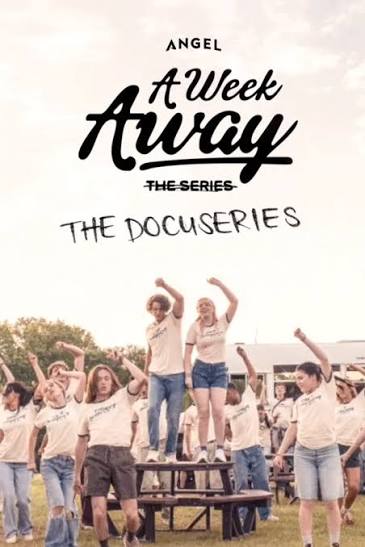



 TV · 2025
A Week Away: The Docuseries
A Week Away Docuseries follows the daily experiences of children at the Christian summer camp Camp Aweegaway as they join competitions, campfires, and conversations that strengthen friendships and personal faith.
A Week Away Docuseries follows campers at Camp Aweegaway who join team-building competitions and gather around campfires. The children form deep friendships through these shared activities. Heartfelt conversations allow them to explore new layers of their faith and identity. Each day presents fresh chances for personal growth and lasting memories at the camp.
Campers return to daily routines that mix adventure with reflection on their beliefs. Friendships develop further as participants support one another during challenges. The series records how these experiences help the kids connect their camp life to their developing sense of self and spirituality. Unforgettable moments arise from both group events and quiet personal realizations.
Creator: Alan Powell
Click any of the following icons below to rent or stream it!
Oops! Is this show WOKE?
Only an account holder or member can file. Cite a scene, a line, or a pattern. Other account holders +1 or −1 that argument, once each. The show is not WOKE until enough of them have given a +1. Enough −1s remove the write-up, and it is no longer shown.
Sign in to file a woke label. One of each criterion per member.
Comments and reviews
Report a mistake
Same rule as woke labels: one report, a written reason, and the community +1 or −1 it — once per member. A net +5 applies the change. Editors can hold it for review, or apply it immediately.
No mistake reports yet.
Sign in to report a mistake. One report per field, per member.
Member review
Becky Soto Member
Oct 22, 2026
★★★★★★★★★★I settled in with A Week Away: The Docuseries on a quiet evening and found myself staying up later than planned. It is not the summer-camp musical itself. It is the unpolished record of how Alan Powell, Steve Barnett, and the rest of the team fought to get that faith-based story made, and that process held my attention in a way a straight making-of rarely does.
The opening stretch still sits with me. Two weeks before cameras were supposed to roll, the actor cast as Max simply drops out. You watch Powell absorb the news in real time, the quiet scramble that follows, the phone calls, the recalculating of every schedule. When he reaches out to Antonio Cipriano and Cipriano says yes, the relief in the room is almost physical. That sequence does not feel staged for cameras. It feels like people who have already poured months into a project suddenly realizing the whole thing could still fall apart, then deciding it will not. I kept thinking about how many smaller productions never recover from a hit like that. Here they just keep moving.
From there the series settles into the work of rebuilding Camp Aweegaway on screen. Cast and crew talk about the actual summer camps they attended growing up, the awkward cabin nights, the skits that went sideways, the quiet moments when faith felt less like a lesson and more like something shared. Those interviews sit next to raw footage of sets going up, costumes being fitted, and music rehearsals that run long. Cozi Zuehlsdorff, who plays Lennie and also carries producing weight, comes across as steady and clear-eyed. You see her stepping between performance and logistics without turning either into a performance for the documentary crew. That balance stuck with me more than any single speech.
What I appreciated most is how little the series tries to smooth the edges. People are tired. Schedules slip. A lighting setup fails and everyone has to reset. Faith is present the entire time, but it is not delivered as a slogan. It shows up in the reason they chose this material in the first place and in the way they keep showing up for one another when the practical problems pile higher. I never felt lectured. I felt like I was watching a group of people who believe the story is worth the trouble and who are willing to look a little unpolished while they prove it.
There is a short stretch later on where the camp is nearly ready and the cast runs a full musical number under less-than-perfect conditions. Someone flubs a lyric, someone else laughs, they reset, and the second take lands cleaner. The camera just stays. No dramatic score, no slow-motion triumph. Just the ordinary satisfaction of getting something right after it went wrong. That beat felt truer to the spirit of the whole project than any polished montage could have. It reminded me why behind-the-scenes pieces can matter when they refuse to tidy everything up.
I rated it four stars because the honesty holds, the central crisis with the lead role gives the early episodes real stakes, and the quieter camp-memory conversations give the later ones warmth without turning soft. It is not perfect television. A couple of interview segments run longer than they need to, and the pacing occasionally drifts when the production itself is in a holding pattern. Still, those are small complaints next to the overall effect. You finish knowing how hard it was to get A Week Away: The Series made, and you finish glad they kept going. For anyone who has ever cared about a faith-centered story reaching an audience, or who simply likes watching creative people refuse to quit, this docuseries is worth the time. I walked away glad I watched it straight through rather than dipping in and out. The messiness is part of the point, and it works.