




 MOVIE · 2026
A Talent for Murder IS WOKE
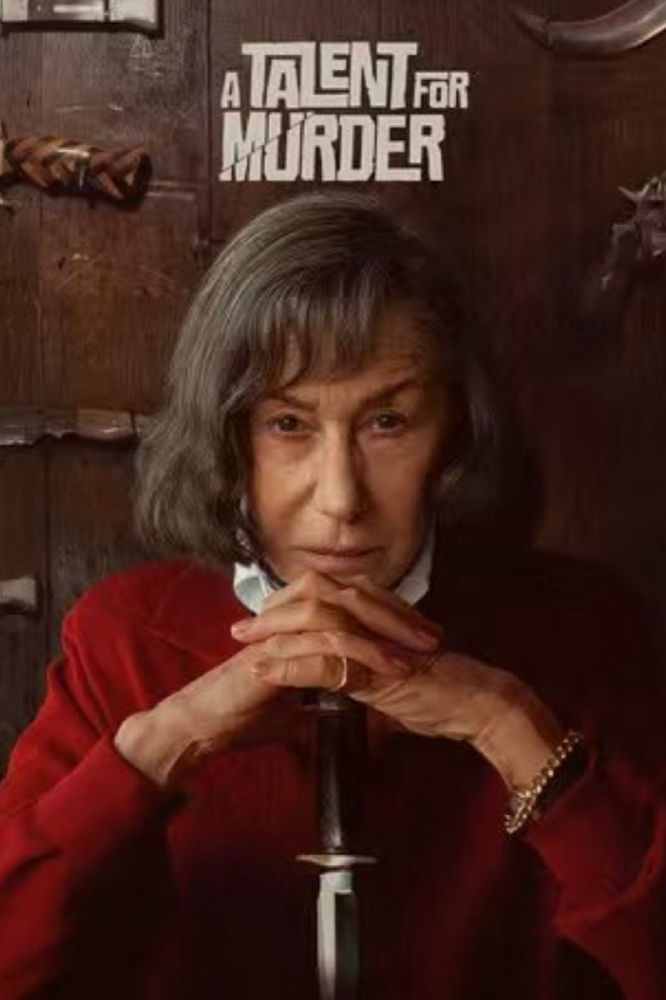
In 1995, an eager young New York editor travels to the Swiss Alps to talk a dying, venomous Patricia Highsmith into writing one last Tom Ripley novel, only to find himself cast in a deadly story she is writing in real time, while the editor sent before him has vanished without a trace.
Edward Ridgeway is a polite, ambitious young editor at a New York publishing house, and his career hinges on one signature. He is sent to a remote village in the Swiss Alps to persuade the legendary crime novelist Patricia Highsmith, ailing, hard-drinking and famously cruel, to write a sixth and final book about her most famous creation, the charming killer Tom Ripley. The last man the publisher sent on the same errand was never heard from again. Highsmith greets Edward with insults, mind games and a house full of guns, knives and poisons, and she is in no hurry to sign anything.
Instead she makes him an offer: one night to prove he can inhabit the mind of a murderer. Together they begin plotting a new Ripley tale set in Rome, in which a young con man stalks and seduces Clementine Balfour, an heiress whose fortune is locked up until her wealthy great-aunt dies. As the story takes shape, Edward himself steps into the role of Ripley, Clementine looks a lot like the woman he flirted with on the train, and the line between the novel and his own life starts to disappear. Edward's manner hardens by the day, and it becomes harder to tell whether he is the writer's collaborator, her creation or her next victim.
Creator: Helen Mirren, Alden Ehrenreich · IMDb
Click any of the following icons below to rent or stream it!
WHAT CRITERIA MAKES IT WOKE?

Oops! Is this show WOKE?
Only an account holder or member can file. Cite a scene, a line, or a pattern. Other account holders +1 or −1 that argument, once each. The show is not IS WOKE until enough of them have given a +1. Enough −1s remove the write-up, and it is no longer shown.
Sign in to file a woke label. One of each criterion per member.
Comments and reviews
Report a mistake
Same rule as woke labels: one report, a written reason, and the community +1 or −1 it — once per member. A net +5 applies the change. Editors can hold it for review, or apply it immediately.
No mistake reports yet.
Sign in to report a mistake. One report per field, per member.
Member review
Wes Calder Member
Oct 29, 2026
★★★★★★★★★★I saw A Talent for Murder on a weeknight screening that wasn’t full, just enough people that you could hear the room react when Highsmith landed a particularly nasty line. The Swiss Alps look properly remote on a big screen—long stretches of white and gray that make the house feel farther from help than any dialogue needs to spell out. You walk in knowing the premise: 1995, a polite young New York editor named Edward Ridgeway gets sent to talk a dying Patricia Highsmith into one last Tom Ripley novel. The man who tried before him vanished. Highsmith greets Edward with insults, mind games, and a house stocked with guns, knives, and poisons. She is in no hurry to sign.
For long stretches that setup holds. The movie understands the pleasure of watching someone smarter and meaner than you toy with a younger person who still believes manners and a contract will save him. Highsmith drinks, needles, and rewrites the conversation in real time. Edward stays professional longer than most people would. The tension is mostly verbal and spatial—doors that don’t open the way you expect, rooms that feel like stages she’s already arranged. I didn’t need a body count every ten minutes. The quiet worked.
What kept pulling me out were the moments that felt less like 1995 and more like the film checking boxes. A woman in the story states plainly that she is gay; it arrives with the flat certainty of something the script wanted on the record. Another female character describes her college dissertation on homoeroticism in ancient art and argues that modern views of that sexuality may simply be a misreading of past norms. Highsmith herself taunts Edward with the line that whether he knows it or not, he likes men. I noticed each of these because they sat a little apart from the rest of the sparring. Highsmith’s real-life biography is complicated enough that a film could have let the atmosphere do the work. Instead the dialogue pauses to underline the point, and the underline is what you remember after the scene ends.
None of that wrecks the movie. It just keeps it from settling into the cold groove it keeps promising. The performances are solid without grandstanding. Highsmith has the right mix of venom and boredom; you believe she would rather play with Edward than finish a book. Edward is ambitious and still green enough that you can see why the publisher thought he might succeed where the last man failed. The house itself is a character—every drawer seems to contain something that could end the visit early. On a large screen those details land: the glint of metal, the way light falls across a table already set for a conversation that won’t stay polite.
The middle hour is the strongest. Once the initial insults are out of the way, the film settles into a rhythm of tests and counters. Edward tries to keep the professional frame intact; Highsmith keeps sliding the frame. A few people around me laughed at the cruelty, the short, dry kind of laugh you hear when a character says something true and unkind. That worked better in a dark room with strangers than it probably would alone. The sound design helps—the wind outside, the quiet inside, the sense that the village is farther away than the map claims.
By the final stretch the movie has to decide whether it is a literary cat-and-mouse or a more conventional thriller with a body and a twist. It splits the difference, which left me neither fully satisfied nor irritated enough to walk out early. The stakes stay a little abstract even when the danger is supposed to be immediate. You understand Edward’s career depends on the signature, and you understand Highsmith is writing him into something he may not leave, but the emotional temperature never quite matches the alpine cold outside the windows.
I rated it 3.5. It is better than a pure curiosity piece and short of the sharp, mean little classic it keeps threatening to become. The location photography and the central performances carry a lot. The inserted speeches about sexuality and the pointed taunt about Edward’s preferences feel like material the film could not resist including, even when the story already had enough edge. Walking out into the lobby light, I mostly remembered the house and the way Highsmith watched him—and those three moments that didn’t need to announce themselves quite so clearly. If you like slow literary games and don’t mind the modern asides, the ticket is fair. It won’t rearrange your week, but it also won’t insult your intelligence for most of its running time. That is enough for a middling night at the movies, and roughly where I landed.