



 TV · 2021
United States of Al
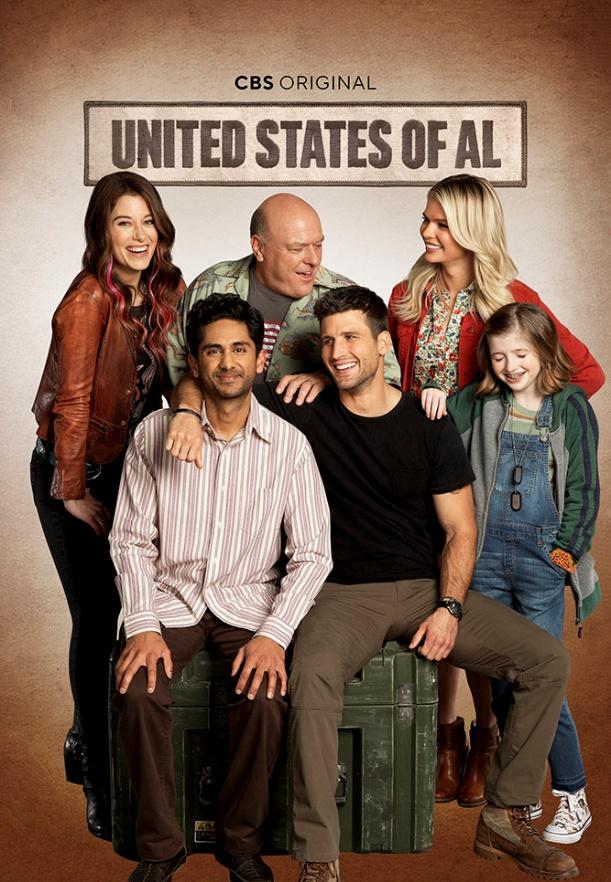
United States of Al follows Marine veteran Riley as he struggles to readjust to civilian life in Ohio while his former Afghan interpreter Al arrives to begin a new life in America.
United States of Al follows Riley, a Marine combat veteran returning from Afghanistan, as he attempts to rebuild his life in Ohio amid the challenges of post-service adjustment. His close friend and interpreter Al, who worked with Riley's unit, immigrates to the United States and moves in with Riley's family to pursue his own fresh start. The series depicts their daily interactions, Riley's efforts to reconnect with his sister and ex-wife, and Al's navigation of American customs and job opportunities.
Al's presence brings both support and friction as the two men confront lingering effects of their wartime experiences together. Episodes explore Riley's attempts to find steady work and emotional stability while Al deals with family separation and cultural differences in his new home. The narrative centers on their mutual reliance and the practical realities of veteran reintegration and immigrant adaptation.
Oops! Is this show WOKE?
Only an account holder or member can file. Cite a scene, a line, or a pattern. Other account holders +1 or −1 that argument, once each. The show is not WOKE until enough of them have given a +1. Enough −1s remove the write-up, and it is no longer shown.
Sign in to file a woke label. One of each criterion per member.
Comments and reviews
Report a mistake
Same rule as woke labels: one report, a written reason, and the community +1 or −1 it — once per member. A net +5 applies the change. Editors can hold it for review, or apply it immediately.
No mistake reports yet.
Sign in to report a mistake. One report per field, per member.
Member review
Omar Quill Member
Oct 20, 2026
★★★★★★★★★★I put United States of Al on after a rough stretch of late-night raids that kept wiping on the same mechanic. Needed something low-stakes that still had actual people in it instead of pure noise. Riley is the Marine back in Ohio trying to get his head around regular days again, and Al is the interpreter who followed him over to start fresh. They share space, chase jobs, deal with family, and the leftover weight from the deployment sits in the background without turning every scene into a speech. That setup worked for me more than I expected.
You’re not supposed to like this one. Scores get weird, positives vanish, and the whole conversation around it feels stacked. I still watched. Gave it the same honest middle rating I’d give a game that does the important parts right and fumbles a few side systems. 3.5 felt fair the whole way through.
Al’s accent sat wrong at first. I’ve never met anyone from that part of the world who sounds quite like it. Whatever the target was, it lands odd. The actor still gets the funny beats across, especially when Al is misreading interview rooms or neighborhood habits. Those moments play like a bad character build you have to live with for a few levels before you can respec. You cringe, then you laugh, then you see him adjust. It stops being a distraction once the friendship with Riley takes the lead.
What carried the show for me is the fathers. There are two of them who actually show up and try. They’re not the root of every problem, not comic idiots, not the default source of harm. That is rarer than it should be. Most stuff I bounce between treats ordinary manhood like the starting boss you have to defeat before the real story begins. Here the dads just parent and support and occasionally screw up like people. It makes the house feel real instead of a stage for punching down. I noticed it every time they were on screen because I’m so used to the opposite.
Riley’s readjustment never goes full melodrama. It’s quieter, closer to the slow recovery after a long campaign where your loadout still feels wrong and everyday quests take extra effort. Helping Al with the small stuff—applications, customs, just sitting through awkward dinners—gives Riley something solid to hold. Their bond doesn’t get sold as a lesson. It just happens over shared time the same way a good group chat forms after enough hours in the same lobby. Different backgrounds, same dumb jokes, same willingness to show up.
Some episodes drag on the sitcom timing. The jokes can feel older than the premise, and a couple of side characters stay thin. I docked it for that. Pacing isn’t always tight, and a few culture-clash bits repeat the same beat. Still, when it stays on the main pair and the family core, it holds. Al wants to build a life here without turning into a walking statement. Riley wants normal without pretending the past never happened. That balance kept me from wandering off to check patch notes mid-episode most nights.
I burned through the bulk of it in chunks between bigger titles, maybe twenty hours total if you count the rewatches of stronger scenes. It filled the same slot as a narrative side game with decent squad writing—nothing that rewrites the genre, but company you don’t mind keeping. The practical problems (work, neighbors, dating misfires) feel lived-in rather than checklist. You see them grind through it the way you grind a tough weekly, learning the pattern, failing forward.
Clean enough that you could leave it running when family is around without cringing. Positive without going soft or mean. The war history stays present but doesn’t own every frame, which is harder to pull off than it looks. No one is framed as broken by default or saved by identity. Competence and decency get earned in the small daily choices. That matched how I already rated it.
Would run it back with the group on a chill night? Depends on the mood. If they want sharp one-liners every thirty seconds, probably not. If they want something that lets regular guys try their best without turning them into the villain of the week, then yes. The accent quirk and the occasional flat joke don’t kill the goodwill the central friendship and those steady fathers build up. I’ll queue another stretch when the next long session leaves me needing something human on the second screen. Solid company, honest middle score, no need to pretend it’s more or less than that.